Most Popular


 Sora Series


 AquaSense Series

 Skimmer & Bundle

 Retail Edition


 Accessories


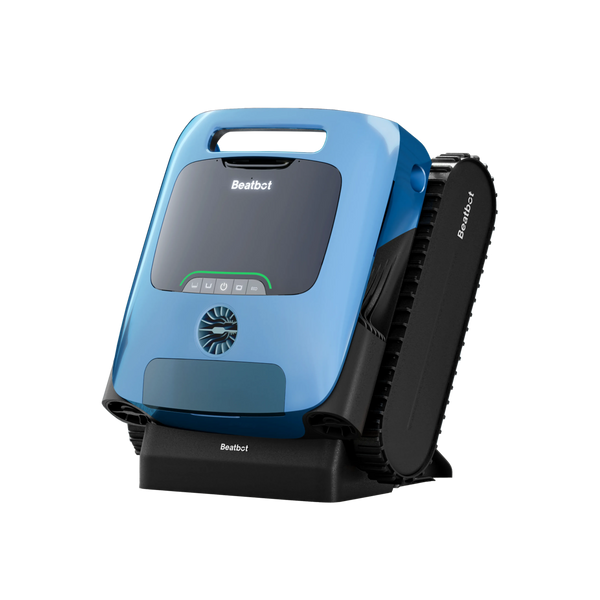
Beatbot robotic pool cleaners are cordless pool robots you drop into the water that then clean the pool on their own power, driving the floor, climbing the walls, scrubbing the waterline, and on models built for it, skimming the surface, before parking at the edge so you can lift them out.
The real question is whether a battery-powered pool robot can clean a whole pool without you babysitting it, and the answer is in how it moves, how it sees the pool, and how it filters what it picks up.
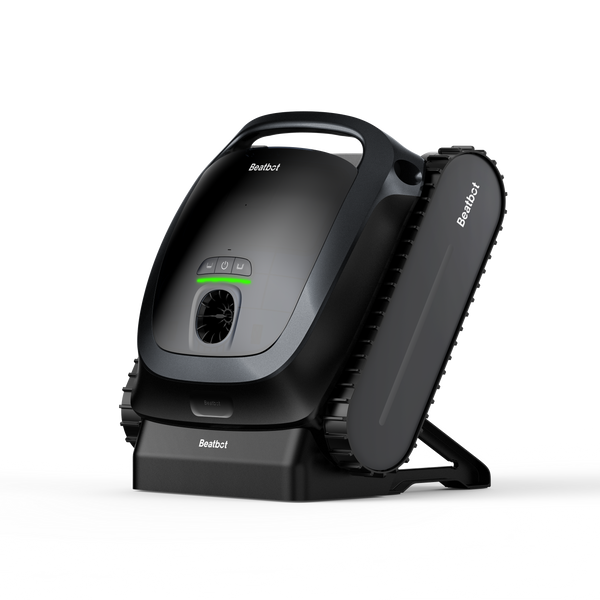
The Beatbot Sora 70 cordless robotic pool cleaner and the Beatbot AquaSense 2 Ultra AI robotic pool cleaner sit at the simple and the fully loaded ends of the range, so between them they show how much of this technology your pool actually needs.
What Does a Beatbot Robotic Pool Cleaner Clean?
A Beatbot pool cleaning robot cleans far more than the floor. Depending on the model it covers four zones, the floor, walls, waterline, and water surface, and the Beatbot AquaSense 2 Ultra adds a fifth job by clarifying the water as it goes.
There is a difference worth knowing before you buy. Climbing a wall and scrubbing the waterline are not the same thing. A pool robot can climb a wall and still skip the narrow band at the surface where sunscreen, body oils, and scum collect into a bathtub ring. Beatbot robotic pool cleaners scrub that band as they climb instead of skipping it, which keeps the worst grime from building up.
The two models split here. The Beatbot Sora 70 cleans all four zones in one cycle and reaches platforms and shallow steps in water as low as 8 inches. The Beatbot AquaSense 2 Ultra cleans the same four zones, cleans elevated platforms deeper than 13.7 inches, and adds ClearWater clarification.
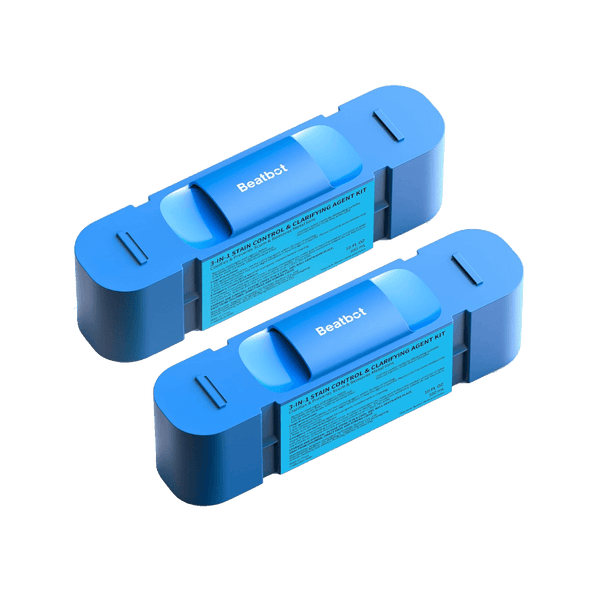
You load a clarifier kit into the robot, and as it cleans it releases a skin-safe solution made from recycled crab shells that clumps oils, dirt, and fine particles together so they settle out and cloudy water turns clear.
This is your first decision. If your pool mainly collects dirt on the floor, four-zone coverage is more than you need. If you fight a waterline ring, leaves on the surface, or water that turns cloudy between treatments, that wider coverage is the reason to step up to the Beatbot AquaSense 2 Ultra.
How Does It Move and Climb Walls?
A Beatbot robotic pool cleaner runs on its own rechargeable battery and drives on rubber tracks, using two sets of roller brushes that grip the surface for traction, and that grip is what lets it climb walls instead of only crawling the floor. The front and rear brush sets turn at different speeds, which gives it the bite to take sharp turns and hold a vertical surface.
The Beatbot Sora 70 handles slopes from 0 to 45 degrees and climbs walls from 45 to 90 degrees, which is how it reaches the waterline rather than topping out partway up. The Beatbot AquaSense 2 Ultra runs an 11-motor system, with floating-chamber motors for buoyancy and a pair of surface propellers for thrust, so it has the power to switch jobs without stalling.
Both models also move up and down through a submarine-inspired buoyancy system, where floating chambers let it sink to vacuum the floor or rise to float on top. This is what makes one machine able to work the deep end and the surface in the same run.
One simple habit keeps climbing reliable. Traction drops when the basket is packed solid, so emptying it keeps a tracked pool cleaner gripping the walls run after run. The more motors and the dedicated buoyancy hardware a model carries, the more confidently it holds walls and the surface, which is where a single-purpose floor cleaner falls short.
Does a Beatbot Pool Cleaning Robot Cover the Whole Pool?
A Beatbot robotic pool cleaner follows a planned route built from its onboard sensors instead of bouncing around at random, so coverage is methodical rather than luck of the draw. How well it handles an awkward layout comes down to whether the model only senses obstacles or also maps the pool with a camera, and that is the biggest difference between them.
The Beatbot Sora 70 uses SonicSense obstacle avoidance built on dual ultrasonic sensors. The front sensor watches for obstacles and cleans the edges, the bottom sensor reads platform heights and slope angles so it can climb between zones without getting stuck, and it lays down a consistent S-shaped path on the floor. In a standard rectangular or freeform pool, that is enough for dependable coverage.
The Beatbot AquaSense 2 Ultra goes further with an onboard camera. Its HybridSense Pool Mapping pairs that AI camera with ultrasonic and infrared sensors, 27 in all, CleverNav plans the route, and the robot runs S-shaped passes on the floor and surface and N-shaped passes on the walls and waterline. Cruise debris detection sends it back to leftover leaves, and the Beatbot app shows the finished map and the exact path it took.
Steps, sitting ledges, and tight corners are where simpler navigation slows down and the clean can come out partial. If your pool is a standard shape, the Beatbot Sora 70 covers it dependably. If it has stairs, curves, or a tanning ledge, or you want to see proof that every area got cleaned, the Beatbot AquaSense 2 Ultra's mapping is what you are paying for.

Does It Pick Up Fine Debris?
A Beatbot pool cleaning robot pulls water and debris through a suction intake into an internal filter basket, and what it traps depends on filter fineness as much as the suction rating. Both models capture everyday debris, and both give you a finer option when small particles are the problem.
The Beatbot Sora 70 moves 6800 GPH through a 6.7-inch intake that swallows whole leaves, and it drops them into a large 6L basket that keeps the cycle from stalling during leaf season. It ships with a 150 µm filter for daily leaves, twigs, insects, and sediment, plus an optional 3 µm ultra-fine filter for dust, sand, pollen, and algae spores.
The Beatbot AquaSense 2 Ultra pulls 5500 GPH through two suction ports into a 3.7L basket with a dual-density 150 µm and 250 µm design, and its cruise debris detection circles back to leaves it spots along the way.
The catch is that the finest material, pollen and silt, is the hardest thing for any pool cleaner to grab, which is the job the ultra-fine filter exists to do, and it suits low-debris polishing rather than a heavy daily load. Match the filter to your debris.
A heavy leaf load wants the big basket and the standard filter, while a pollen, sand, or cloudiness problem wants the fine filter, and for cloudiness specifically, the Beatbot AquaSense 2 Ultra's clarifier does what a filter alone cannot.
Does It Clean the Waterline and Surface?
Both of these jobs are real work, not just labels on the box. At the waterline a Beatbot robotic pool cleaner scrubs the band where oils and lotion build into a ring, and at the surface it floats and pulls in debris, which is different from a pool cleaner that only rises to the top so you can grab it.
For surface work the two models use different hardware. The Beatbot Sora 70 uses JetPulse technology, a twin-jet system whose four coordinated streams pull floating leaves, insects, and pollen toward the central suction inlet while outward streams form a barrier that stops debris-laden water from slipping past the sides.
App targeting lets you send it straight to a leafy corner. The Beatbot AquaSense 2 Ultra skims the surface with side brushes while its surface propellers drive it across the water, steered from the app as part of its 5-in-1 system.
Surface cleaning handles leaves and visible floaters well, while a fine pollen film stays the toughest to capture, which is why JetPulse is built to draw debris in before it escapes the intake. Your setting decides this. A pool under trees that collects leaves daily gets a skimmer's worth of work from surface cleaning, while a bare, open pool may not need it at all.

How Do You Get It Out of the Pool?
When the cycle ends or the battery runs low, a Beatbot robotic pool cleaner floats itself up to the pool edge and drains the water it was holding, so you lift a far lighter machine off the surface instead of fishing one off the bottom with a pole. This is the part you deal with every single cycle, and it is a real reason a cordless model is easier to live with.
Both models work the same way here. The Beatbot Sora 70 activates its floating chambers once the battery drops below 12 percent, then surfaces and steers to the edge. The Beatbot AquaSense 2 Ultra parks above the surface near the edge and waits about 20 minutes.
Both run SmartDrain, which releases the water inside the robot to cut the lifting weight, and if it drifts on the surface before you reach it, one tap in the Beatbot app calls it back to the edge.
That is what separates a cordless Beatbot robotic pool cleaner from one that sinks to the floor and has to be dragged up full of water. If bending over the deep end with a hook is the part you dread, this matters as much as any cleaning spec.
FAQs
How long does a Beatbot robotic pool cleaner run on one charge?
On one charge the Beatbot Sora 70 runs up to 5 hours on the floor or 7 on the surface and covers about 3,230 square feet, then recharges in roughly 4.5 hours. The Beatbot AquaSense 2 Ultra's larger 13,400 mAh battery reaches up to 10 hours of surface cleaning.
Do you need a pump, hose, or plumbing to run one?
No. Beatbot robotic pool cleaners are self-contained, with their own battery, motors, and filtration, so there is no hose, booster pump, or wall outlet involved. You drop the robot in and start it, and the Beatbot Sora 70 even runs from buttons on the body without the app.
What kinds of pools does a Beatbot robotic pool cleaner work in?
Both models clean rectangular, kidney, round, and freeform pools, and they clean concrete, fiberglass, vinyl, and ceramic tile safely. The Beatbot Sora 70 works in above-ground and in ground pools, so it fits simpler setups too.
How often should you empty the filter basket?
Empty it after each cleaning cycle, and sooner during heavy leaf weeks when it fills fast. The Beatbot Sora 70's larger 6L basket goes longer between emptyings, so it suits pools that shed a lot of debris.