Most Popular


 Sora Series


 AquaSense Series

 Skimmer & Bundle

 Retail Edition


 Accessories


A battery powered pool vacuum runs on an internal rechargeable battery with no cable or hose of any kind connecting to the pool deck. The category ranges from entry-level cordless robotics (60 to 90 minute runtime, 1,200 to 1,800 GPH suction) through premium cordless with 10,000mAh+ batteries that clean up to 3,230 square feet on a single charge with 6,800 GPH water flow. Battery capacity has advanced enough that cordless now covers pools from small to large without the runtime and coverage limitations that used to define the category.

What Counts as a Battery-Powered Pool Vacuum?
The category has two functional types: handheld rechargeable vacuums for spot cleaning, and cordless robotic cleaners for automated whole-pool cleaning.
Handheld rechargeable vacuums
Handheld battery vacuums attach to a telescopic pole and are walked across the pool by the owner. Runtime is typically 30 to 60 minutes. They still require active use each session, and they typically only handle the pool floor. Suitable for small pools, spot cleaning, or as a supplemental tool alongside an automated cleaner. Price range: $100 to $300.
Cordless robotic pool cleaners
Cordless robotic cleaners move and clean autonomously with no cable at all. This is what most searches for battery-powered pool vacuums are actually looking for. The category ranges from entry-level (60 to 90 minute runtime, 1,200 to 1,800 GPH, floor-only coverage) through premium (10,000mAh+ batteries with 5 to 7 hours per charge, 6,800 GPH, and full 5-in-1 coverage of floor, walls, waterline, water surface, and shallow zones). Price range: $300 to $2,500+.
What to Look for in a Battery-Powered Pool Vacuum
Six specifications matter most: battery capacity and runtime, water flow rate, filter capacity and fineness, coverage tier, navigation intelligence, and retrieval workflow. Battery capacity is the single most impactful spec because it determines whether the cleaner completes a full cycle in one charge.
Battery capacity and runtime
Entry-level cordless cleaners use 5,000 to 7,000mAh batteries that deliver 60 to 120 minutes of runtime. Premium models use 10,000mAh+ batteries that deliver 5 to 7 hours per charge depending on cleaning mode. Runtime scales with cleaning intensity: water surface cleaning is the least demanding, floor-only cleaning is next, full-pool cleaning (floor + walls + waterline) is the most demanding. Match runtime to what your pool actually needs, plus meaningful margin for battery degradation over 3 to 4 years.
Water flow rate (GPH)
Water flow determines how effectively debris is captured. Basic cordless models deliver 1,200 to 2,500 GPH, adequate for light debris and floor-only cleaning. Premium cordless reaches 6,800 GPH, which matches high-end corded specs and handles heavy debris (autumn leaves, storm debris, high pollen periods) without leaving material behind.
Filter capacity and fineness
Filter basket size determines how often the cleaner needs to be emptied. Small baskets (1 to 2L) require mid-cycle emptying during heavy debris. Larger baskets (5 to 6L) handle a full cycle without interruption. Fineness is measured in microns: standard 150-micron media captures leaves and larger debris; optional 3-micron ultra-fine filters capture pollen, algae spores, and fine calcium particulate. Look for models that ship with 150-micron standard filter and support an ultra-fine option.
Coverage tier
Coverage tiers stack: floor-only, floor + walls, or full 5-in-1 (floor + walls + waterline + water surface + shallow zones). Higher tiers cover the zones where debris and residue actually accumulate rather than just the pool bottom. For pools with heavy bather use, hard water, or visible waterline buildup, full-coverage tiers are the value choice.
Navigation intelligence
Random-path cleaners (bumper sensors + pivot logic) leave gaps on freeform pools and waste battery covering the same patches. Sensor-based navigation (gyroscope, ultrasonic, or LiDAR) plans efficient paths across pool shapes. Since battery runtime is finite, navigation efficiency directly determines how thoroughly the cleaner covers the pool per charge.
Retrieval workflow
Cordless cleaners must be lifted out of the pool at the end of each cycle for charging. Basic models surface wherever the cycle ends and require reaching into the pool. Higher-end models include automated retrieval that drives the cleaner to the pool edge before shutting off, and floating designs that automatically bring the unit to the water surface. Some models also automatically drain internal water before pickup, meaningfully reducing lifting weight. This is worth checking before purchase because it repeats every cleaning cycle.

Best Battery Powered Pool Vacuums: Beatbot Models
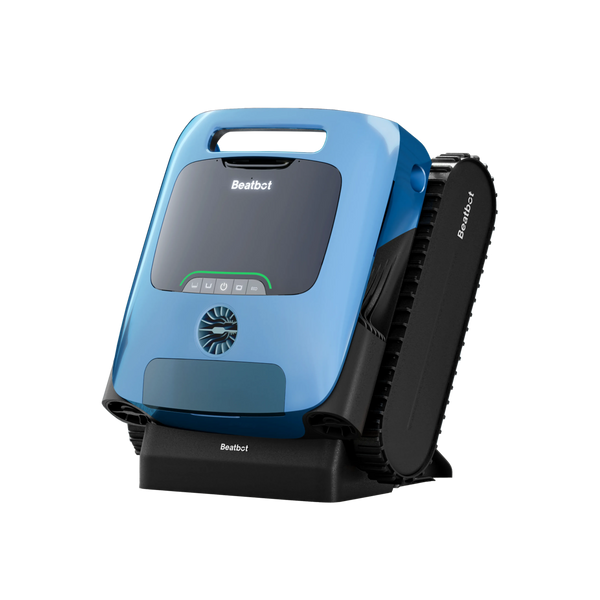
Beatbot offers two cordless robotic pool cleaners in the premium tier of the battery-powered category. Both are fully wireless with no cables or hoses, both use mapping navigation, and both support ultra-fine filtration and full-pool coverage that entry-level cordless models cannot deliver. Each targets a different combination of the priorities covered above.
Best for Waterline Cleaning and Water Clarity: Beatbot AquaSense 2 Ultra
The AquaSense 2 Ultra targets the two areas cordless cleaners historically underperform in: waterline residue and water clarity.
Waterline coverage: Dual-pass waterline cleaning scrubs the tile band twice per pass, physically removing body oils, sunscreen, and mineral residue at the water-air boundary.
Water clarity: The ClearWater natural clarification system automatically disperses a skin-safe, eco-friendly clarifier derived from chitosan during each cleaning cycle, binding fine particles into filter-capturable clusters. This captures the fine residue that would otherwise pass through standard filter media and stay suspended as a subtle water haze.
Navigation: HybridSense AI mapping combines AI camera, ultrasonic, and infrared sensors to plan systematic coverage across freeform, curved, or complex pool layouts.
Best for Full Pool Coverage and Heavy Debris: Beatbot Sora 70
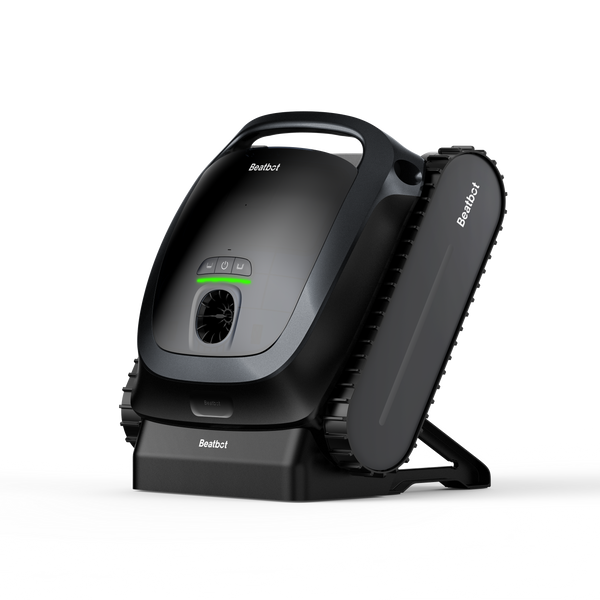
The Beatbot Sora 70 cordless robotic pool cleaner targets the most demanding pool cleaning workload: full 5-in-1 coverage, large pool areas, heavy debris, and fine particulate capture in a single cycle.
Battery capacity and runtime: A 10,000mAh battery delivers up to 7 hours of water-surface cleaning, 5 hours of floor cleaning, or 4.5 hours of combined floor, walls, and waterline cleaning per charge. This covers pools up to 3,230 square feet in a single session, well beyond what typical cordless batteries handle.
Water flow and filtration: 6,800 GPH water flow with a 6L filter basket handles heavy debris loads including autumn leaves and storm debris. The included 150-micron standard filter comes with an optional 3-micron ultra-fine filter for pollen, algae spores, and fine sediment.
Coverage tier: 5-in-1 cleaning covers water surface, waterline, walls, floor, and shallow zones down to 8 inches. The 8-inch minimum operating depth reaches tanning ledges, entry steps, and built-in benches that standard cleaners cannot access.
Retrieval: Submarine-inspired floating technology automatically brings the cleaner to the pool edge at cycle end, and SmartDrain releases internal water before pickup to reduce lifting weight. At 22.9 pounds, it sits under the 25-pound threshold for comfortable manual retrieval by hand.
Choosing between them
If waterline residue or water clarity is the specific ongoing concern, AquaSense 2 Ultra directly addresses these zones. If the priority is covering the entire pool including shallow features in one cycle, or if heavy debris loads and larger pool sizes drive the choice, Sora 70 delivers the broader coverage and longer runtime.

Common Mistakes When Buying a Battery-Powered Pool Vacuum
Sizing runtime exactly to current pool coverage
A cordless cleaner that just barely covers the pool in one battery charge when new will not cover it adequately after 2 to 3 years of use, when battery capacity has degraded 15 to 25 percent. Size runtime with meaningful margin, not to the exact requirement. If a 90-minute model just covers your pool with 5 minutes to spare, look at 5+ hour models with 10,000mAh batteries instead.
Assuming all cordless cleaners perform similarly
The gap between entry-level cordless (60 minute runtime, 1,200 GPH) and premium cordless (5+ hours, 6,800 GPH) is large: roughly 4x the runtime and 5x the water flow. Do not compare a cheap cordless to a premium cordless as if they belong to the same tier. Match the tier to what your pool actually needs.
Buying floor-only when the waterline is the visible problem
Waterline residue is what most owners notice first. A floor-only cleaner addresses one visible zone while leaving the more visible one uncleaned. If waterline buildup is persistent, floor-only cleaning at any price will disappoint.
Overlooking the retrieval workflow
Cordless cleaners must be lifted out at the end of each cycle for charging. Weight, handle design, floating retrieval, and internal water drainage all affect how consistently the cleaner actually gets used. A heavy waterlogged unit at the bottom of the pool is a physical task multiple times per week. Models that surface automatically and drain internal water before pickup meaningfully reduce this friction.
Not accounting for battery service life
Lithium-ion battery packs typically last 300 to 500 charge cycles before capacity degrades noticeably (3 to 4 years of regular use). Models with integrated batteries reach end-of-life along with the pack; models with higher-quality battery management systems and larger initial capacity extend usable service life. Look for units with 10,000mAh+ batteries and warranties that cover the battery separately, since these typically indicate the manufacturer expects the battery to last.
{{IMG_3: a well-maintained residential swimming pool with clear water and tile detail, backyard landscaping, morning light, no swimmers or equipment visible, photorealistic | A well-maintained residential swimming pool with clear water and clean tiles in a landscaped backyard. | gen:1080x446}}
Price Tiers for Battery-Powered Pool Vacuums
$100 to $300: rechargeable handheld
Handheld battery vacuums operated by hand via a telescopic pole. Runtime is 30 to 60 minutes. Service life is 2 to 4 seasons. Suitable for spot cleaning, small pools, or as a supplemental tool alongside a primary automated cleaner. Not automated: the owner walks the head across the pool.
$300 to $700: entry to mid-range cordless robotic
Cordless robotic cleaners with floor-only or basic floor + wall coverage, 60 to 120 minute runtime, and 1,200 to 2,000 GPH water flow. Random or basic pattern navigation. Service life is 3 to 5 seasons, limited primarily by battery capacity degradation. Suitable for small to medium pools with light debris loads.
$700 to $1,500: premium cordless with wall coverage
Cordless robotic cleaners with floor, wall, and waterline coverage, 120 to 180 minute runtime with 6,000 to 8,000mAh batteries, and 2,500 to 3,500 GPH water flow. Mapping or AI navigation on higher-end models. Service life is 4 to 6 seasons. Value sweet spot for medium pools with moderate debris and waterline concerns.
$1,500 to $2,500+: premium cordless with full 5-in-1 coverage
Cordless robotic cleaners with full 5-in-1 coverage (floor, walls, waterline, water surface, shallow zones), 10,000mAh+ batteries delivering 5 to 7 hours per charge, 5,000 to 6,800 GPH water flow, ultra-fine filtration (3 microns optional), and smart mapping navigation with automated retrieval. Service life is 5 to 8 seasons with proper maintenance. Justified for larger pools, heavy debris, or pools where full-coverage automation is the goal.
Maintenance Tips to Extend Battery Life
Lithium-ion battery life is the single most consequential factor in cordless pool cleaner service life. A few maintenance habits meaningfully extend the useful runtime over the cleaner's lifespan.
Do not leave the cleaner in direct sunlight during or after charging. Heat is the biggest factor in accelerated lithium-ion degradation. Store the unit and charger in a shaded location, and allow the unit to cool for 20 to 30 minutes after a cleaning cycle before charging.
Avoid deep discharging repeatedly. Running the cleaner until it shuts off from empty battery, then immediately charging to full, is the fastest way to reduce charge cycle count. Charging when 20 to 30 percent battery remains, and unplugging around 90 to 95 percent, extends the number of usable cycles.
For off-season storage, charge the battery to about 50 percent before storing. Lithium-ion cells stored at full charge or empty for extended periods lose capacity faster than cells stored at partial charge. If storing for more than three months, top up to 50 percent every three months.
Do not store the cleaner in freezing conditions. Any residual water inside can freeze and damage internal components, and lithium-ion cells stored below freezing can permanently lose capacity. Bring the unit indoors for winter storage in cold climates.
Empty the debris basket and rinse the filter after every cycle. A loaded filter forces the motor to work harder, drawing more current from the battery and shortening runtime per cycle.
FAQs
How long does a battery-powered pool vacuum run on one charge?
Entry-level cordless robotic cleaners run 60 to 90 minutes per charge. Mid-range models reach 120 to 180 minutes. Premium models with 10,000mAh batteries run up to 5 hours for floor cleaning or 7 hours for water surface cleaning. Handheld rechargeable vacuums typically run 30 to 60 minutes.
Are cordless pool vacuums as effective as corded ones?
Premium cordless models with 10,000mAh+ batteries deliver 6,800 GPH water flow and 5+ hours of runtime, matching corded specs in the areas that matter most. Entry-level cordless (60 to 90 minute runtime, 1,200 to 1,800 GPH) is limited compared to corded equivalents. The gap between cordless tiers is larger than the gap between premium cordless and corded, so choose based on the specific pool need rather than assuming corded is automatically better.
How often should I charge a cordless pool vacuum?
Charge after each cleaning cycle, but do not leave the unit on the charger indefinitely between uses. Modern lithium-ion charging systems reduce current as the battery approaches full, but leaving the unit at full charge for days contributes to gradual capacity degradation. Charge when needed, unplug around 90 to 95 percent, and top up to 50 percent for off-season storage.
Do battery powered pool vacuums work in salt water pools?
Confirm the specific model is rated for salt water use before purchase. Salt water accelerates corrosion of exposed metal components, and battery seals need to be adequate to prevent salt water intrusion. Look for corrosion-resistant construction and chemical-resistant charging contacts. Beatbot's Sora 70, for example, uses titanium safe-charging contacts and has been tested through 480 hours of salt-spray exposure.
Can a battery powered pool vacuum clean walls and the waterline?
Higher-end cordless robotic cleaners cover floor, walls, and waterline in a single cycle. Entry-level models typically cover only the floor. Confirm the specific model's coverage tier in the product specifications: look for terms like "wall climbing," "waterline scrubbing," or "5-in-1 cleaning."
How long do the batteries last in a cordless pool vacuum?
Lithium-ion battery packs typically last 300 to 500 charge cycles before capacity degrades noticeably. For most owners this translates to 3 to 4 years of regular use before runtime drops meaningfully. Larger batteries (10,000mAh+) that start with more capacity end with more capacity after degradation, giving longer usable service life.