Most Popular


 Sora Series


 AquaSense Series

 Skimmer & Bundle

 Retail Edition


 Accessories


High total alkalinity is one of the most common reasons pool water turns hazy, resists pH adjustment, and creates rough surfaces. Muriatic acid is the standard tool for lowering it, but the dosing is not arbitrary.
The amount depends on your pool's current alkalinity reading, your target range, and the volume of water you are treating. Get it right and your water stabilizes within hours. Get it wrong and you will spend days chasing pH swings or dealing with corrosion.
This guide covers the correct dosage, how to apply muriatic acid safely, and how to confirm results. It also explains what happens when alkalinity stays out of range long enough to matter.
What Is Total Alkalinity and Why Does It Matter?
Total alkalinity (TA) measures the water's ability to resist changes in pH. The Pool & Hot Tub Alliance recommends keeping total alkalinity between 80 and 120 parts per million (ppm) for most residential pools. Within that range, pH holds steady against the acids and bases that enter water from swimmers, rain, and sanitizers.
When alkalinity climbs above 120 ppm, pH becomes increasingly resistant to adjustment. You add acid to bring pH down and the number barely moves because high alkalinity acts as a buffer, absorbing the acid before it can affect pH.
The water also tends to turn cloudy because elevated alkalinity encourages calcium carbonate precipitation. Surfaces develop scale, especially on plaster, tile grout, and vinyl. Chlorine loses effectiveness at elevated pH levels, which compounds the problem.
The fix requires addressing alkalinity directly. Muriatic acid (hydrochloric acid diluted to 31.45% concentration) reacts with bicarbonate in the water and converts it to carbon dioxide and chloride ions, which can lower pH and alkalinity simultaneously. This dual effect is why dosing precision matters: too little and you make no progress; too much and you overshoot, leaving the water corrosive.
What Is the Target Alkalinity Range Before Adding Acid?
Before calculating a dose, confirm your current reading and your target. The Pool & Hot Tub Alliance recommends 80 to 120 ppm as the standard range. For pools with plaster or concrete surfaces, staying closer to 80 to 100 ppm reduces the risk of scale. For vinyl-lined pools, 100 to 120 ppm is generally safer because the liner is more sensitive to low-pH conditions than to high-alkalinity scale.
|
Pool Surface |
Recommended TA Range |
|---|---|
|
Plaster / Gunite |
80 – 100 ppm |
|
Fiberglass |
80 – 120 ppm |
|
Vinyl liner |
100 – 120 ppm |
|
Painted concrete |
80 – 100 ppm |
|
Tile |
80 – 120 ppm |
If your current reading is above 150 ppm, expect to make multiple treatments over several days. Dropping alkalinity by more than 30 to 40 ppm in a single session stresses the water chemistry and can cause pH to drop erratically. Gradual correction gives you better control.
How Much Muriatic Acid Lowers Alkalinity by 10 ppm?
The standard dosing guideline for muriatic acid at 31.45% concentration is approximately 1 quart (32 oz) per 10,000 gallons of water to lower total alkalinity by roughly 10 ppm. This figure comes from the National Swimming Pool Foundation's established water chemistry guidelines. Use it as your baseline calculation, then confirm with a test kit after treatment.
|
Pool Size (Gallons) |
Dose to Drop TA by 10 ppm |
Dose to Drop TA by 20 ppm |
Dose to Drop TA by 30 ppm |
|---|---|---|---|
|
10,000 gal |
1 qt (32 oz) |
2 qt (64 oz) |
3 qt (96 oz) |
|
15,000 gal |
1.5 qt (48 oz) |
3 qt (96 oz) |
4.5 qt (144 oz) |
|
20,000 gal |
2 qt (64 oz) |
4 qt (128 oz) |
6 qt (192 oz) |
|
25,000 gal |
2.5 qt (80 oz) |
5 qt (160 oz) |
7.5 qt (240 oz) |
|
30,000 gal |
3 qt (96 oz) |
6 qt (192 oz) |
9 qt (288 oz) |
These amounts are starting-point estimates, not exact chemical guarantees. Water temperature, current pH, calcium hardness, and the specific concentration of your acid product all affect how much TA actually drops. Always retest before adding a second dose.

How Do You Add Muriatic Acid to Lower Alkalinity?
Application method matters as much as dosage. Pouring acid directly onto pool surfaces or into the skimmer can cause localized corrosion and uneven chemical distribution. The correct method concentrates the acid in the deepest part of the pool to maximize alkalinity reduction while minimizing pH impact on the rest of the water.
Turn off the pool pump before adding acid. With circulation off, the acid settles to the floor rather than dispersing immediately throughout the water column. This lets the acid react with the bicarbonate in the concentrated zone and off-gas carbon dioxide, which is the mechanism by which alkalinity drops. After 30 to 60 minutes, turn the pump back on to circulate.
Pour the acid slowly into the deepest end of the pool, in a wide arc close to the water surface, so you can add muriatic acid safely without creating a concentrated spot. Never add water to acid. Always pour acid into water. Use chemical-resistant gloves, eye protection, and work in a well-ventilated area. After application, wait at least four hours before retesting. Retest in the same location each time for consistent readings.
If you need to drop alkalinity by more than 30 ppm total, split the treatment into two or three sessions spaced 24 hours apart. Retesting between sessions prevents over-correction.

Why Does Pool Alkalinity Keep Rising After Treatment?
Alkalinity does not stay fixed after a single correction. Several factors push it back up consistently: baking soda or sodium bicarbonate added by mistake or from old balancing habits, well water with naturally high bicarbonate content, and the buffering effect of certain algaecides and clarifiers. If you are adding an alkalinity increase to hold pH up and then adding acid to bring alkalinity down, you are running in circles.
Calcium hypochlorite (cal-hypo) shock raises both pH and alkalinity and is a frequent culprit in pools that seem to need constant acid treatment. Switching to liquid chlorine or trichlor tabs for routine sanitation reduces this cycle significantly. The National Swimming Pool Foundation's water chemistry guidance notes that product selection directly affects how often chemical corrections become necessary.
High-bicarbonate fill water is the other major driver. If your tap water tests above 150 ppm alkalinity out of the hose, every top-off raises the pool's TA. Testing fill water before use and pre-treating it, or simply accepting that you will need periodic acid treatments, is the practical approach.
What Happens to pH When You Add Muriatic Acid?
Muriatic acid can lower pH and alkalinity at the same time, so the intended target may be TA, but pH will also drop. The intended target when treating for high alkalinity is TA, but pH will also drop. How much pH moves depends on how high both readings were before treatment and how much acid you added.
If your pH was already at the lower end of the normal range (7.2 to 7.4) when you treated for high alkalinity, expect pH to drop below 7.0 after a full correction. The Centers for Disease Control and Prevention recommends keeping pool pH between 7.2 and 7.8 for safe swimming.
Water below 7.0 is corrosive to metal fixtures, pump seals, and pool surfaces. If pH falls below 7.0 after acid treatment, aerate the water aggressively by running water features, jets, or fountains for several hours. Aeration raises pH without increasing alkalinity, which is exactly what you need in this situation.
The practical sequence: add acid to target TA, retest both TA and pH after four hours, aerate if pH is too low, then retest again before adding any additional acid.
How to Confirm Alkalinity Has Dropped After Treatment
Retest no sooner than four hours after adding acid with the pump running, because accurate pool water balance depends on checking pH and alkalinity after circulation. Use a liquid test kit or a digital photometer rather than test strips for alkalinity measurements. Test strips have acceptable accuracy for pH but are less reliable for total alkalinity readings, where a 10 to 20 ppm error can lead to over-treatment. The Taylor K-2006 test kit is a widely used reference standard among pool service professionals.
Test from the same depth and location each time, typically elbow-deep at the center of the pool. Surface water chemistry differs from mid-column readings and gives inconsistent comparisons between tests. If the reading shows the target range has been reached, run the pump for an additional two hours before closing out the treatment. If the reading is still above target, calculate the next dose based on the remaining gap and treat the following day.
How Does a Robotic Pool Cleaner Help After Chemical Treatment?
After adjusting alkalinity with muriatic acid, fine calcium carbonate particles that were suspended in the water before treatment often settle on the pool floor. This white or grayish residue is common after large chemistry corrections, and it needs to be vacuumed out or it slowly dissolves back into the water, partially reversing the alkalinity reduction you just achieved.
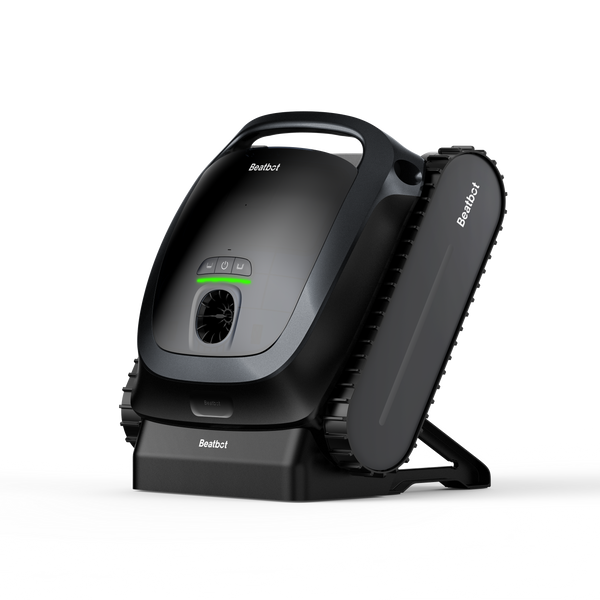
A robotic pool cleaner handles this efficiently. The Beatbot AquaSense X robotic pool cleaner, rated at 6,800 GPH suction and a 150 μm filtration basket, collects fine particulate from the floor and walls in a single cycle, covering pools up to 3,875 sq. ft.
The AstroRinse™ self-cleaning station empties the debris bin and backflushes the filter in approximately three minutes, so the robot is ready for the next cleaning without manual maintenance. This matters after a chemical correction because the volume of settled material can be significantly higher than in a routine cleaning cycle.
The Beatbot AquaSense 2 Ultra robotic pool cleaner adds HybridSense™ AI mapping with 27 sensors, including camera, infrared, ultrasonic, and dual time-of-flight sensors, that trace an efficient S-path across the floor and N-path along walls and the waterline.
Its dual-pass waterline scrubbing removes scale residue that high alkalinity often deposits at the water surface before it hardens. The 13,400 mAh battery supports up to six hours of floor cleaning, sufficient for most pools to complete a full post-treatment pass without recharging.
For pools where surface debris is a concern alongside floor sediment, the Beatbot Sora 70 robotic pool cleaner is the only automated pool cleaner in its price range that cleans both the pool floor and the water surface. Its JetPulse™ dual-jet system actively draws floating debris inward rather than relying on passive skimming, which is particularly useful after acid treatment when surface oils and particulates can concentrate near the waterline.
The 6L debris basket handles heavy collection loads, and the optional 3 μm fine-filtration cartridge (sold separately) captures particles that standard 150 μm filters pass through, making it a logical complement to a post-treatment cleanup.
FAQs
Can I add muriatic acid and shock the pool on the same day?
Adding both on the same day is not recommended. Muriatic acid and chlorine shock interact aggressively and can create chlorine gas near the application point if poured in the same area.
If you need to shock and lower alkalinity in the same week, add the acid first, wait at least four hours with the pump running, retest, and only then add shock to the deep end. If chlorine levels are already at or above 5 ppm, hold off on acid treatment entirely until chlorine drops to a normal range.
Does muriatic acid lower alkalinity faster than dry acid?
Muriatic acid (liquid hydrochloric acid) works faster than sodium bisulfate (dry acid) and is more cost-effective for large corrections.
When comparing muriatic acid vs dry acid, dry acid is gentler to handle and dissolves more slowly, which some pool owners prefer for smaller adjustments. For a correction of 20 ppm or more, muriatic acid is the more practical choice. For minor adjustments under 10 ppm, dry acid gives you a slower reaction that is easier to control. Both products lower total alkalinity and pH; the choice comes down to the size of the correction and handling preference.
Is it safe to swim after adding muriatic acid?
Wait at least four hours after adding muriatic acid before swimming, and retest pH before anyone enters the water.
The Centers for Disease Control and Prevention recommends a pH of 7.2 to 7.8 for safe swimming.
If pH has dropped below 7.0, do not allow swimming until it recovers. Running water features or a pool fountain for one to two hours will raise pH through aeration without affecting alkalinity.
My alkalinity is at 200 ppm. How many treatments will it take?
Dropping from 200 ppm to 100 ppm requires reducing alkalinity by 100 ppm. Treating more than 30 to 40 ppm per session risks unpredictable pH drops, so plan for three or four treatments over as many days.
Calculate each dose based on the most recent test result, not the original reading, and retest before every subsequent addition.
Patience in the correction phase prevents the pH crashes that result from over-acidifying in a single session.