Most Popular


 Sora Series


 AquaSense Series

 Skimmer & Bundle

 Retail Edition


 Accessories


Baking soda raises a pool's total alkalinity and nudges the pH upward, which stabilizes the water against sudden chemistry swings. Pool owners use it for one job: bringing low alkalinity (below 80 ppm) back into the 80 to 120 ppm range so the pH stops drifting and the water feels softer. Roughly 1.5 lb of baking soda per 10,000 gallons raises alkalinity by about 10 ppm. Add it in small doses, dissolve it first, and give the pool a full circulation cycle before retesting.
What Does Baking Soda Do in a Pool?
Baking soda (sodium bicarbonate) is an alkaline buffer. Dissolved in pool water, it raises total alkalinity (TA), the water's resistance to pH change. A pool with healthy alkalinity holds its pH steady even when swimmers, rain, or chlorine shift the chemistry. Low alkalinity is the cause behind most pH that keeps drifting low.
The distinction that trips up most pool owners: baking soda raises pH only slightly. A pool at pH 7.2 with low alkalinity might climb to 7.4 or 7.5 after a full baking soda dose, not higher. The tool for raising pH without moving alkalinity much is soda ash (sodium carbonate), a chemically different compound. Baking soda is for the TA problem; soda ash is for the pH problem.
Target ranges from the CDC's Model Aquatic Health Code are pH 7.2 to 7.8 and total alkalinity 60 to 180 ppm, with most residential pools running best at 80 to 120 ppm. Baking soda does not sanitize, kill algae, or remove metals.
The reaction itself is near-instant: sodium bicarbonate dissociates the moment it hits water, and the alkalinity shift begins as the powder dissolves. What takes time is mixing. One full turnover cycle, roughly six to eight hours on a standard residential pump, is how long the water needs before a test strip reads an accurate post-dose TA value.
When Should You Add Baking Soda to Your Pool?
Add baking soda when a test strip or liquid test kit shows total alkalinity below 80 ppm, especially if the pH is also drifting below 7.2 and feels hard to keep stable. That combination points to a buffer problem, not a chlorine or algae problem.
The most reliable trigger is a physical symptom plus a low TA reading: eyes stinging after a swim, cloudy water right after shocking, chlorine burning off unusually fast, or a pH that keeps crashing back to 7.0 after every correction. If TA tests inside the 80 to 120 ppm band and the water still looks off, baking soda is not the answer; the problem is elsewhere in the chemistry.
Seasonal timing matters. Heavy spring rainfall dilutes alkalinity fast because rainwater is naturally acidic and low in minerals. Pool owners in rainy regions test weekly in spring and early summer and dose as a maintenance top-up. After a heavy pool party, after shocking, and after refilling significant volume are the other three moments when a TA check is worth running.

How Much Baking Soda Does a Pool Need?
The working ratio is 1.5 lb of baking soda per 10,000 gallons to raise total alkalinity by approximately 10 ppm. A 20,000-gallon pool with a TA reading of 60 ppm needs roughly 6 lb to reach 80 ppm. The same pool starting at 40 ppm needs around 12 lb to reach the middle of the target band.
|
Pool Size |
Baking Soda for +10 ppm |
Baking Soda for +20 ppm |
|
5,000 gal |
0.75 lb |
1.5 lb |
|
10,000 gal |
1.5 lb |
3 lb |
|
15,000 gal |
2.25 lb |
4.5 lb |
|
20,000 gal |
3 lb |
6 lb |
|
25,000 gal |
3.75 lb |
7.5 lb |
Never dump the full calculated amount in one go. Large single doses spike the pH temporarily, cloud the water, or over-shoot TA. Cap a single dose at around 2.5 lb and wait six to eight hours of circulation before retesting.
Pool volume is where most home calculations go wrong. A rectangular pool's volume in gallons equals length × width × average depth × 7.5. Oval and kidney-shaped pools use 5.9 as the multiplier because their usable volume is smaller. When the real volume is unknown, use the lower estimate.
How Do You Add Baking Soda to a Pool Correctly?
Broadcast, do not pour. Walk the perimeter with the pool pump running and sprinkle the baking soda in a slow, wide arc across the surface. The powder dissolves as it sinks, circulation distributes it, and no concentrated pocket forms that could cloud or stain the liner.
Premixing is optional, not required. Baking soda dissolves cleanly on contact with water, so direct broadcasting works in almost all cases.
Premixing earns its keep in two scenarios: on vinyl-lined pools, where a pocket of undissolved powder against the liner can etch a faint ring; and for doses above 3 lb, where the slurry goes into solution faster than dry powder alone. Fill a 5-gallon bucket with warm pool water, stir in the measured dose until fully dissolved, then pour the slurry slowly across the deep end with the pump running.
Two habits keep the process clean. First, avoid broadcasting on a windy day; powder drifts onto the deck and stings eyes. Second, keep the pump running for at least six hours after dosing so the baking soda fully dissolves and mixes through the water column. Shutting the pump off early traps undissolved powder near the drain.
Cloudiness for a few hours after a full dose is normal. The water may look milky while fine particles suspend in the column, then clears once circulation carries them to the filter. Cloudiness lasting beyond 24 hours points to an overdose, a dirty filter, or a pH above 7.8 precipitating calcium.

What Mistakes Do Pool Owners Make with Baking Soda?
Treating cloudy water with baking soda is the first. Cloudiness has many causes: high calcium hardness, dead algae, under-filtered debris, pH out of range, or a chlorine imbalance. Baking soda fixes only the TA-related version, and only indirectly.
Skipping the wait is the second. Pool chemistry moves in hours, not minutes. A reading taken 15 minutes after broadcasting a dose is useless because the water has not mixed yet. Six to eight hours with the pump running is the minimum; an overnight cycle is better.
Ignoring the filter is the third. Baking soda dissolves completely, but the chemical shift it causes can loosen existing scale, stir sediment, or bind with existing particulate into a mild haze. A clogged filter turns that haze into a multi-day event.
How Do You Clean Up After a Baking Soda Treatment?
Two things typically need cleaning after a dose: a thin layer of fine sediment that settles on the floor once the water clears, and a light waterline film if the TA correction ran alongside a chlorine shock. Manual vacuuming works but is slow, and fine particulate passes through standard vacuum heads unless the filter media is tight enough. A cordless robotic pool cleaner with fine filtration handles both jobs in one cycle without tying up the pool pump.
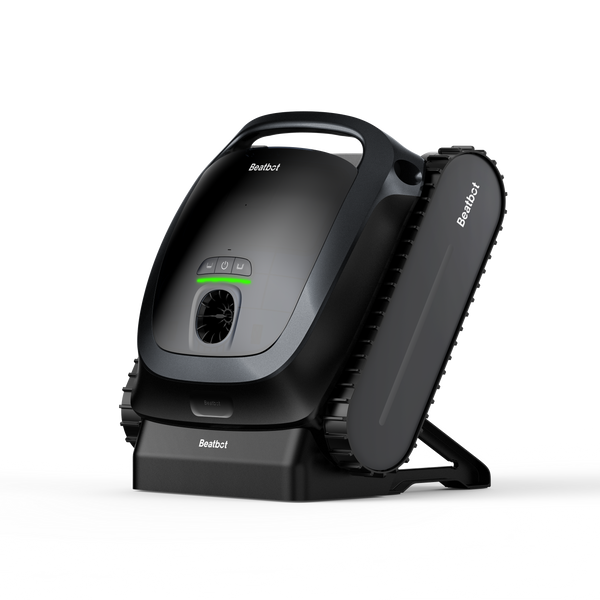
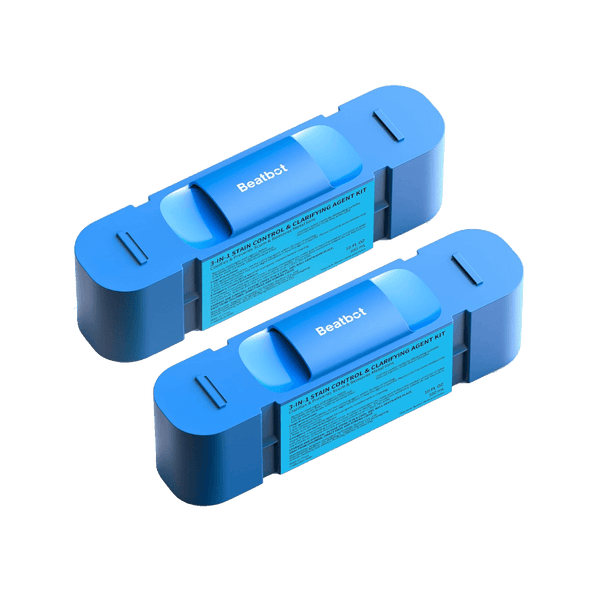
The Beatbot AquaSense 2 Pro robotic pool cleaner pairs well with chemical maintenance through its ClearWater™ Clarification System. A built-in reagent pump dispenses a chitosan-based natural clarifier as the robot moves, and the clarifier binds the microscopic particles that cause post-treatment haze into larger clumps that the onboard dual-layer filtration (down to 150 μm) then captures.
A 5-in-1 single cycle covers the floor sediment, waterline film, and any lingering surface scum left by the dose. One 300 ml clarifier kit lasts about a month at weekly use.
The Beatbot Sora 70 robotic pool cleaner earns its place through the optional 3 μm ultra-fine filter that swaps into its 6L basket. After a baking soda or shock treatment, the residual particles are often smaller than the 150 μm standard media can hold; the 3 μm filter captures fine sand, pollen, dead algae, and reagent residue that the primary filter lets pass.
Users switch between the standard basket for routine debris and the ultra-fine filter for post-treatment polishing, and a 10,000 mAh battery runs up to 4.5 hours on floor, walls, and waterline cleaning in one cycle.

FAQs
Can I use baking soda instead of pool alkalinity increaser?
Yes. Commercial alkalinity increaser is sodium bicarbonate, the same compound as baking soda, usually at higher purity and a higher price per pound. Store-brand baking soda works identically. Check that the box lists sodium bicarbonate as the only ingredient and avoid products with added scents or anti-caking agents.
Will baking soda clear up algae or a green pool?
No. A green pool needs chlorine shock plus an algaecide to kill the bloom, then filtration to clear the water. Baking soda only restores alkalinity so chlorine can work at full strength; used alone on a green pool, it has no meaningful effect on the algae itself.
How long after adding baking soda can I swim?
After a standard maintenance dose with the pump running, swimming is safe within 15 to 30 minutes once the water clears. For a large corrective dose that clouds the water, wait for visibility to return to the floor and retest before getting in. Baking soda is non-irritating at pool concentrations.
Does baking soda work in a saltwater pool?
Yes. Saltwater pools run the same alkalinity and pH chemistry as chlorine pools once the salt cell generates chlorine. Salt cell efficiency actually improves when alkalinity sits inside the 80 to 120 ppm range.
How often should I add baking soda to my pool?
Only when the TA test reads below 80 ppm. That usually means every few weeks in rainy seasons, once a month in stable conditions, or not at all if the alkalinity holds. Routine dosing on a fixed schedule without testing risks pushing TA above 120 ppm and causing cloudy water or scale.
Can you add too much baking soda to a pool?
Yes. TA above 180 ppm causes persistent cloudy water, calcium scale on tiles and equipment, and a pH that becomes hard to lower. The fix is muriatic acid or dry acid dosed in small increments, with retesting between doses until TA returns to the 80 to 120 ppm band.