Most Popular


 Sora Series


 AquaSense Series

 Skimmer & Bundle

 Retail Edition


 Accessories


For most residential salt water pools, the correct salt level is between 2,700 and 3,400 ppm. The precise target depends on the salt chlorine generator (SCG) installed: each unit has its own operating range and ideal midpoint, and running outside that range causes the cell to underperform or shut down on a low-salt alarm.
Check the manual for your specific SCG model first. The general range above covers the majority of residential systems, but the manufacturer specification is the authoritative number for your pool.

What Salt Level Does Your System Actually Require?
Salt level requirements vary by SCG brand and model. Most fall between 2,700 and 3,400 ppm, but the operating windows and ideal midpoints differ. Running at the midpoint of the manufacturer's recommended range, rather than at the minimum, gives the system tolerance for normal variation between tests without triggering a low-salt alarm or reducing chlorine output.
The table below shows the typical operating ranges for widely used residential SCG systems.
|
Salt Chlorine Generator |
Minimum (ppm) |
Ideal Range (ppm) |
Maximum (ppm) |
|
Hayward AquaRite |
2,700 |
3,200 |
3,400 |
|
Pentair IntelliChlor |
2,700 |
3,000 – 3,200 |
3,500 |
|
Jandy TruClear |
2,700 |
3,000 – 3,200 |
3,400 |
|
CircuPool Universal |
2,500 |
3,000 – 3,200 |
3,500 |
|
Intex (above ground) |
2,500 |
3,000 |
3,500 |
Ranges are based on typical manufacturer specifications. Always verify against the manual for your specific model and firmware version, as specifications are updated periodically.
A few brands, particularly some commercial or specialty systems, operate at lower salt concentrations around 1,800 to 2,200 ppm by design. These are sometimes marketed as low-salt systems. If you are unsure what type of SCG is installed, locate the model number on the control unit or cell housing and check the manufacturer's documentation before adding salt.
How to Test Salt Level Accurately
Salt level can be tested three ways: the SCG's built-in display, electronic salt test meters, and salt test strips. Each has a different accuracy level and a different appropriate use. The SCG display is the least accurate for precise readings but is useful for trend monitoring. A calibrated digital meter is the most accurate and the right tool for any adjustment decision.
Salt chlorine generator display reading
Most SCG units display a salt level reading on the control panel, derived from the electrical conductivity of the water as it passes through the cell. This reading is convenient but is affected by water temperature (conductivity changes with temperature) and cell condition (scale buildup on the cell alters the reading).
SCG displays can be off by 200 to 500 ppm from the actual salt concentration, particularly in pools with temperature swings or cells that have not been recently cleaned. Use the SCG display for routine monitoring of direction (trending up or down) but not as the basis for salt addition calculations.
Digital salt meter (most accurate)
A handheld digital salt meter measures electrical conductivity and converts it to a salt concentration reading. Quality meters accurate to within 100 to 200 ppm are available for under fifty dollars. Calibrate the meter against the manufacturer's calibration solution before first use and periodically thereafter.
Test the water sample at a consistent temperature if the meter does not have automatic temperature compensation, as conductivity is temperature-dependent. For any decision involving adding salt to the pool, a digital meter reading is more reliable than the SCG display.
Salt test strips
Salt test strips provide a rough indication of salt concentration and are useful for a quick check of whether the level is approximately in range or significantly off.
They are not accurate enough for precise addition calculations: strip readings can vary by 500 ppm or more from actual concentration depending on strip age, water temperature, and reading technique. Use strips for a fast visual check between more precise meter tests, not as the basis for adding salt.

How to Add Salt to a Salt Water Pool Correctly
Use pool-grade sodium chloride that is 99.8 percent pure or higher with no additives, anti-caking agents, or iodine.
Calculate the dose based on pool volume and the gap between current and target salt levels using a pool salt calculator, then add conservatively: it is easier to add more salt than to dilute an overshoot. Distribute salt around the perimeter of the pool with the pump running and allow 24 hours of full circulation before retesting.
Calculate the dose before adding anything
Salt does not evaporate or get destroyed by sunlight. The only ways salt leaves a pool are through splash-out, backwashing, overflow from rain, and partial draining. Adding salt without calculating the dose is one of the most reliable ways to overshoot the target.
Use the pool's known volume in gallons, the current tested salt level, and the target level to calculate the exact pounds needed. A pool calculator that accounts for pool shape and dimensions gives a more accurate volume estimate than a rough approximation.
Use only pool-grade sodium chloride
Do not use rock salt, water softener salt with additives, road salt, or table salt. Rock salt and road salt contain impurities that cloud the water and can stain pool surfaces. Water softener salts often include anti-caking agents that reduce water clarity and affect SCG cell performance.
Table salt contains iodine and anti-caking agents that interfere with pool chemistry. Pool-grade sodium chloride at 99.8 percent purity or higher is the only appropriate product.
Add salt with the pump running and distribute it broadly
Pour salt slowly around the perimeter of the pool rather than dumping it in a single location. Salt dissolves slowly and can settle on the pool floor in concentrated piles that temporarily bleach vinyl liners or etch plaster surfaces if left in direct contact.
With the pump running and salt distributed broadly, most pool-grade salt dissolves within a few hours. Do not run the SCG until the salt has fully dissolved and circulated, typically 24 hours after addition.
Wait 24 hours before retesting
Retest salt level no sooner than 24 hours after the addition, with the pump having run continuously during that period. Testing too soon after adding salt gives a localized reading near the addition point rather than a representative sample of the full pool volume. If the reading after 24 hours is still below target, calculate and add a second smaller dose rather than guessing at a quantity.
What Happens When Salt Level Is Too High or Too Low?
Both directions of deviation cause problems, though low salt and high salt produce very different symptoms. Low salt reduces chlorine output and triggers system alarms. High salt does not produce an immediate visible problem but causes long-term corrosive damage to equipment, metal fittings, and pool surfaces.
Salt level too low
When salt drops below the SCG's minimum operating threshold, the system either reduces chlorine output proportionally or shuts down entirely and displays a low-salt alarm. The pool continues circulating water, but without active chlorine generation, free chlorine drops and the pool becomes vulnerable to algae growth and bacterial contamination.
A pool that keeps developing algae despite a functioning SCG is often running low salt without an active alarm: the system is generating some chlorine but not enough to maintain the required concentration under the pool's actual demand. Test salt level any time chlorine output appears insufficient relative to cell runtime.
Salt level too high
Salt above 4,000 to 5,000 ppm begins causing perceptible saltiness in the water that some swimmers notice as a taste difference. More significantly, elevated salt concentration accelerates corrosion of metal pool equipment, ladder hardware, light fixtures, and fittings.
Heater heat exchangers are particularly vulnerable: sustained high salt levels corrode the internal passages of copper and cupronickel heat exchangers and shorten their service life measurably. High salt also accelerates scale deposits on the SCG cell, requiring more frequent acid cleaning.
There is no chemical way to reduce salt in a pool: the only fix is dilution through partial draining and refilling with fresh water.
SCG cell scale from chemistry imbalance
Scale deposits on the SCG cell are not caused by salt level alone but by the combination of high pH, high calcium hardness, and elevated water temperature. The cell operates in a high-pH microenvironment as it generates chlorine, which accelerates calcium carbonate precipitation on the cell plates.
Maintaining pH between 7.4 and 7.6 and calcium hardness between 200 and 400 ppm is the primary prevention. Regular inspection of the cell every three months and acid cleaning when visible scale appears prevents the cell plates from becoming coated enough to reduce chlorine output.
Salt Level Is Only One Part of Salt Water Pool Chemistry
A salt water pool requires the same complete chemistry management as a conventionally chlorinated pool, with a few adjustments specific to SCG systems. Salt level determines whether the generator can produce chlorine. Everything else determines whether that chlorine is effective and whether the water and equipment stay in good condition.
Free chlorine target
The free chlorine target for a salt water pool is the same as for a conventionally chlorinated pool: 1 to 3 ppm for most residential pools. The SCG generates chlorine continuously during its runtime rather than through periodic manual addition, but the goal is the same concentration.
Adjust the SCG output percentage and daily runtime to maintain that range without manual additions on most days. CYA level affects how much free chlorine is needed: the appropriate free chlorine level for a given CYA is the same regardless of whether the chlorine comes from an SCG or liquid chlorine.
pH management in salt water pools
Salt water pools tend to drift upward in pH faster than conventionally chlorinated pools because the electrolysis process that generates chlorine also produces hydroxide ions that raise pH.
Most salt water pools require more frequent pH correction downward than conventional pools, and some owners use a CO2 injection system or an automatic acid dosing system to manage pH without manual additions. Maintaining pH between 7.4 and 7.6 is the single most important factor in both chlorine effectiveness and SCG cell longevity.
Cyanuric acid in salt water pools
Outdoor salt water pools need cyanuric acid to protect chlorine from UV degradation, exactly as conventional pools do. The target CYA range for a salt water pool is typically 70 to 80 ppm, somewhat higher than the 30 to 50 ppm recommended for conventional pools.
The higher target compensates for the fact that SCGs generate unstabilized chlorine: without adequate CYA, UV degradation during daylight hours can consume chlorine faster than the cell generates it. Monitor CYA monthly and adjust as needed.
Calcium hardness and the Langelier Saturation Index
Calcium hardness in a salt water pool should be maintained between 200 and 400 ppm, with the lower end of that range (200 to 250 ppm) preferred to reduce scale formation on the SCG cell.
The Langelier Saturation Index (LSI), which combines pH, alkalinity, calcium hardness, and temperature into a single balance score, is a useful tool for salt water pool management because it quantifies the water's tendency to either deposit scale or corrode surfaces.
A slightly negative LSI (mildly undersaturated) is preferable to a positive one in a salt water pool because it reduces scale on the cell even though it slightly increases the pool's potential to etch plaster surfaces.

Keeping Pool Surfaces Clean in a Salt Water Pool
Salt water pools develop mineral deposits and scale on surfaces for the same reasons conventional pools do: high pH and calcium hardness cause calcium carbonate to precipitate. The waterline is the most visible accumulation point, because evaporation concentrates minerals at the water-air boundary.
The pool floor and walls accumulate fine sediment and calcium deposits over time that physical cleaning removes more efficiently than chemistry alone.
Consistent surface cleaning reduces the mineral and organic load that would otherwise contribute to SCG cell scaling and chemistry drift. When fine calcium and organic particles accumulate on the pool floor, they eventually resuspend in the water column and create additional demand on both the filter and the cell.
For salt water pools, which already tend toward higher pH and therefore higher scale risk, keeping surfaces clear of accumulation is a more consequential maintenance habit than in conventionally chlorinated pools.
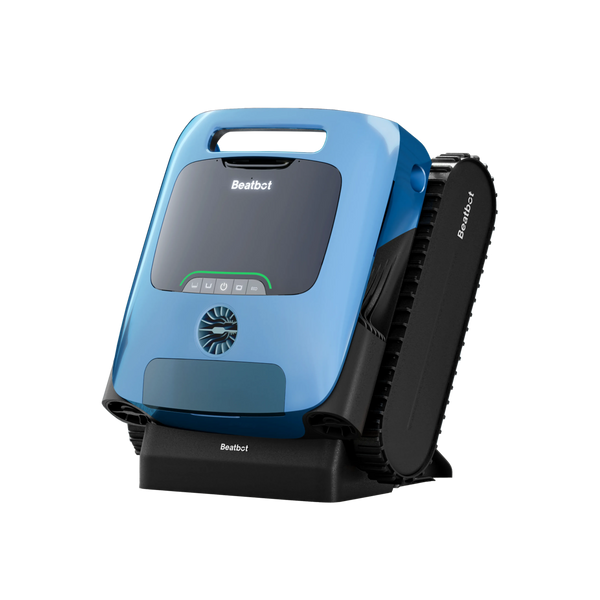
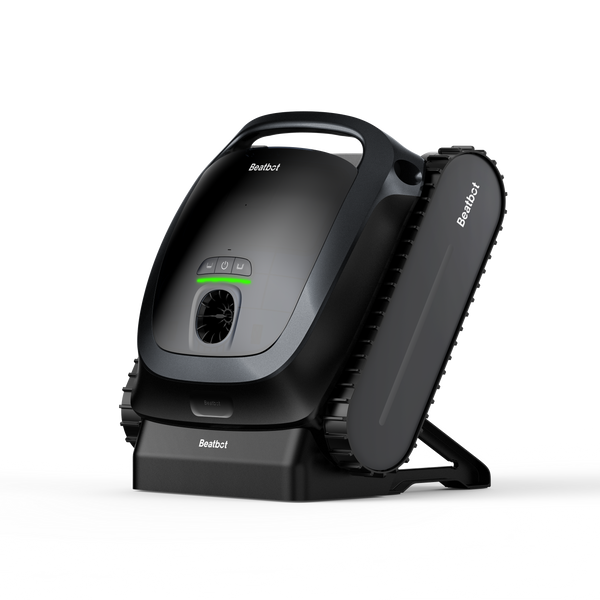
The Beatbot Sora 70 robotic pool cleaner covers the floor, walls, waterline, and water surface in a single automated cycle, with professional waterline cleaning that scrubs the tile band where calcium deposits and oil residue concentrate most heavily in salt water pools.
Its 6,800 GPH suction with an optional 3-micron ultra-fine filter captures the fine calcium particles and sediment from the pool floor before they resuspend and contribute to water turbidity or SCG cell loading.
Scheduling a Sora 70 cleaning cycle weekly in a salt water pool maintains the surface cleanliness that keeps chemistry adjustments predictable and extends the interval between SCG cell acid cleanings.

FAQs
What happens if salt level is too high in a pool?
Salt above 4,000 to 5,000 ppm does not cause immediate harm to swimmers, but it accelerates corrosion of metal equipment, ladder hardware, and light fixtures. Heater heat exchangers are particularly vulnerable to elevated salt concentration over time.
The only way to reduce salt in a pool is dilution through partial draining and refilling with fresh water. There is no chemical treatment that removes salt from pool water.
How often should I test salt level?
Test salt level once a month during the swim season, or any time the SCG displays a low-salt alarm or chlorine output appears reduced relative to runtime. Salt does not deplete quickly in normal operation: it leaves the pool only through splash-out, backwashing, and water changes.
Monthly testing is sufficient for most pools. After a significant rain event that overflows the pool or after a large water change, retest before adjusting.
Can I use water softener salt in my pool?
No. Water softener salts commonly contain additives including anti-caking agents, resin cleaners, and sometimes iron-removal compounds that reduce water clarity, affect SCG cell performance, and can stain pool surfaces.
Use only pool-grade sodium chloride rated at 99.8 percent purity or higher with no additives. The cost difference between pool-grade salt and water softener salt is small; the potential problems from using the wrong product are not.
Does rain dilute the salt level in a pool?
Yes, but typically not enough to require immediate adjustment after a single rain event. A heavy rainfall that overflows the pool or significantly raises the water level dilutes salt proportionally to the volume of rainwater that replaced pool water.
If the pool overflows significantly, test salt level after the water level returns to normal and add salt if the reading has dropped below the lower end of the SCG's recommended range.
How do I know if my SCG salt reading is accurate?
The SCG display reading and the actual salt concentration can differ by 200 to 500 ppm due to cell scale, water temperature effects on conductivity, and cell age. To verify accuracy, test the water with a calibrated digital salt meter and compare the reading to the SCG display.
If the difference is consistently more than 300 to 400 ppm, inspect the cell for scale and clean it if needed. A clean cell in a pool with stable water temperature produces a SCG display reading closer to the actual concentration.
Why does my salt water pool still get algae if the SCG is running?
The most common causes are: salt level is below the SCG's operating threshold so the cell is producing less chlorine than the runtime percentage suggests, CYA is too low so UV is degrading chlorine faster than the cell generates it, pH is too high so chlorine is mostly in its inactive form despite adequate free chlorine readings, or the SCG cell is scaled and underperforming without displaying a fault.
Test salt, CYA, and pH before adjusting cell output or runtime. Recurring algae in a salt water pool with an apparently functioning SCG is almost always a chemistry balance issue rather than a cell failure.