Most Popular


 Sora Series


 AquaSense Series

 Skimmer & Bundle

 Retail Edition


 Accessories


A solar pool skimmer floats on the water and uses sunlight to catch debris before it sinks. A robotic pool cleaner works underwater, using battery power or a cord to scrub and vacuum the floor, walls, and waterline. They are not interchangeable. They solve different cleaning problems.
What is a Solar Pool Skimmer?
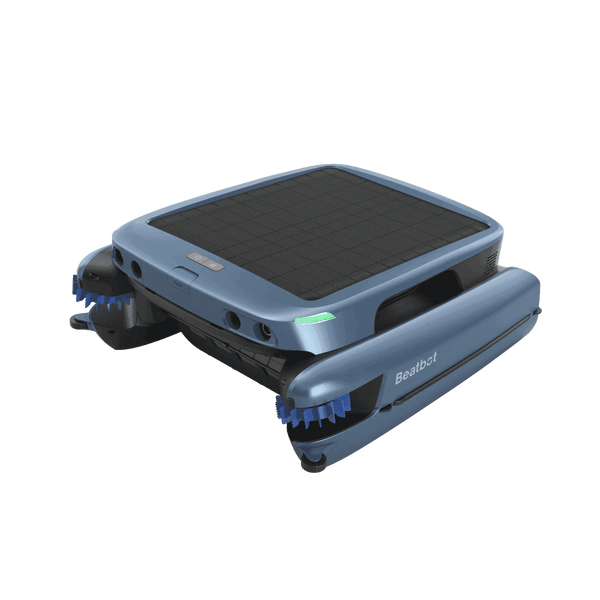
A solar pool skimmer is a floating robot with an onboard solar panel that powers a small motor or paddle system. It moves across the pool surface and collects leaves, pollen, insects, and other buoyant debris before they sink.
It runs cordless and hands-free, and during daylight hours, it cleans without adding to your electric bill. By catching debris while it is still floating, a solar skimmer reduces what ends up in your main filter, on your pool floor, and in the spots you would otherwise have to brush or net by hand.
What is a Robotic Pool Cleaner?
A robotic pool cleaner is an underwater cleaning machine that drives itself across the pool floor and walls. It scrubs surfaces with rotating brushes and pulls debris into an internal filter basket.
Most modern models run cordless on a rechargeable battery. Their main job is the part of the pool a net cannot handle well: the bottom, the corners, the steps, and the waterline.
Suction motors of 6,000 GPH or higher lift sand, algae, and heavier debris off the floor. Brushes scrub vinyl, concrete, fiberglass, or tile. Onboard sensors help with obstacle avoidance and route planning. Most cleaning cycles run for a few hours per session.
Solar Pool Skimmer vs Robotic Pool Cleaner: Key Differences
A solar skimmer works on the water surface and runs on sunlight, often for much of the day during peak summer. A robotic pool cleaner works below the surface and runs in scheduled sessions on a rechargeable battery or electrical cord. That one difference shapes almost every other trade-off.

Cleaning Zone Coverage
A solar pool skimmer cleans only the water surface. It collects leaves before they sink, along with pollen, bugs, sunscreen residue, and oil. A robotic pool cleaner handles the floor, walls, and waterline, including debris that has already settled, stuck, or started growing on a hard surface.
That split is easy to understand because most robotic cleaners are built around suction inlets on the underside of the machine. The inlet pulls debris from below as the cleaner moves across the floor. That design works well underwater, but it does not naturally reach the water surface.
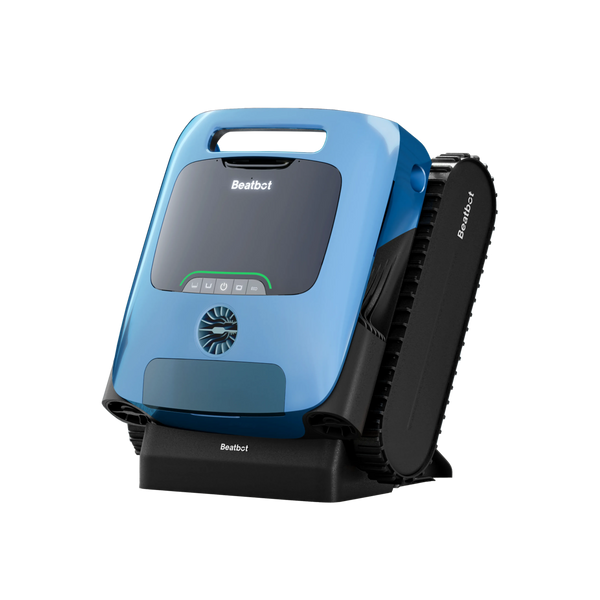
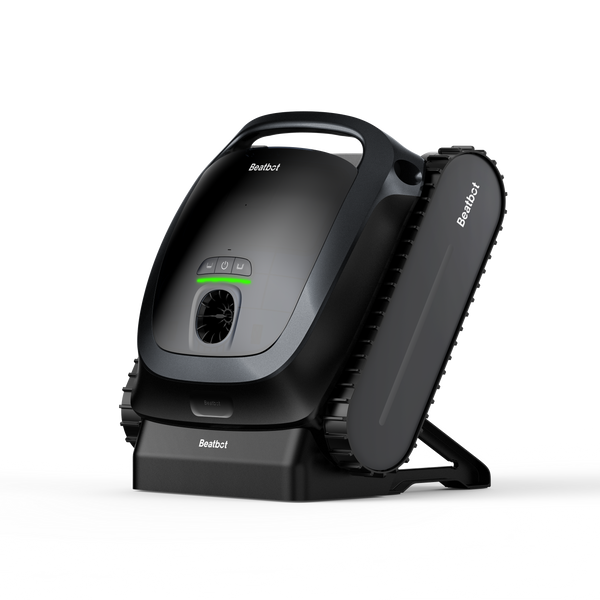
A few newer models are starting to solve that limitation. The Beatbot Sora 70 uses a JetPulse™ system with side-mounted jets that pull floating debris toward the central suction inlet, so one cycle can cover the floor, walls, waterline, and water surface together. "Robotic cleaner" no longer always means "submerged-only," and a one-machine setup can make sense in some pools. No solar skimmer works the other way around.
Power Source and Runtime
Solar skimmers are built for long, steady, low-intensity cleaning. A solar panel keeps the unit charged during the day, while a small onboard battery helps it keep moving through clouds or into the evening. Runtime is usually thought of as "all daylight hours," not a fixed two- or three-hour cycle. Once you buy the device, operating cost is effectively zero.
The limitation is just as real. Solar performance depends on sun exposure, so shaded yards, long cloudy stretches, and winter months can reduce cleaning time. Better solar skimmers address that with a stronger onboard battery and a second charging option. The Beatbot iSkim Ultra, for example, pairs a 24W solar panel with a 10,000mAh battery and includes a magnetic wireless charger as a plug-in backup.
Robotic pool cleaners are designed for shorter, higher-power sessions. The motors and suction needed to lift sand and scrub walls draw far more power than surface skimming, so the machine cleans hard for a few hours, then returns for charging. Cordless models typically deliver 2 to 5 hours of runtime, depending on cleaning mode and pool size.
Debris Type and Maintenance
A skimmer targets debris that floats long enough to be caught. Most use mesh baskets sized for leaves, twigs, bugs, and larger particles. Once debris sinks, a surface skimmer can no longer reach it.
A robotic cleaner is built for what has dropped to the floor or stuck to the walls: heavy sand, algae, fine dirt, and decaying leaves. Filtration is usually finer, often around 150 µm for daily cleaning, with some models offering an ultra-fine filter for microscopic debris such as pollen and fine sand.
The maintenance routine follows the job. A solar skimmer that runs 10 or more hours a day fills its basket faster, so emptying can become a daily habit during heavy debris season. A robotic cleaner runs less often but captures more during each session, so basket emptying usually follows your cleaning schedule instead of becoming a separate daily chore.
Pickup and Retrieval
A solar skimmer floats. When you need to remove it, you walk to the edge and lift it out. No reaching into deep water, no heavy pull, no awkward angle.
A robotic pool cleaner sinks. When the cycle ends, the unit often sits on the pool floor, full of water, sometimes in the deep end. It can weigh 20 to 30 pounds when lifted out. For many owners, retrieval is the most annoying part of using a robotic cleaner.
Better robotic cleaners now solve this with surface-parking or wall-parking features that bring the unit to the pool edge when cleaning is done.
The Beatbot Sora 70 uses a submarine-inspired floating system that surfaces the robot and moves it to the pool edge. Its SmartDrain™ release empties internal water before lifting, so retrieval feels closer to picking up a skimmer than dragging a soaked machine out of deep water.
Pool Type and Size Compatibility
Solar skimmers work with almost any pool. Inground, above-ground, vinyl liner, fiberglass, concrete, tile, freeform, or rectangular. Since the device floats, pool shape and wall material are rarely an issue.
Robotic pool cleaners are more selective. Most models specify a maximum coverage area, often around 3,000 to 3,300 square feet on a single charge, so larger pools may need more than one cycle. Above ground pools also have compatibility limits.
Many robotic cleaners are designed for inground pools and may not handle soft-walled or inflatable pools well. Most also need a minimum water depth to stay submerged. Wall material matters too, since vinyl and fiberglass are generally easier to climb than rough concrete or tile.
Price and Ownership Cost
Solar skimmers cover a wide price range. Basic models start under $300, while advanced robotic skimmers with sensors, app control, and larger baskets can reach the $1,000 to $1,500 range. After purchase, operating cost is effectively zero.
Robotic pool cleaners also vary widely. Entry-level cordless models often start around $500 to $700. Mid-range models with surface cleaning, app control, and larger batteries can sit between $1,500 and $3,000. Ongoing costs include electricity for charging, occasional brush and filter replacements, and battery replacement after several years of use.
A higher-end solar skimmer and an entry-level robotic cleaner may cost about the same, but they do completely different work.
How to Choose Between a Solar Skimmer and a Robotic Pool Cleaner
Start with the cleaning job that takes the most time by hand. If the problem is the floor and walls, choose a robotic pool cleaner. If the problem is constant surface debris, choose a solar pool skimmer. Then look at pool size and debris volume. Larger pools and high-debris yards often justify both devices, because one machine alone will leave coverage gaps.
A standard inground pool with light to moderate debris and limited tree cover usually does fine with a robotic pool cleaner alone. A model like the Beatbot Sora 70 stretches further into hybrid territory than most because its JetPulse™ surface cleaning handles light floating debris in the same cycle that covers the floor, walls, and waterline.
For owners who would rather buy one machine than two, this is the kind of robotic cleaner that makes that approach workable.
A pool surrounded by mature trees, exposed to wind, or used heavily during pollen season is different. Surface debris keeps arriving throughout the day, and a robotic cycle every other night cannot keep up with that pace.
That is where a dedicated solar skimmer earns its place alongside a robotic cleaner. The Beatbot iSkim Ultra is built for this type of debris load, with a 9L filter basket that holds roughly 400 to 800 medium-sized leaves per session, so daily emptying does not become a constant chore.
Its ClearWater™ clarification system also works on water clarity while the skimmer catches surface debris. The skimmer handles debris during the day; the robotic cleaner handles whatever gets past it overnight.
An above-ground or smaller pool with mostly surface debris and no major floor or wall issues can often be managed with a solar skimmer plus occasional manual vacuuming, without buying a robotic cleaner at all.
FAQs
Can I use a solar pool skimmer in a saltwater pool?
Most solar skimmers are saltwater-compatible, but check the spec sheet before buying. Parts exposed to pool water need corrosion-resistant materials such as ASA plastics and IP-rated electronics. Older or low-cost models without those protections can break down faster in saltwater.
How often do I need to empty a solar pool skimmer's basket?
During heavy debris season, daily. During normal conditions, every two to three days is more realistic. Emptying frequency depends on tree cover, pollen, and wind. Larger baskets reduce how often you empty them, but they do not remove the chore entirely.
Do robotic pool cleaners work without electricity?
Cordless battery-powered models run a full cleaning cycle without being plugged in, but they still need a wall outlet between sessions for recharging. Corded models need constant power during cleaning. Neither type runs completely off-grid.
Can a solar pool skimmer get stuck in pool corners?
Better models use sensors plus reverse-and-turn logic to escape corners and walls. Basic paddle-driven skimmers without sensors can still get lodged against steps, walls, or pool features and may need manual repositioning. Sensor-equipped models are the safer choice for freeform or complex pool shapes.
How long do robotic pool cleaner batteries last before needing replacement?
Most lithium-ion battery packs last three to five years with regular use, depending on charge cycles and storage conditions. Replacement batteries are available for many premium models. Budget cleaners often build the battery into the unit, which can shorten the product's usable life.