Most Popular


 Sora Series


 AquaSense Series

 Skimmer & Bundle

 Retail Edition


 Accessories


Above ground pool lights come in four popular styles, and picking the right one depends mostly on your pool wall material and how much installation you want to take on. The main options are magnetic wall lights, return-jet lights, floating or submersible LED lights, and solar rope or top-rail lights. Above ground pools have no factory-cut wall niche to hold a fixture, so each of these works around that in a different way. Soft-sided vinyl pools pair best with magnetic lights, hard-walled steel or resin pools suit return-jet fixtures, and renters or budget-minded owners often reach for floating solar LEDs that need no wiring at all.

The Four Main Above Ground Pool Lighting Options
The four most popular options are magnetic wall lights, return-jet lights, floating or submersible LED lights, and solar rope or top-rail lights. They differ most in how they draw power and how they attach to the pool, and that is what makes one a good match for your setup and another a poor one.
Above ground lighting relies on low-voltage induction, plug-and-play return fittings, batteries, and solar panels rather than the hardwired fixtures an inground pool uses, so you can light the water without cutting the liner or hiring an electrician.
The table below sorts the four types by best use, power source, and installation method.
| Light Type | Best For | Power Source | Installation |
|---|---|---|---|
| Magnetic Wall | Soft-sided vinyl and steel-wall pools | Low-voltage plug or battery | Magnet aligns through the wall |
| Return-Jet | Hard-walled steel or resin pools | 12V corded transformer | Screws into the return fitting |
| Floating LED | Renters and any pool style | Solar or batteries | Drop into the water |
| Solar Rope | Top rails and perimeter ambiance | Solar panel | Clips or adhesive |
Cost tracks with installation and brightness. Floating and basic solar lights are the most affordable, while return-jet fixtures and smart rail kits sit at the higher end.
Magnetic Wall Lights for Soft-Sided Pools
Magnetic wall lights are the top choice for soft-sided vinyl and steel-frame above ground pools because they pass power through the wall without any holes. A transmitter sits on the outside of the pool wall and a separate light unit sits on the inside, held together by a strong magnetic field that carries low-voltage current through the liner.
Because nothing is cut or drilled, you can reposition the light anywhere on the wall in seconds. The transmitter converts standard 120V power into a safe, low-voltage current before it reaches the water, so no high-voltage wire ever enters the pool. Common options such as the Intex magnetic LED wall light are rated to illuminate a pool up to about 24 feet across.

One clever safety feature is buoyancy. If the inner light gets bumped and separates from the external magnet, it floats to the surface instead of sinking, so you never have to reach into a dark pool to retrieve it. For a typical soft-sided vinyl pool, a magnetic light is the simplest upgrade you can make.
On thicker resin top-ledge pools the magnet can struggle to hold through the denser material, so check your wall thickness or step up to a return-jet light. Keep the magnet contact point free of sand too, since grit trapped against a flexing vinyl wall can slowly wear a hole in the liner.
Return-Jet Lights for Hard-Walled Pools
Return-jet lights are the best fit for hard-walled steel or resin pools where you want a bright, permanent fixture. These lights screw directly onto the existing water return fitting, the nozzle where filtered water flows back into the pool, so you avoid cutting any new holes in the liner or wall.
A return-jet unit combines a directional water jet with a high-intensity LED, so it lights the pool while still aiming the return flow to help circulation. Installation usually takes only a few minutes. The light plugs into a standard 110V GFCI outlet through a weather-tight transformer that drops the voltage to a safe 12V before it reaches the water, and quality LED units are rated for tens of thousands of hours of use.

For hard-sided owners who want consistent, hardwired-style brightness with the least modification, a return-jet light gives the most professional result. Multi-color and app-controlled models are widely available, so you are not limited to a single white beam. It does need an outlet within reach and some cord management along the top rail, so it suits owners who want a fixed light rather than one they move around.
Floating and Submersible LED Lights
Floating and submersible LED lights are the easiest option when you want zero installation, full portability, or a low-cost light, which makes them a favorite for renters. They need no wiring at all. You either drop a floating orb on the surface or set a weighted submersible puck on the floor, and it runs on solar charging or replaceable batteries.
These lights are built for ambiance rather than raw output. Many charge in the sun during the day and switch on automatically at dusk, and some battery models shut off after an hour to conserve power. Modern submersible pucks have come a long way from party favors, with IP68 waterproof ratings and 16 or more color modes. Familiar picks include Intex and Blue Wave solar floating lights, most of which cost less than a hardwired fixture.

They will not match a corded return-jet light for brightness, and solar versions dim on cloudy days, but for mood lighting and flexibility they are the easiest way to start. Grouping three or four floating lights near the edges keeps them out of the way while still spreading color across the water.
Solar Rope and Top-Rail Lights
Solar rope and top-rail lights add a perimeter glow by wrapping around the metal frame or rim of an above ground pool, outlining the structure rather than lighting the water itself. They clip, zip-tie, or stick onto the top rail and run off an attached solar panel, so there is no wiring to run.
This category ranges from heavy-duty IP65-rated copper wire rope lights that wrap the outside rail to peel-and-stick smart LED strips you can control from an app or sync to backyard music. Both light the edge of the pool and the surrounding deck, which improves visibility around the water and sets the mood for evening gatherings.

Rail and rope lights work best as an accent layer, not as your main underwater light. Because they outline the rim instead of reaching the floor, pair them with a magnetic or return-jet light if you want real in-water visibility for night swimming.
How Do You Choose the Right Above Ground Pool Light?
Choosing the right above ground pool light comes down to five factors, your pool wall material, power source, brightness, waterproof rating, and safety certification. Match the light type to your wall first, then compare everything else.
Wall material is the deciding factor. Soft-sided vinyl and steel-frame pools take magnetic lights, hard-walled steel or resin pools suit return-jet fixtures, and renters or anyone without a nearby outlet lean toward floating and submersible options.
Power source shapes both installation and upkeep. Corded lights give consistent brightness but need a GFCI outlet and cord management. Rechargeable lights are portable but must come out to charge. Solar lights are the easiest to set up, though their output rises and falls with daily sunlight.
Brightness is measured in lumens, and more lumens reach the center of a larger floor. Some LED units use COB (chip-on-board) technology, which packs many small chips into one module for a denser, more even beam that makes the water look clear rather than spotty.
Waterproof rating tells you how the light handles water. An IP68 rating is the standard for anything meant to stay submerged, while IP67 is fine for splash zones and lights that only get temporary immersion.
Safety comes down to certification. Look for a UL or ETL listing, and always plug a corded light into a GFCI outlet, which cuts power instantly if it detects a fault. The single most important match is still wall type, since a light built for a soft-sided pool will not perform the same on a rigid resin wall.
Why Water Clarity Matters Once Your Pool Is Lit
Lighting exposes water clarity. A bright light picks out every leaf on the floor, the oily ring along the waterline, and any cloudiness in between, so the glow only looks as good as the water it passes through. Cloudy water scatters the light and looks dull no matter how bright the fixture.
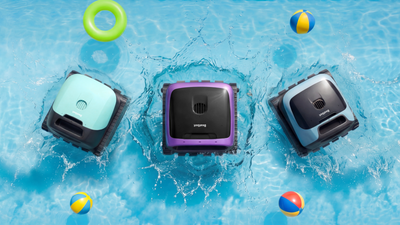
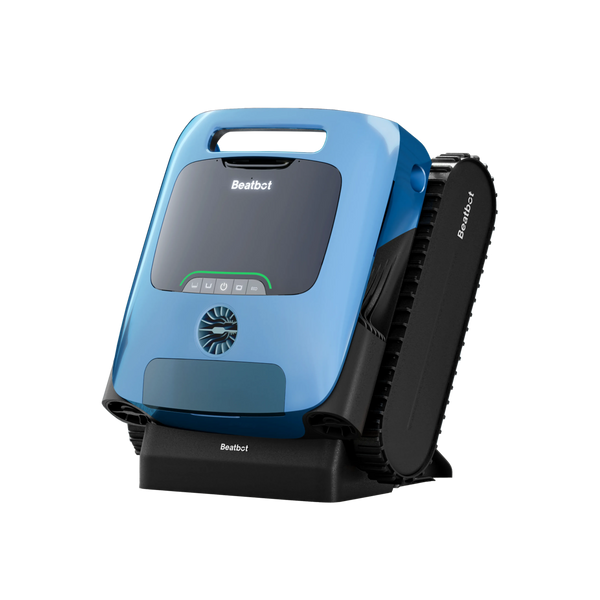
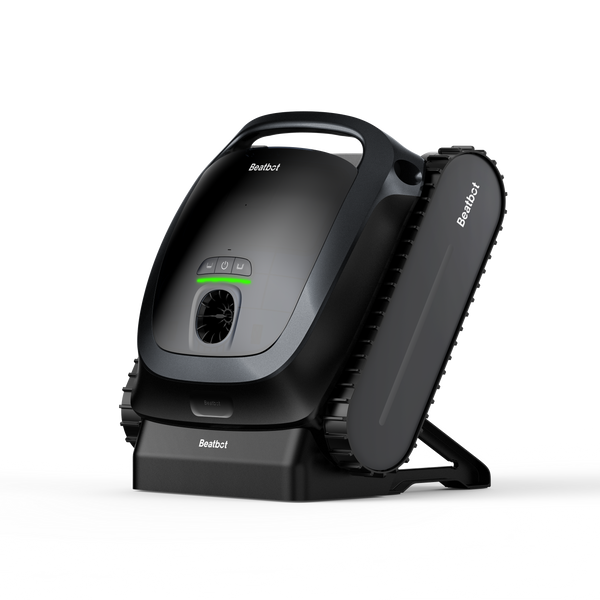
Evening is when a lit pool gets the most use, which puts the floor and the waterline on display at the moment you most want them clean. Above ground pools are a natural fit for cordless robotic pool cleaners like the Beatbot Sora 10 and Beatbot Sora 30, both built for above-ground and in-ground pools across vinyl, fiberglass, concrete, and tile.
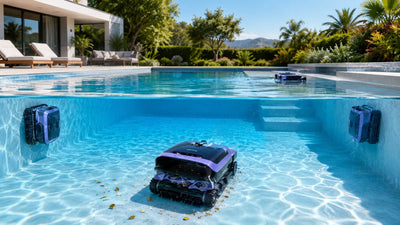
The Beatbot Sora 10 robotic pool cleaner cleans the floor, walls, and waterline, including the two zones your lights expose most. Its dual front roller brushes scrub the waterline where oils and algae leave a visible ring, and 6,800 GPH of suction lifts settled leaves and sand off the floor. When the cycle ends, smart waterline parking returns it to the waterline for easy pickup, so you lift it out by hand instead of reaching into dark water.
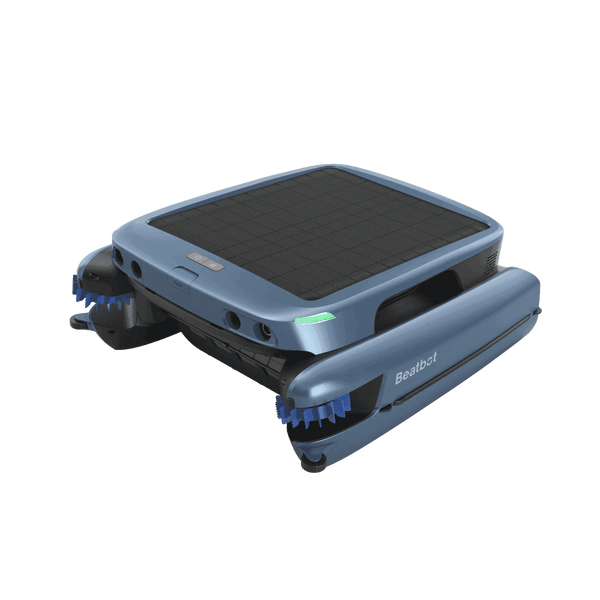
The Beatbot Sora 30 cordless pool cleaner cleans the same floor, walls, and waterline, and handles retrieval differently. Its floating design surfaces the whole unit when cleaning finishes, and the SmartDrain system empties the water inside first, so lifting it out after a late swim takes one hand.

Keeping the water clear this way lets the light shine through clean water instead of picking out debris on the floor.
FAQs
How Much Do Above Ground Pool Lights Cost?
Prices range widely by type. Floating and basic solar lights often cost under $40, magnetic wall lights run roughly $35 to $250 depending on brightness, and return-jet or smart rail systems usually fall between $70 and $210. Wall type and needed brightness tend to matter more than price alone.
Can You Use Inground Pool Lights in an Above Ground Pool?
Not directly. Inground fixtures are built to sit inside a wall niche that above ground pools do not have. Use a magnetic, return-jet, floating, or submersible light instead, since all four are designed for walls and returns rather than a recessed housing.
How Many Lights Do You Need for an Above Ground Pool?
One well-placed magnetic or return-jet light is usually enough to illuminate a round pool up to about 24 feet across. If you want more atmosphere, add floating lights or top-rail strips as a second layer rather than a second main light.
Do Above Ground Pool Lights Need to Be Removed for Winter?
Most do. Corded and rechargeable units use quick-disconnect designs, so you should unplug the power, lift the light out, wipe the lens clean, and store it somewhere dry. Leaving a light in a pool that freezes can crack the housing or ruin the seals.
What Color Pool Light Looks Best at Night?
Warm white and soft blue tones tend to look the most upscale and relaxed, while bright white reads more functional for safety. Multi-color RGB lights are best saved for parties, since constant color cycling can feel busy for everyday evening use.