Most Popular


 Sora Series


 AquaSense Series

 Skimmer & Bundle

 Retail Edition


 Accessories


Yes. Beatbot robotic pool cleaners are designed to clean irregular and freeform pools, not just standard rectangles. A freeform pool has curved walls, no straight runs, and often includes tanning ledges, swim-outs, or bowl-shaped contours.
Beatbot models such as the Sora 70 and Sora 30 use ultrasonic sensing and adaptive path planning to map these layouts in real time and adjust how they move through them. That gives them full coverage of floors, walls, the waterline, and shallow features across pool shapes that defeat cheaper cleaners or push owners back to manual brushing.
What Makes a Pool Irregular or Freeform?
An irregular or freeform pool is any pool that does not follow a simple rectangular or oval outline. Instead of straight walls meeting at right angles, freeform pools use curves, lagoon-style contours, kidney shapes, figure-eight layouts, or custom designs that follow the slope of a yard. Many also add tanning ledges, sun shelves, swim-outs, and beach entries that sit at different depths than the main floor.
These design choices change how a pool needs to be cleaned. A rectangular pool has predictable wall lengths and corners, so a cleaner can run a consistent back-and-forth pattern and still reach everything. A freeform pool has no such predictability. The walls bend, the floor depth shifts gradually instead of in clear steps, and tight curved corners trap leaves and sediment where water circulation is weakest.
Can Robotic Pool Cleaners Handle Curved Walls and Odd Shapes?
Robotic pool cleaners can handle curved walls and odd shapes, but only if they navigate by sensing rather than by following a fixed pattern. A fixed-pattern cleaner assumes the pool is roughly a box.
When it reaches a curve, it loses its reference line and either repeats areas it already covered or skips sections it never reached. Curved corners and gently sloped transitions are where this kind of cleaner falls short, because there is no straight wall to guide it.
Sensor-driven robots build an understanding of the pool as they go, detecting where walls are, how steep a slope is, and where an obstacle sits. That lets the robot turn earlier, climb at the right point, and shape its coverage path to the actual pool. In a freeform pool, that adaptive navigation is what gets the robot into the hardest sections instead of past them.

How Beatbot Robots Clean Freeform and Irregular Pools
Beatbot robotic pool cleaners navigate freeform pools with ultrasonic sensors that detect walls, slopes, and obstacles, then adjust the cleaning path in real time. The Beatbot Sora 70 and Beatbot Sora 30 robotic pool cleaners both use this approach, so neither depends on the pool being a simple shape.
The Beatbot Sora 70 cordless pool robot uses SonicSense obstacle avoidance, powered by dual ultrasonic sensors. The front sensor handles real-time obstacle detection for safe navigation and precise edge cleaning, while the bottom sensor reads platform heights and slope angles so the robot knows when it is approaching a ledge or a change in floor depth.
Its navigation adjusts automatically to any pool configuration, from standard rectangles to custom and infinity-style designs. On floors it follows optimized S-shaped paths, and dual-group roller brushes give it the traction to climb sloped walls and the bowl-shaped surfaces common in curved pools.
The Beatbot Sora 30 pool cleaning robot uses the same SonicSense obstacle avoidance system. Its long-wavelength sensing detects obstacles from a distance, so the robot pre-plans its path and glides around fixtures instead of colliding with them or getting stuck.
Like the Sora 70, it cleans the floor in S-shaped patterns and uses dual-group roller brushes for tighter turns and stronger traction. Both models are rated for all pool shapes, including rectangular, round, kidney, and freeform, and for all common pool materials such as concrete, ceramic tile, vinyl, and fiberglass.
Do Beatbot Cleaners Reach Tanning Ledges and Shallow Areas?
Yes. The Beatbot Sora 70 and Sora 30 both clean shallow areas and platforms, reaching zones as shallow as 8 inches of water. Tanning ledges, sun shelves, and swim-outs are among the most common features in freeform pools, and they are also where warm, slow-moving water lets algae take hold and where visible debris collects fastest. Most cleaners ignore these zones, which is why owners end up scrubbing them by hand.
The Beatbot Sora 70 robotic pool cleaner uses its bottom ultrasonic sensor to detect platform heights and slope angles, then transitions onto elevated areas and cleans them as part of its cycle. It actively identifies accessible platforms and shallow zones, so steps and ledges are cleaned before algae there spreads to the rest of the pool.
The Beatbot Sora 30 cordless pool cleaner also seeks out platforms and shallow areas down to 8 inches. Its ultrasonic sensors and real-time obstacle detection let it navigate tanning ledges, swim-outs, and custom layouts without getting stuck or skipping spots.
For a freeform pool with a beach entry or a raised shelf, the robot cleans those design features rather than leaving them while it handles only the deep floor.

Can Beatbot Robots Clean Curved Corners and Hard-to-Reach Areas?
A Beatbot robotic pool cleaner covers the entire pool in a single cycle, including the curved corners and walls that fixed-pattern cleaners miss. Edge and waterline coverage is part of the standard cycle, so the perimeter of an irregular pool is cleaned along with the floor rather than left as an afterthought. Because the robots follow the contour of a kidney curve or a lagoon edge instead of cutting across it, those sections get the same attention as a straight wall.
Curved walls demand traction and tight turning. Both models use dual-group roller brushes placed front and back, which gives them the grip to climb and the maneuverability to turn inside a curve. The Sora 70 is rated to climb walls and adapt to any pool shape and design, including the bowl-shaped surfaces of freeform construction.
Curves and ledges also add cleaning distance, so a freeform pool often has more surface to cover than its footprint suggests. Both robots carry a 10,000 mAh battery rated for up to 5 hours of floor cleaning. The Beatbot Sora 70 covers up to about 3,230 square feet on a single charge, and the Beatbot Sora 30 covers up to about 3,200 square feet, enough to finish a complex layout in one session.
Which Beatbot Model Suits a Freeform Pool Better?
The Beatbot Sora 70 and Sora 30 share the same navigation approach, so both read curves and reach ledges equally well. The better choice depends on whether your pool also has a surface-debris problem.
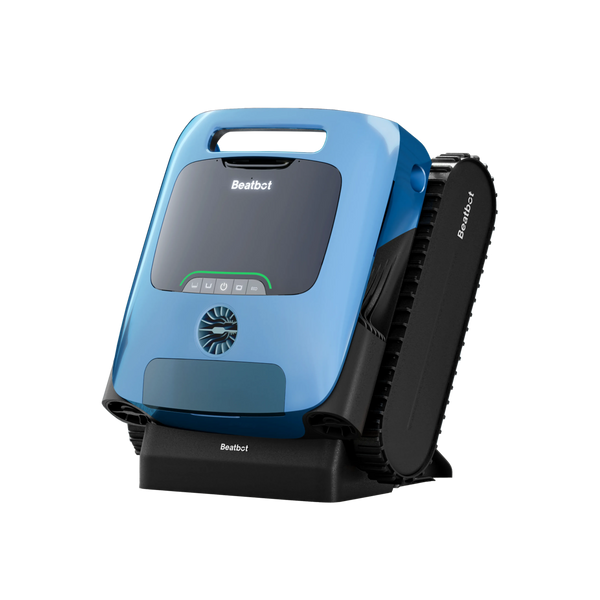
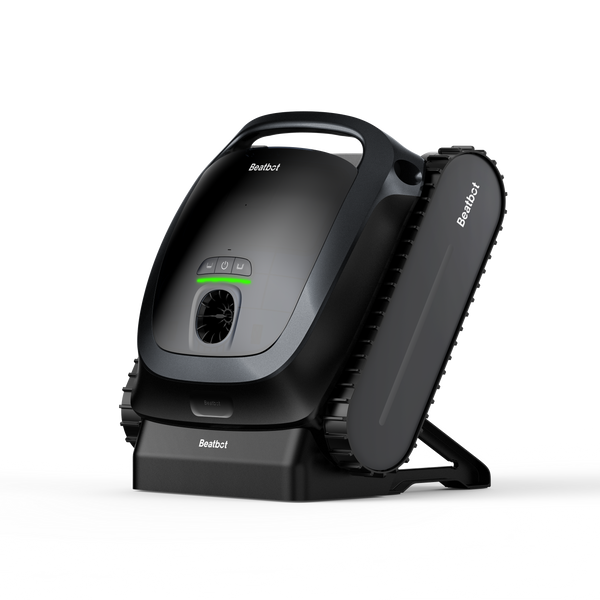
The Beatbot Sora 30 cordless pool robot cleans three zones in a single cycle: floor, walls, and waterline. It cleans shallow areas and platforms down to 8 inches and carries a 5L debris basket with 150-micron filtration, backed by a 2-year warranty. For a freeform pool that mainly needs its floors, walls, and shaped features kept clean, the Sora 30 covers the layout completely.
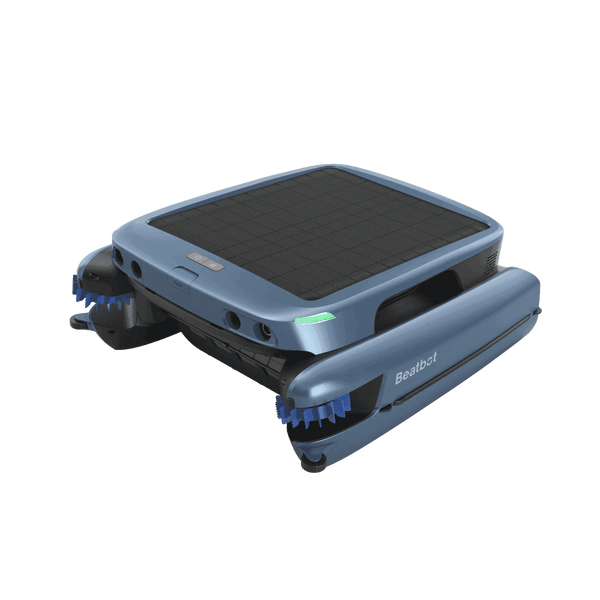
The Beatbot Sora 70 robotic pool cleaner adds a fourth zone: the water surface. Its JetPulse system uses dual converging jets to pull floating leaves and debris inward and capture them, alongside floor, wall, waterline, and shallow-platform cleaning.
It carries a larger 6L debris basket. For a freeform pool surrounded by trees, or one where leaves and pollen collect on the surface before they sink, the Sora 70 removes a skimming task that would otherwise stay manual.
If surface leaves and floating debris are a recurring issue, the Sora 70's water-surface cleaning earns its place. If the pool stays clear on top and the concern is thorough floor, wall, and ledge coverage, the Sora 30 is a complete solution for the shape itself.
FAQs
Do robotic pool cleaners work in saltwater freeform pools?
Yes. The Beatbot Sora 70 and Sora 30 are rated for all common pool materials, including concrete, ceramic tile, vinyl, and fiberglass, and run the same whether the pool uses a saltwater or traditional chlorine system. The cleaning system responds to pool shape and debris, not water chemistry.
Will a robotic pool cleaner get stuck in a freeform pool?
Beatbot robots are built to avoid this. SonicSense obstacle avoidance detects fixtures and walls from a distance, so the robot pre-plans its path around them rather than running into them. Narrow swim-outs and curved corners are read as part of the layout, not as traps that leave the robot stranded mid-cycle.
How do I get the robot out of a freeform pool with no clear corner?
Both models use smart water-surface parking. When the cycle finishes or the battery runs low, the robot rises to the surface and moves to the pool edge, so retrieval does not depend on a defined corner or reaching into deep water.