Most Popular


 Sora Series


 AquaSense Series


 Skimmer & Bundle
 Retail Edition


 Accessories


Above ground pool vacuums fall into three categories: manual, suction-side, and robotic. Manual vacuums are cheapest and require active effort each session. Suction-side cleaners automate the work using the pool's own pump. Robotic cleaners run independently with their own motor and filtration, deliver the most thorough clean, and cost the most upfront. For most above ground pool owners, a robotic cleaner is the best long-term value, but the right specific pick depends on pool size, debris load, and whether walls and waterline need cleaning along with the floor.

Why Above Ground Pools Need a Specialized Vacuum
Above ground pools differ from in-ground pools in four ways that matter for vacuum selection: vinyl or flexible liners that need gentle brushes, flat floors that suit systematic navigation, shallower water (typically 48 to 52 inches) that destabilizes some heavier cleaners, and smaller pumps that cap the performance of suction-side equipment. A vacuum that ignores these constraints either damages the liner over time or underperforms in the shallower water depth.
Vinyl liners in particular are vulnerable to stiff bristled brushes and heavy equipment that can scratch, tear, or stretch the material over repeated use. Above ground pools also collect debris differently than in-ground pools: leaves, grass clippings, dust, pollen, and insects settle quickly on the flat floor, especially after storms or heavy bather use, and a vacuum optimized for a deep in-ground pool can struggle to navigate or clean efficiently in 4 feet of water. Equipment specifically rated for above ground use is built around these constraints rather than working around them.
The Three Types of Pool Vacuums for Above Ground Pools
Manual vacuums are the cheapest option ($30 to $100) and the most labor-intensive, requiring active use each session. Suction-side cleaners ($100 to $300) automate the process but depend on the pool's own pump for power. Robotic cleaners ($400 to $2,000+) run independently with their own motor and filtration, deliver the most thorough cleaning, and place no load on the pool's pump. Each type suits a different combination of pool size, budget, and effort tolerance.
Manual vacuums
A manual vacuum attaches to a telescopic pole and connects to the pool's filtration system through a hose. The owner walks the vacuum head across the floor by hand, pushing debris into the pool's filter. This is the cheapest option, with prices typically between $30 and $100 for a complete kit (pole, hose, vacuum head), and requires no installation beyond connecting the hose. The trade-off is consistent time and physical effort: 20 to 45 minutes per session depending on pool size, and most owners find that motivation drops off after the first season of regular use. Manual vacuums work best for small above ground pools (under 15 feet) or as a supplemental spot-cleaning tool alongside an automated cleaner.
Suction-side cleaners
A suction-side cleaner connects to the pool's skimmer line and uses the suction generated by the pool's pump to move randomly across the floor, collecting debris that then passes into the pool's filter. Prices typically range from $100 to $300. These units are simple to install and require no electrical setup beyond what the pool already has, but their cleaning performance is directly tied to the strength of the pool's pump: above ground pools often run smaller, lower-horsepower pumps (well under 1 HP in many cases) which limits how effectively a suction-side cleaner can move and capture debris. They also add load to the existing pump and filter, which shortens the maintenance interval on both. Pentair Kreepy Krauly and Hayward Diver Dave are common suction-side models in this category.
Robotic cleaners
A robotic cleaner operates entirely independently of the pool's pump, using its own electric motor and self-contained filtration system. Because it does not rely on the existing pump, a robotic cleaner delivers consistent performance regardless of the pool's filtration setup, and it removes debris before that material ever reaches the pool's main filter, reducing strain on the existing equipment. Prices range widely: entry-level above ground robotic cleaners (floor-only coverage) start around $400 to $600, mid-range models with active scrubbing and smart navigation run $600 to $900, and premium robotic cleaners with wall climbing, waterline scrubbing, and surface skimming run $1,000 to $2,500+. Most robotic units designed for above ground use are lightweight (10 to 20 pounds) and easy to lift out of the water at the end of a cycle.
Key Features That Actually Matter When Choosing a Vacuum
The features that have the most impact on cleaning results in an above ground pool are liner-safe brush material, navigation efficiency, suction power, debris capacity, lightweight construction, and ease of setup. A vacuum that lacks any of these will see less consistent use over a season, which undermines its rated cleaning performance regardless of how impressive its spec sheet is.
Liner-safe brush material
Vinyl liners require soft brushes, typically rubber or PVC, that scrub effectively without scratching or tearing the liner material. Stiff metal-bristle brushes designed for plaster or concrete in-ground pools can damage a vinyl liner over repeated use. Confirm that any vacuum considered for an above ground pool is explicitly rated as liner-safe before purchase. Most robotic cleaners marketed for above ground use meet this requirement; many in-ground cleaners do not.
Lightweight design
Above ground pool walls and liners are more flexible than rigid in-ground shells, so a heavy cleaning unit places unnecessary stress on the pool structure, particularly when being lifted out of the water at the end of a cleaning cycle. Lightweight robotic units (under 20 pounds) are easier to handle, less likely to deform the liner during removal, and less stressful on the pool wall. This is particularly important for owners who will be lifting the unit out by hand without a caddy.
Efficient navigation
Flat-bottom above ground pools benefit most from vacuums that move systematically across the floor rather than randomly. Random-path cleaners (most basic suction-side and entry-level robotic units) statistically leave gaps in coverage on small, contained floor areas. Robotic models with mapping or sensor-based navigation (often marketed as SmartNav, AI navigation, or pattern cleaning) achieve more complete coverage in less time. Look for navigation systems that actually scan and map the pool, not just bumper-sensor random pivoting.
Strong suction and debris capacity
Above ground pools accumulate lightweight debris (leaves, pollen, insects, fine dust) that requires adequate suction to capture without clogging. Robotic cleaners in the 3,000 to 4,000 GPH range handle typical residential debris loads well; pools with heavy tree cover or after storms benefit from higher GPH ratings (5,000+) and finer filtration (3 to 10 microns). A large debris basket or filter capacity reduces how often the unit needs to be emptied mid-cycle, which is the maintenance task most owners skip and which directly affects cleaning consistency.
Compatibility with pool size
Manufacturers specify a maximum pool size for each cleaner (typically expressed in feet of pool length or square footage). Running a robotic cleaner in a pool significantly larger than its rated capacity results in incomplete coverage, longer cycle times, and faster motor wear. Cable length matters too: a corded robotic cleaner needs cable long enough to reach the deepest point of the pool with slack remaining. Confirm both ratings against your pool's actual dimensions before buying.
Easy setup and operation
Plug-and-play robotic units that need no more than placing in the water and powering on, or suction-side cleaners with quick-connect hose fittings, see the most consistent use over a season. Equipment that requires complex installation, multiple tool adjustments, or daily troubleshooting tends to be used less often, which defeats the purpose of buying it. App control and weekly scheduling are useful additions on robotic models, particularly for owners who want truly hands-off automation.
Low energy consumption
Robotic cleaners typically use 150 to 200 watts during operation, which is dramatically less than the booster pumps required for pressure-side cleaners or the additional pump load suction-side cleaners place on the system. Over a swim season, the difference adds up: a robotic cleaner costs roughly $5 to $15 per season in electricity at typical residential rates, while suction-side operation adds noticeably to the existing pump's monthly draw.
Quiet operation
Above ground pools are usually located close to the house or patio, so noise level affects when and how often the cleaner can be run without disrupting the household. Robotic cleaners generally operate at 50 to 65 decibels (similar to a quiet dishwasher), which allows running them during evening hours or while entertaining. Suction-side cleaners themselves are quiet but require the pool's pump to be running, which adds the pump's noise to the operation.
How to Match the Vacuum Type to Your Specific Pool
The right vacuum type depends on three pool-specific factors: pool size, debris environment, and whether wall and waterline cleaning matter to you. Working through these factors in order narrows the choice from three types to the right specific tier within one type.
By pool size
Pools under 12 feet (small round or Intex-style): A handheld battery-powered vacuum or basic manual unit is sufficient. The pool is small enough that manual cleaning covers it completely in 10 minutes, and a full-size robotic cleaner often has trouble turning or covers the same patches repeatedly in such a small footprint.
Pools 12 to 18 feet (medium round or small oval): The decision genuinely depends on owner preference and pump capacity. A suction-side cleaner works well if the pump is rated 1 HP or higher; an entry-level robotic cleaner is the next step up if pump capacity is borderline or minimizing pump wear is a priority.
Pools 18 to 24 feet (larger round or standard oval): A robotic cleaner becomes the clear value choice. Manual vacuuming is no longer a casual task, and most suction-side cleaners struggle to cover the full floor area on the smaller pumps common at this pool size. Wall climbing starts to add real value.
Pools 24 feet and above (large oval or rectangular): A robotic cleaner is essentially required unless you enjoy manual labor. Confirm the unit is rated for the full pool surface area (square footage, not just length) and that cable length, if corded, reaches the deepest point with slack. The productivity gap between robotic and manual at this size pays back the cost difference within one season.
By debris environment
Light debris (open yard, minimal trees): A basic suction-side cleaner or entry-level robotic unit handles the load. Filter capacity matters less than navigation efficiency.
Moderate debris (some tree cover, suburban setting): Look for adequate debris basket capacity that does not require mid-cycle emptying. A top-loading filter basket (easier to remove and rinse than side-loading models) is worth a small premium because frequent emptying is the maintenance task owners most often skip.
Heavy debris (mature trees, autumn use, post-storm conditions): A robotic cleaner with high suction (5,000 GPH or above) and fine filtration (3 to 10 micron) is the practical requirement. Suction-side cleaners are typically not adequate at this debris level. Fine filtration matters here because heavy debris loads include not just leaves but the fine organic particles that result from leaves breaking down in the water.
By coverage needs
Floor only: Adequate for pools with light bather use, stable chemistry, and minimal waterline buildup. Most budget robotic cleaners and all suction-side cleaners operate at this tier. If the waterline shows no visible discoloration at the end of a typical week, floor-only is enough.
Floor and walls: The middle tier handles floor and walls but does not actively scrub the waterline band. Suitable for pools with moderate bather use where some algae or biofilm starts establishing on walls between manual brushings.
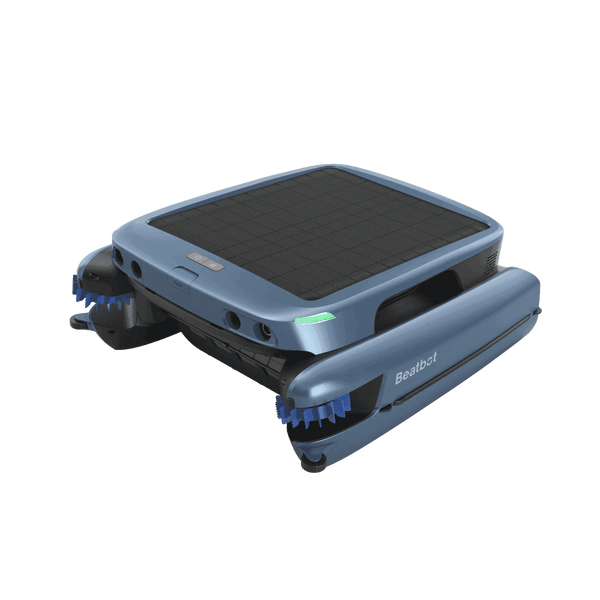
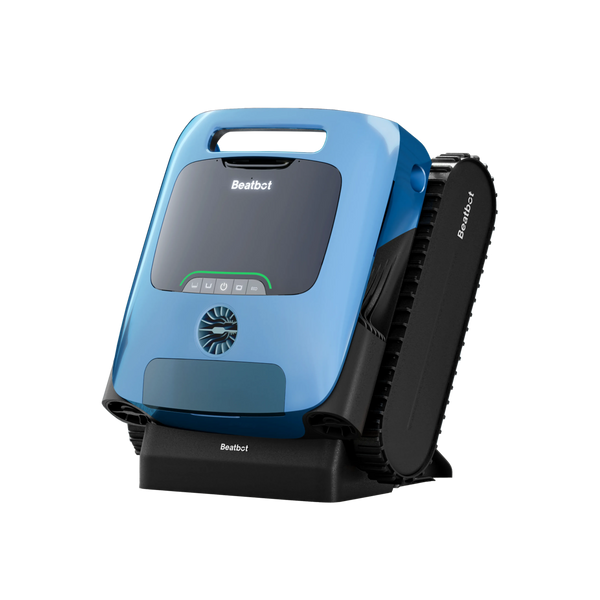
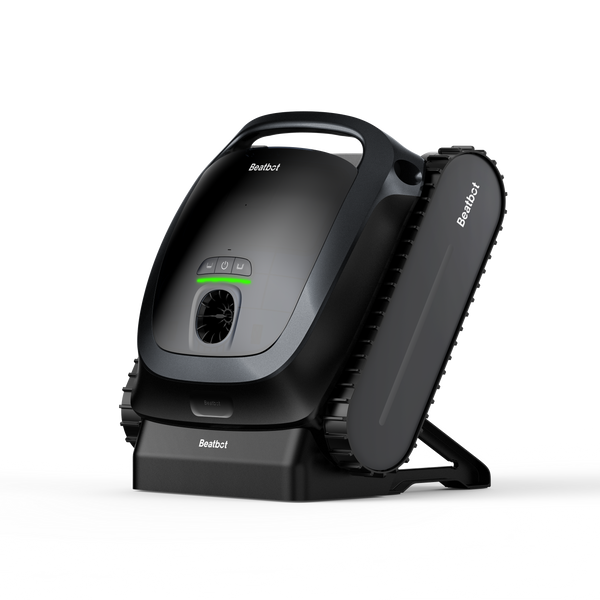
Floor, walls, and waterline: Top-tier coverage adds active waterline scrubbing, which addresses the band where body oils, sunscreen residue, and mineral deposits concentrate fastest. Above ground pools with heavy bather use, frequent gatherings, or hard water benefit most from this tier. The Beatbot Sora 70 is an example of a robotic cleaner that operates at this level: its 5-in-1 cleaning covers floor, walls, waterline, and water surface in a single cycle, with a 3-micron ultra-fine filter that captures the fine particulate generated when waterline residue is broken loose. For above ground pools that show a visible band of buildup at the waterline at the end of a week, this tier addresses the source rather than just the visible result.
Quick Comparison: Vacuum Type by Pool Situation
The table below summarizes the recommendations from the preceding sections. Use it as a quick reference; the detailed discussion in each section above is more reliable for borderline cases or pools with unusual conditions.
|
Your situation |
Primary recommendation |
Typical price range |
|
Pool under 12 ft, light use |
Manual or handheld battery vacuum |
$30 – $150 |
|
Pool 12-18 ft, strong pump (1+ HP) |
Suction-side cleaner |
$100 – $300 |
|
Pool 12-18 ft, weak pump |
Entry-level robotic (floor only) |
$400 – $600 |
|
Pool 18-24 ft, moderate debris |
Mid-range robotic (floor + scrubbing) |
$600 – $900 |
|
Pool 24+ ft or heavy debris |
Premium robotic (full coverage) |
$1,000 – $2,500 |
|
Heavy bather use, hard water |
Robotic with waterline scrubbing |
$1,200 – $2,500 |
|
Tight budget, occasional use |
Manual telescopic vacuum |
$30 – $80 |
Pump strength and liner condition override these recommendations when they conflict. Confirm the pool's pump horsepower before considering any suction-side cleaner.
Benefits of Using a Quality Pool Vacuum
Consistent vacuuming improves water clarity, reduces algae risk, extends pump and filter lifespan, and protects the pool liner. These benefits compound over time: a pool that is vacuumed regularly needs less chemical correction, which reduces the demand on the filtration system, which makes the entire maintenance cycle progressively easier rather than harder.
Improved water clarity
Removing fine debris (dust, pollen, fine organic matter) before it dissolves or breaks down in the water reduces the gradual haze that develops in pools left unattended for even a few days. Consistent vacuuming supports stable water chemistry because the filter and the sanitizer are dealing with a lower organic load.
Reduced manual labor
Automatic vacuums (suction-side or robotic) reduce hands-on cleaning time from 20 to 45 minutes per session to essentially zero. This is the benefit owners notice most quickly: by the second or third season of using a robotic cleaner, most owners would not go back to manual vacuuming even at significant savings.
Reduced algae risk
Organic debris is the nutrient source algae need to establish. Removing it regularly, before it has a chance to settle and decompose, makes it measurably harder for algae to take hold, which reduces how often shock treatment and other intensive chemical interventions are needed.
Extended pump and filter lifespan
Debris that accumulates on the pool floor eventually gets pulled into the pump and filter through normal circulation, forcing both to work harder and wear out faster. A vacuum, particularly a robotic one that removes debris before it reaches the pump, reduces this load directly. The pump and filter on a regularly vacuumed pool typically reach the end of their rated service life rather than failing prematurely from accumulated load.
Liner protection
Dirt and grit on the pool floor act as a mild abrasive against the liner surface, particularly in areas where swimmers walk or where the liner flexes with water movement. Regular, gentle cleaning removes that abrasive material before it has a chance to wear down the liner over a season. A liner with consistent cleaning lasts the full 7 to 10 year service life rather than developing wear patterns that shorten it.
Common Mistakes That Lead to Buying the Wrong Vacuum
The most common purchasing mistakes for above ground pool vacuums are not about features but about mismatch between equipment and pool. Knowing the patterns helps avoid buying the wrong product and having to replace it within a season.
Buying an in ground pool cleaner because it has higher specs
In-ground pool cleaners are often heavier, designed for deeper water, and built with brushes intended for plaster or concrete surfaces. Used in an above ground pool with a vinyl liner, they can scratch or stretch the liner, struggle to maintain stability in 4-foot water, and put unnecessary stress on the flexible pool wall when being lifted out. Higher GPH or larger filter capacity does not compensate for being the wrong type of equipment for the pool.
Choosing cordless to avoid cable management
Cordless robotic cleaners eliminate the cable management problem but introduce two new ones: limited runtime per charge (typically 60 to 90 minutes, which may not complete a cleaning cycle in a larger pool), and reduced suction power compared to corded equivalents (most cordless models operate at 1,200 to 1,500 GPH versus 3,000 to 4,000 GPH on comparable corded units). The cable on a corded robotic cleaner is a minor inconvenience compared to the suction and runtime gap it preserves. Cordless makes sense for very small pools where the limitations do not affect cleaning completion, or for pools without convenient outdoor electrical access.
Sizing to the current pool instead of the next pool
Above ground pools sometimes get replaced or upgraded within the cleaner's service life. A cleaner sized exactly to the current pool may not cover an upgraded pool, while a cleaner rated for somewhat larger pools handles the current pool without issue and continues to work after an upgrade. If a pool change is likely within the next 4 to 7 years, size up slightly.
Underestimating ongoing replacement parts costs
Robotic cleaner filter cartridges and brush rollers wear out and need periodic replacement. Filter replacements typically run $30 to $80 per cartridge, and brush sets $40 to $150 depending on the model. Some brands' replacement parts are significantly more expensive than others, and parts availability varies. A cleaner that is cheaper upfront but has expensive or hard-to-find replacement parts can cost more over its service life than a more expensive unit with affordable parts. Check replacement part pricing before buying.
Skipping the recommended pool size check
Manufacturers specify a recommended maximum pool size (in feet or square footage) for each cleaner. Running a robotic cleaner in a pool significantly larger than its rated capacity produces incomplete coverage and accelerates motor wear. This rating is not marketing language: it reflects the unit's actual operational range. Confirm pool dimensions match the cleaner's specification before purchase.

What to Expect at Each Price Tier
Above ground pool vacuums fall into roughly four price tiers, each with a typical service life and feature set. Knowing what you actually get at each level helps decide whether to spend more now or replace cheaper equipment more often. Higher tiers do not always justify themselves for every pool; the value comparison depends on pool size and how heavily the cleaner will be used.
Under $100: manual and entry handheld
Manual telescopic vacuums and basic battery-powered handheld units. Service life is 2 to 4 seasons with reasonable care. Suitable for small pools (under 15 feet), occasional spot cleaning, or as a supplemental tool alongside an automated cleaner. No automation, full owner effort each session. Best value if you genuinely use the pool only occasionally or have a very small footprint to clean.
$100 to $400: suction-side cleaners and entry handheld
Suction-side automatic cleaners and higher-end handheld battery vacuums. Service life is 3 to 5 seasons. Suction-side units automate the work but require the pool's pump to be running and add load to existing equipment. Acceptable for pools with strong pumps (1 HP or higher) and moderate debris loads.
$400 to $900: entry to mid-range robotic
Floor-focused robotic cleaners and mid-tier units with active scrubbing brushes and smart navigation. Service life is 4 to 6 seasons. Examples in this range include the Dolphin Escape (around $600 to $700, floor-only with HyperBrush scrubbing and SmartNav 2.0), and the Dolphin E10 (around $500, basic floor cleaning for above ground). These units handle most residential above ground pools well but typically do not include wall climbing, waterline scrubbing, or app control. This is the value sweet spot for most above ground pools 15 to 24 feet.
$900 to $2,500+: premium robotic with full coverage
Robotic cleaners with floor, wall, waterline, and sometimes water-surface coverage in a single cycle, with fine filtration, smart mapping, and app or remote control. Service life is 5 to 8 seasons with proper maintenance. Justified for pools with heavy bather use, hard water (significant waterline buildup), or owners who want a fully hands-off solution. The longer service life and broader coverage often make this tier cheaper per season than replacing $400 entry units every three years.
Maintenance Tips to Extend the Life of Your Pool Vacuum
Routine maintenance of the vacuum itself meaningfully extends its service life. Most premature failures come from a few specific habits: not emptying the filter regularly, leaving the unit in direct sunlight when stored, running it in unbalanced water, and improper off-season storage.
Empty the debris basket or filter cartridge after every cleaning cycle, or at minimum after every 2 to 3 cycles. A loaded filter forces the motor to work harder, which accelerates wear and reduces suction during subsequent cycles. For robotic models, rinse the filter media with a garden hose after emptying to remove fine particulate that does not shake out on its own.
Inspect brushes for wear at the start of each season and replace them when they show visible flattening or hardening. Worn brushes scrub less effectively and can put more stress on the drive motor as it tries to compensate for reduced contact friction.
Store the unit out of direct sunlight when not in use. UV degrades plastic housings, rubber tracks, and brush materials over time, even on units rated for outdoor use. A simple cover, a shaded location, or moving the unit indoors between uses extends component life noticeably.
Do not run the cleaner in pool water with very high chlorine (above 5 ppm) or during active shock treatment. High chlorine concentrations degrade rubber tracks, brushes, and seals faster than normal operating chemistry. Wait until chlorine drops back to the 1 to 3 ppm range before running the unit after shocking.
For off-season storage in cold climates, drain the unit completely, allow it to dry, and store it in a location that will not freeze. Water remaining inside the cleaner can freeze and crack internal components. For corded units, store the power supply indoors regardless of climate, as it is the most expensive single component to replace.
FAQs
What is the cheapest way to vacuum an above ground pool?
A manual telescopic vacuum with a hose attachment, typically $30 to $80 for a complete kit. It connects to the pool's skimmer or dedicated vacuum line and is operated by hand. It works, but takes 20 to 45 minutes per session depending on pool size and is the option owners most commonly abandon after a season in favor of automation.
Are cordless robotic pool cleaners worth it for an above ground pool?
For very small pools (under 15 feet), cordless can be reasonable because the limited runtime is enough to complete a cleaning cycle. For larger pools, corded robotic cleaners are typically a better value: they run continuously without battery limitations, deliver significantly higher suction (3,000 to 4,000 GPH versus 1,200 to 1,500 GPH for cordless), and avoid the recharge management cordless units require between sessions.
Can I use the same vacuum if I switch to an in ground pool later?
Most above ground pool vacuums are optimized for the specific constraints of above ground pools (flexible liners, flat floors, shallower water) and may not perform optimally in an in-ground pool with different geometry and rigid surfaces. Some robotic cleaners are rated for both above ground and in-ground use; these typically cost more upfront but make sense if a future in-ground pool is likely.
What suction rate (GPH) do I need for an above ground pool vacuum?
For most above ground pools, 3,000 to 4,000 GPH from a robotic cleaner handles typical residential debris (leaves, pollen, fine dust, insects). Higher GPH ratings (5,000+) benefit pools with heavy debris loads or larger surface areas. Suction rates significantly above 6,000 GPH are typically aimed at large pools or pools with persistent fine sediment. Higher is not always better: very high suction in a small pool can stir up settled debris faster than the filter captures it, temporarily worsening water clarity during the cycle.