Most Popular


 Sora Series


 AquaSense Series

 Skimmer & Bundle

 Retail Edition


 Accessories


By fall, a pool that stayed relatively clean through summer can suddenly be covered with oak leaves, maple leaves, acorns, pine needles, and small twigs. After a windy night, debris may spread across the surface while older leaves have already started sinking to the floor.
And during peak leaf season, cleaning them once is rarely enough. More leaves can keep falling throughout the day. To make fall pool care easier, we’ve put together practical ways to reduce leaves in the water, remove them before they sink, and keep your pool cleaner through peak leaf season.
Can You Actually Keep Leaves Out of a Pool?
Not really—unless you keep the pool covered all fall.
And if there are large trees nearby, the wind is usually in charge. A calm morning can turn into a pool full of oak leaves, maple leaves, pine needles, and twigs by the afternoon, even if the nearest branches are nowhere near the water.
During peak leaf season, you can clean the yard, trim nearby branches, and still watch the wind deliver another batch straight into the pool.
Use a Pool Cover or Leaf Net When Practical
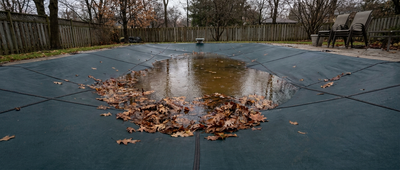
A cover is the simplest way to keep a heavy wave of fall leaves out of the water, especially overnight or when the pool will not be used for a few days.
For pools under large trees, a leaf net can be especially useful during peak drop because the leaves stay on the net instead of soaking in the pool. Once enough collect, you can lift or clear the net rather than fishing wet leaves from the water.
The downside is convenience. If you still use the pool often, covering and uncovering it every day can become another chore. In that case, use the cover when leaf fall is heaviest—such as overnight, before windy weather, or when you will be away—and rely on surface cleaning the rest of the time.
Catch Floating Leaves Before They Sink
A hand skimmer works perfectly well for a few leaves. The frustrating part starts when you have to do it again a few hours later—and then again the next morning.
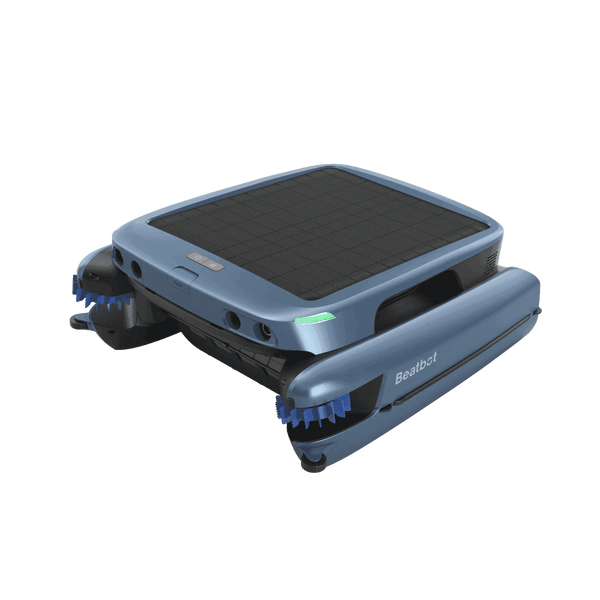
If your pool sits under trees and leaves keep dropping throughout the day, the Beatbot iSkim Ultra can take over much of that repetitive surface cleanup. Its 9L filter basket gives it plenty of room for leaves and other floating debris, while 20 sensors help it navigate around the pool in planned cleaning paths instead of simply drifting with the water. Dual-side brushes also help pull debris away from edges and into the basket.
The iSkim Ultra uses a 24W solar panel together with a 10,000mAh battery, so it can keep working through long stretches of leaf fall without needing to be taken out and recharged after every short cleaning session. On battery power alone, it can run for around 18–20 hours, making it better suited to pools where new leaves keep arriving throughout the day.
This is also how some pool owners deal with fall leaves in practice. In a recent r/pools discussion, a first time pool owner with a large hickory tree asked how to handle the coming leaf season. One of the most upvoted suggestions was to use a solar surface robot to catch leaves before they sink, then let a bottom robot deal with whatever makes it to the floor.
Remove Leaves That Have Already Sunk
Some leaves will still find their way to the bottom—especially after a windy day. Once they get soaked, they tend to settle around the floor, steps, and shallow areas.
Once that happens, wet leaves may collect in the deep end, around steps, on shallow platforms, or across uneven sections of the pool floor. A few scattered leaves can usually be handled with a leaf rake, but when debris is spread across a larger area, an underwater robotic cleaner can save a lot of repetitive work.
For this kind of cleanup, AquaSense 2 Ultra and Sora 70 are suited to two different situations.
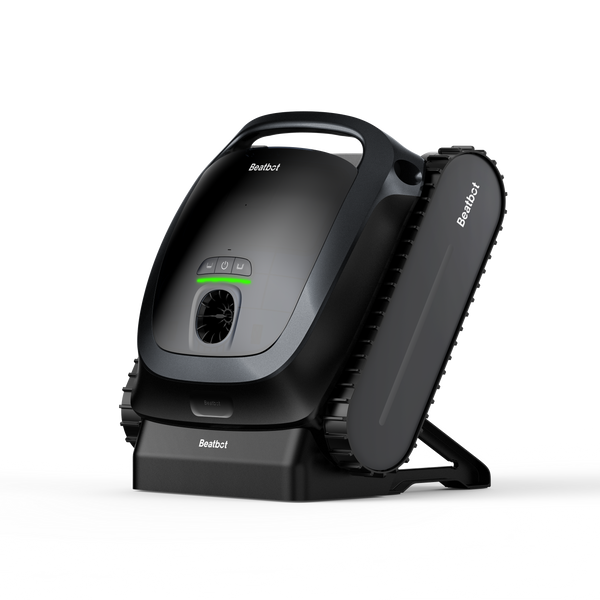
The AquaSense 2 Ultra is the better choice when the challenge is the pool itself. Its HybridSense AI system combines a camera with multiple sensors to understand more complicated layouts, making it particularly suitable for pools with steps, platforms, changing depths, irregular floor shapes, and multiple areas where leaves can collect. AI debris detection also helps it identify heavier debris zones instead of treating every part of the pool floor the same way. It provides 5,500 GPH suction and up to 6 hours of floor cleaning.
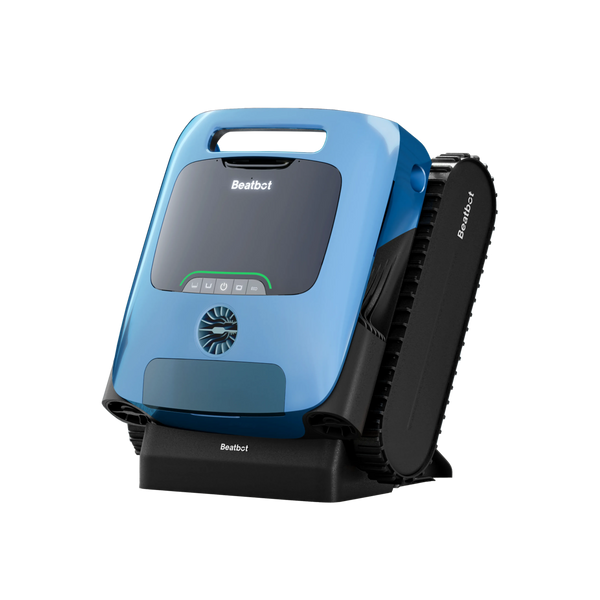
The Sora 70, on the other hand, is the better choice when the challenge is the amount of fall debris. If your pool regularly collects wet leaves, acorns, twigs, and other debris, its 6,800 GPH suction and large 6L debris basket give it more pickup power and more room before the basket needs to be emptied. It also uses SonicSense obstacle avoidance and planned S-shaped cleaning paths, and can clean shallow areas down to about 8 inches, which is useful when leaves pile up on tanning ledges or shallow platforms.
| AquaSense 2 Ultra | Sora 70 | |
|---|---|---|
| Best for | Complex pool bottoms and irregular layouts | Heavy fall leaves and larger debris loads |
| Main advantage | Smarter mapping and debris detection | Stronger suction and larger debris capacity |
| Suction | 5,500 GPH | 6,800 GPH |
| Floor runtime | Up to 6 hours | Up to 5 hours |
| Debris storage | Dual filter baskets | 6L basket |
| Navigation | HybridSense AI + debris detection | SonicSense + S-shaped paths |
| Shallow-area cleaning | Platform detection | Down to about 8 inches |
If the bottom is covered with a thick pile of soaked leaves, remove the bulk with a leaf rake first. Then let the robot handle the scattered leaves and smaller debris left behind.
Don't Let Fall Leaves Overload the Skimmer
Your built-in skimmer is there to pull floating debris from the water before it sinks. During most of the year, it can quietly handle things like insects, small leaves, and other surface debris without much attention.
Fall is different. When leaves start dropping heavily, the skimmer basket can fill much faster than usual. A packed basket can restrict water flow, while smaller leaf fragments may get pulled farther into the circulation system and end up in the pump basket.
During peak leaf season, check the skimmer basket more often and clear large patches of leaves with a net or surface robot before they all get pulled toward the same skimmer opening. After windy weather, it is also worth checking the pump basket for any debris that made it through.
What Should You Do After a Windy Fall Day?
A windy fall night can leave more than a few leaves behind. You may wake up to floating leaves, acorns, and twigs on the surface, a packed skimmer basket, and wet debris already sitting in the deep end or on shallow ledges.
Start with the largest debris first. Pick out branches, larger twigs, and thick clumps of leaves by hand or with a leaf rake so they do not jam the skimmer or fill a robot basket too quickly.
Next, clear the surface while most of the fresh leaves are still floating. Empty the skimmer basket at the same time, and check the pump basket if the skimmer was already packed with debris.
Once the surface is under control, look at the bottom—especially the deep end, steps, corners, and tanning ledges where wet leaves tend to settle.
After that, let a Beatbot smart robotic pool cleaner take care of the rest. It can handle the scattered leaves and leftover debris, helping cut down on repetitive manual cleanup so you can spend that time on something you actually want to do.
Let Beatbot Handle More of the Fall Cleanup
If fall leaves are an everyday problem, you do not have to keep switching between a hand skimmer, leaf rake, and pool vacuum. A surface robot can deal with fresh leaves as they fall, while an underwater robot takes care of whatever makes it to the bottom.
The best setup really depends on your pool.
AquaSense 2 Ultra + iSkim Ultra: Best for More Complex Pools
If your pool has steps, raised platforms, changing depths, or an irregular floor, AquaSense 2 Ultra + iSkim Ultra is the more complete pairing.
The iSkim Ultra stays on the surface, collecting fresh leaves before they have much chance to sink. Its 9L basket is especially useful during fall, when leaves can pile up quickly.
Below the surface, AquaSense 2 Ultra is better at dealing with a more complicated layout. Its HybridSense AI system uses a camera and multiple sensors to understand different areas of the pool and identify where debris has collected. It can also clean platform floors with at least 13.7 inches of water, so leaves sitting on raised areas do not always have to be removed by hand.
This is the combination I would look at when the problem is not just “a lot of leaves,” but a lot of leaves in a pool with plenty of places for them to hide.
AquaSense 2 + iSkim Ultra: Best for Everyday Full Pool Cleaning
For a more straightforward backyard pool, AquaSense 2 + iSkim Ultra gives you a simpler surface-and-underwater setup.
The iSkim Ultra handles the leaves that keep landing on the water, while AquaSense 2 takes care of the floor, walls, and waterline.
This pairing makes sense when your pool does not need the more advanced navigation of AquaSense 2 Ultra, but you still want two robots sharing the daily workload instead of repeatedly skimming the surface and cleaning the bottom yourself.
Sora 30 + iSkim Ultra: Best for Heavy Everyday Leaf Debris
If the pool layout is fairly simple but fall debris is relentless, Sora 30 + iSkim Ultra is probably the more practical combination.
The iSkim Ultra keeps working on the fresh leaves above, while Sora 30 picks up the leaves, acorns, and smaller debris that have already settled underwater. Its 6,800 GPH suction is useful when the bottom gets messy quickly.
Sora 30 also works in water as shallow as 8 inches, as long as the platform is at least 3.3 × 3.3 ft. That can make a real difference if leaves tend to gather on tanning ledges or shallow shelves—areas you might otherwise end up clearing by hand.
Prefer One Robot? AquaSense 2 Ultra or Sora 70
Not everyone wants to manage separate robots for the surface and underwater cleaning. If you prefer one machine to handle more of the pool, AquaSense 2 Ultra and Sora 70 are the two stronger options—but they suit different pools.
Choose the AquaSense 2 Ultra if your pool has a more complicated layout. Its HybridSense AI navigation and debris detection are better suited to pools with steps, platforms, changing depths, and irregular areas where fall leaves tend to collect. It can handle both surface and underwater cleaning, giving you broader coverage without running a separate skimmer.
The Sora 70 makes more sense when the bigger challenge is simply the amount of fall debris. Its 6,800 GPH suction, large 6L debris basket, and ability to clean in water as shallow as 8 inches make it a strong all-in-one option for pools that regularly collect leaves, acorns, twigs, and other seasonal debris.
| Your Pool | Beatbot Setup | Why It Fits |
|---|---|---|
| Complex pool, want full-pool cleaning with one robot | AquaSense 2 Ultra | AI navigation, debris detection, and surface + underwater cleaning |
| Heavy fall leaves, want one robot | Sora 70 | 6,800 GPH suction, 6L basket, and surface + underwater cleaning |
| Complex floor + very heavy surface leaves | AquaSense 2 Ultra + iSkim Ultra | Advanced underwater coverage + dedicated surface cleaning |
| Standard pool with regular fall leaves | AquaSense 2 + iSkim Ultra | Balanced two-robot full-pool setup |
| Heavy everyday leaves and simpler pool layout | Sora 30 + iSkim Ultra | Strong underwater pickup + continuous surface cleaning |
Whichever setup you choose, oversized branches and unusually thick piles of soaked leaves are still worth removing by hand first. After that, let the robots take over the repetitive cleanup instead of spending another morning chasing leaves around the pool.
Conclusion
Fall leaf season can be one of the most frustrating times of the year for pool owners. Just when you finish cleaning the surface, another windy afternoon can bring in more leaves, acorns, and debris from nearby trees.
Beatbot smart robotic pool cleaners could help take care of the repetitive work, from collecting floating debris to cleaning leaves that settle underwater. That means less time spent skimming, scooping, and cleaning the same leaves again—and more time enjoying your backyard during the fall season.
FAQs
How do I keep leaves from filling my pool every day in fall?
You probably cannot stop every leaf from reaching an open pool, especially if large trees are nearby. The easiest approach is to use a cover or leaf net when practical and remove floating leaves before they sink.
Why does my pool skimmer basket fill up so quickly during fall?
Heavy leaf drop can fill the skimmer basket much faster than usual. Check and empty it more often during peak leaf season, especially after windy weather, so water flow does not become restricted.
What is the easiest way to remove leaves from the bottom of a pool?
For a few scattered leaves, use a leaf rake or underwater pool robot. If the bottom is covered with a thick layer of wet leaves, remove the bulk manually first, then let the robot handle the remaining debris.
Should I cover my pool during fall leaf season?
A cover or leaf net can significantly reduce the amount of leaves entering the pool. It is especially useful overnight, during heavy leaf drop, before windy weather, or when the pool will not be used for several days.
Can a robotic pool cleaner handle fall leaves?
Yes. A surface robot can collect floating leaves before they sink, while an underwater robot can pick up leaves that have already settled on the floor. For unusually heavy piles or large branches, remove the biggest debris manually first.