Most Popular


 Sora Series


 AquaSense Series

 Skimmer & Bundle

 Retail Edition


 Accessories


Leveling ground for an above-ground pool means removing soil from high spots so the entire footprint sits within 1 inch of level across the pool's diameter. The surface must be firm, compacted, and slightly larger than the pool itself.
Always dig down to the lowest point rather than filling in low spots with loose soil, which compresses under the water's weight and leaves the pool tilted. A 15-foot round pool holds more than 5,000 gallons, and uneven ground puts unequal pressure on the wall, liner seams, and uprights.

Step 1: Choose the Right Location
Pick a flat, open spot at least 10 feet from the house, property lines, and any septic or leach field, and call 811 before digging to confirm no underground utilities cross the site. The area should get reasonable sun, drain away from the pool rather than toward it, and sit clear of overhanging trees.
Measure the pool's outer diameter and mark a circle at least 2 feet wider than the pool on every side, giving you room to work and shape the edge cleanly. Avoid slopes steeper than a foot of drop across the pool's diameter; anything more requires serious earthmoving or a retaining wall, which is a separate project.
Step 2: Clear the Area Down to Solid Soil
Remove all grass, sod, roots, and surface debris inside your marked circle, and keep digging until you hit firm, undisturbed subsoil. Loose topsoil compresses under load and has to come out. A flat shovel works for small pools; for anything over 15 feet, rent a sod cutter.
Haul the removed sod and organic matter off-site rather than piling it near the edge. Buried grass clippings and roots rot out over time and leave soft pockets that settle under the liner. Rake the cleared area smooth and pick out rocks, sticks, and anything sharp. If the site sits on heavy clay, break up the top inch or two so the next layer bonds to it rather than sitting on a slick surface.

Step 3: Find the Lowest Point and Shave Down High Spots
Identify the lowest point in your cleared circle and bring every other part of the pad down to meet it. Drive a stake in the center, attach a string with a loop that rotates freely, and run a long 2x4 with a spirit level from the stake to the edge. Rotate the board around the full circle and shave down any high spot the bubble flags with a flat shovel or garden rake.
Never fill low spots with loose dirt to bring them up to level. The target is less than 1 inch of variation across the entire diameter, measured after the soil is compacted.
For pools too large for a 2x4 to span, use a line level on a tight string between stakes, or a laser level for the most accurate reading. Mark high spots with spray paint before shaving them down.
Step 4: Compact the Soil
Compact the entire pad firmly before adding any base material. A plate compactor rented from a hardware store does the job in under an hour for most residential pools. A heavy hand tamper works for smaller pools but takes significantly longer.
Lightly mist the soil with a hose before compacting to help the particles bind, but do not soak it into mud. Make several overlapping passes across the full circle until a footprint no longer leaves a mark. Recheck the pad with your 2x4 and level after compacting, since soil settles unevenly during this step.

Step 5: Add a 2-Inch Base Layer of Sand or Stone Dust
Spread a 2-inch layer of masonry sand or stone dust evenly across the compacted soil. This layer smooths out minor imperfections and cushions the vinyl liner against punctures. Stone dust compacts harder than sand and resists shifting better under load, which matters for larger pools.
Rake the base material to a uniform thickness, mist it with water, and compact it again. Run your 2x4 and level across the surface one more time; any dip or crown here will telegraph through to the pool wall and waterline.
Skip fine play sand. It shifts easily, does not hold a compact surface, and migrates out from under the liner as the pool flexes over years of use.
Step 6: Lay a Pool Pad or Liner Barrier
Install a pool floor pad or heavy-duty geotextile barrier over the base layer before setting the pool. The pad absorbs small impacts, adds insulation, and blocks grass, weeds, and small roots from pushing through into the liner over time.
Cut the pad to roughly the pool's diameter, lay it flat with no folds or wrinkles, and tape any seams between sections. Walk the surface one last time to feel for hard lumps or sharp edges. Once the pool wall goes up on this base, correcting anything underneath means draining and starting over.
Tips and Common Mistakes to Avoid
A 24-foot round pool can put over 50,000 pounds of pressure on the pad, so any uncompacted fill will show up as visible tilt within a week. Compact thoroughly; do not try to save time on Step 4.
Check level in multiple directions. A pad can read flat along one line and still crown or dip across the perpendicular axis. Rotate your 2x4 and level through the full circle in overlapping positions, and verify with a line level on a string across the diameter as a second check.
Most yards have a built-in slope for drainage, often more than an inch across a 15-foot span, and it will not be obvious by eye. Measure it; do not eyeball it.
The area directly under the pool must be dead level. Any outward pitch for drainage belongs in the surrounding grade, not under the pool wall.
Once the pad is level and the pool is installed, the layout you just built determines what cleaning equipment fits it. Above ground pools have three structural traits that shape that decision: shallow minimum water depth at the edges, built-in platforms or steps on many newer models, and high walls that make reaching down to grab a cleaner awkward.
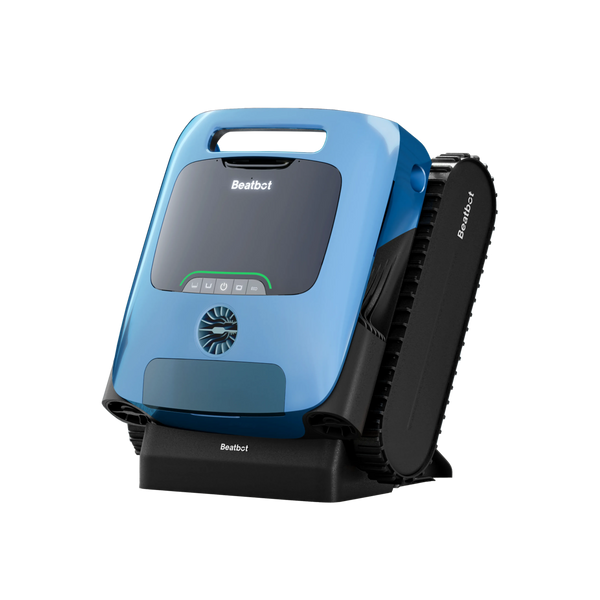
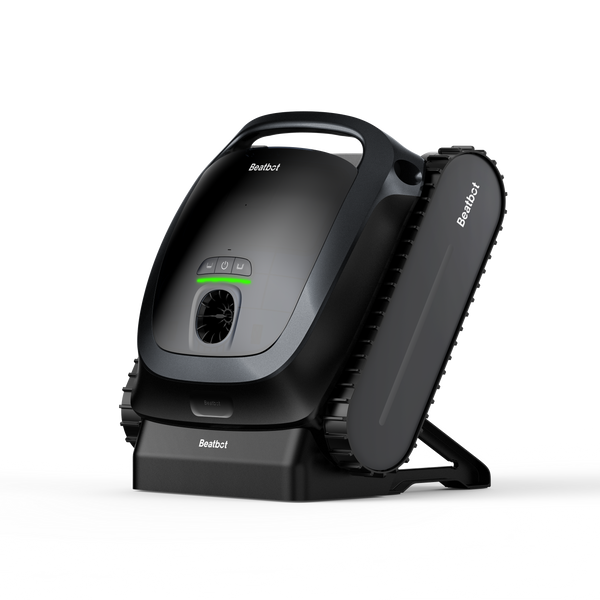
For the third trait, the reach-down problem, the Beatbot Sora 10 robotic pool cleaner uses smart waterline parking to navigate itself to the pool's edge at the end of each cycle and position within 10 minutes for easy pickup, so retrieval does not require hooks or reaching deep into the water. It runs in water as shallow as 13.8 inches, which covers standard above-ground pool depths.
For pools with steps or platform areas, the Beatbot Sora 30 pool cleaning robot operates in water as shallow as 8 inches and actively seeks platforms with a minimum area of 3.3 × 3.3 feet, covering floor, walls, and waterline in one cycle. Its SmartDrain system releases internal water before pickup, so the robot is light enough to lift out with one hand, and a 10,000mAh battery supports up to 5 hours of floor cleaning per charge.
For larger above ground pools that collect floating debris, including autumn leaves, pollen films, and post-storm buildup, the Beatbot Sora 70 cordless pool robot adds JetPulse water surface cleaning to floor, wall, and waterline coverage, running up to 7 hours on surface cleaning alone. Its 6L filter with 150 µm filtration, plus an optional 3 µm fine filter, handles heavy seasonal debris without mid-cycle emptying.
FAQs
How level does the ground need to be for an above-ground pool?
The pad should be within 1 inch of level across the pool's full diameter. Most manufacturers void the warranty on a pool installed on a pad that is more than 2 inches out of level.
Can I put an above-ground pool on slightly sloped ground?
A slight slope is fine as long as you cut down the high side to match the low side rather than building up the low side with fill. Slopes steeper than 1 inch per foot usually require a retaining wall or serious earthwork, which is worth getting a local installer to quote.
What happens if my pool is not perfectly level?
An unlevel pool tilts visibly at the waterline, stresses the wall and uprights unevenly, and stretches the liner at the low end. On larger pools, it can lead to wall failure. Anything over 2 inches across the diameter should be corrected by draining and re-leveling.
How long does it take to level ground for an above-ground pool?
A 15 to 18-foot round pool takes a reasonably fit adult one full day, or half a day with a second person and rented equipment. Larger or sloped sites can take two days. Most of the time is spent clearing sod and compacting, not leveling itself.
Do I need sand under an above-ground pool?
A base layer is strongly recommended, but it does not have to be sand. Stone dust, crushed limestone fines, or a dedicated pool pad all work well, and many installers prefer stone dust because it compacts harder and resists shifting better than sand.