Most Popular


 Sora Series


 AquaSense Series

 Skimmer & Bundle

 Retail Edition


 Accessories


Most above ground pools hold between 3,000 and 25,000 gallons, depending on shape, diameter, and wall height. A 24-foot round pool with a 52-inch wall holds roughly 13,500 to 14,800 gallons, while a 12-foot round pool holds closer to 3,000 to 3,900 gallons. Knowing your exact volume controls how much chlorine, shock, and stabilizer you need, how long the pool takes to heat, and how often the filter should run.

How to Calculate Gallons in Your Above Ground Pool
Pool volume in gallons equals water volume in cubic feet multiplied by 7.48. Average depth means actual water depth, not wall height: above ground pools are typically filled to about 6 inches below the top rail, so a 54-inch wall holds roughly 48 inches of water.
Round Pool Formula
Gallons = 3.14 × radius² × average depth × 7.48
Radius is half the diameter. For a 24-foot round pool with 52-inch walls (water depth ≈ 3.83 ft): 3.14 × 12² × 3.83 × 7.48 ≈ 12,960 gallons. Manufacturer charts often round this to 13,500 because they assume slightly higher fill levels.
Oval Pool Formula
Gallons = length × width × average depth × 5.9
The 5.9 multiplier already accounts for the elliptical shape and the cubic-feet-to-gallons conversion. A 15' × 30' oval with a 52-inch wall and 4-foot water depth holds about 10,620 gallons.
Rectangular Pool Formula
Gallons = length × width × average depth × 7.48
If the bottom is flat, average depth equals actual water depth. If it slopes from a shallow end to a deep end, add the two depths and divide by two.
Above Ground Pool Sizes and Gallon Capacity Charts
These tables show typical capacities at the two most common wall heights, 52 inches and 54 inches, based on real fill levels rather than absolute maximum.
Round Pool Capacity
|
Pool Diameter |
52-inch Wall |
54-inch Wall |
|---|---|---|
|
12 ft |
3,000 gal |
3,400 gal |
|
15 ft |
4,978 gal |
5,310 gal |
|
18 ft |
7,646 gal |
8,156 gal |
|
20 ft |
9,439 gal |
10,066 gal |
|
21 ft |
10,408 gal |
11,096 gal |
|
24 ft |
13,594 gal |
14,492 gal |
|
27 ft |
17,205 gal |
18,341 gal |
|
30 ft |
21,240 gal |
22,643 gal |
Working backward from a target volume: a pool around 10,000 gallons matches a 20- to 21-foot round or a 15' × 30' oval, while a 20,000-gallon pool matches roughly a 30-foot round or a 21' × 43' oval.
Oval Pool Capacity
|
Pool Size |
52-inch Wall |
54-inch Wall |
|---|---|---|
|
12' × 24' |
6,797 gal |
7,247 gal |
|
15' × 30' |
10,620 gal |
11,322 gal |
|
18' × 33' |
14,019 gal |
14,946 gal |
|
18' × 40' |
16,993 gal |
18,118 gal |
|
21' × 43' |
21,328 gal |
22,739 gal |
Rectangular Pool Capacity
|
Pool Size (L × W) |
52-inch Wall |
54-inch Wall |
|---|---|---|
|
10' × 16' |
4,793 gal |
5,116 gal |
|
12' × 24' |
8,629 gal |
9,210 gal |
|
16' × 32' |
15,341 gal |
16,374 gal |
|
18' × 40' |
21,572 gal |
23,025 gal |
Rectangular above ground pools are less common in residential setups but show up often in semi-permanent and resin-frame installations.

Why Gallon Count Affects Pool Maintenance and Cost
Gallon count drives chemical, energy, and equipment costs across the season. Chemical dosing scales linearly: adding 1 ppm of free chlorine to a 5,000-gallon pool takes about 1 ounce of liquid bleach, while a 22,000-gallon pool needs roughly 4.5 ounces. Stabilizer, alkalinity increaser, and calcium hardness adjusters all follow the same scale, so a 20 percent volume error throws every reading off.
Heating is just as sensitive. A 1°F rise on a 22,000-gallon pool requires roughly 184,000 BTUs, almost three times what a 7,500-gallon pool needs.
Cleaning workload also scales with size: a larger pool means more floor and wall surface for debris, longer manual vacuum runs, and more frequent filter emptying. A robotic pool cleaner sized to your gallon range removes that workload entirely.
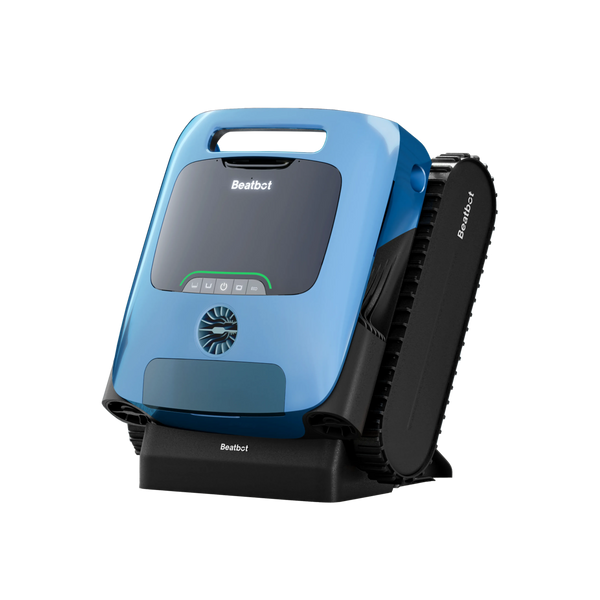
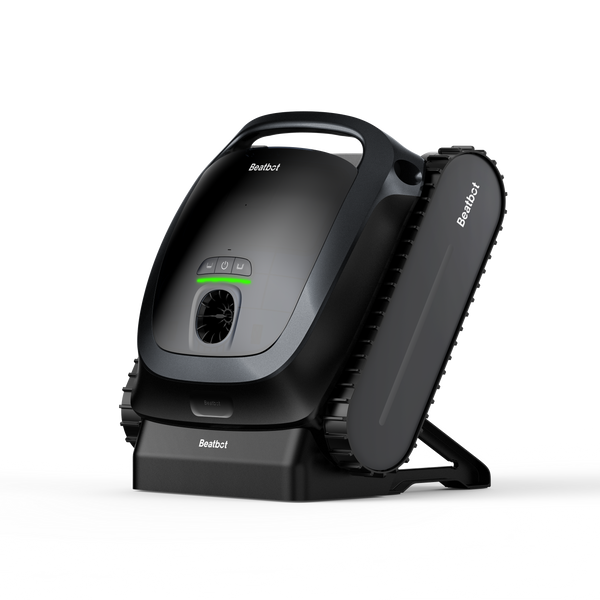
For above ground pools holding 15,000 gallons or more, the Beatbot Sora 70 robotic pool cleaner finishes a full cycle without stopping to recharge or empty mid-run, with up to 5 hours of continuous floor cleaning and a 6L debris basket that absorbs heavy seasonal leaf loads in one pass.
Many above ground pools include built-in entry steps or molded seats that conventional cleaners cannot enter. The Beatbot Sora 30 cordless pool robot operates in water as shallow as 8 inches, actively seeking platforms and shallow areas that other cleaners skip.
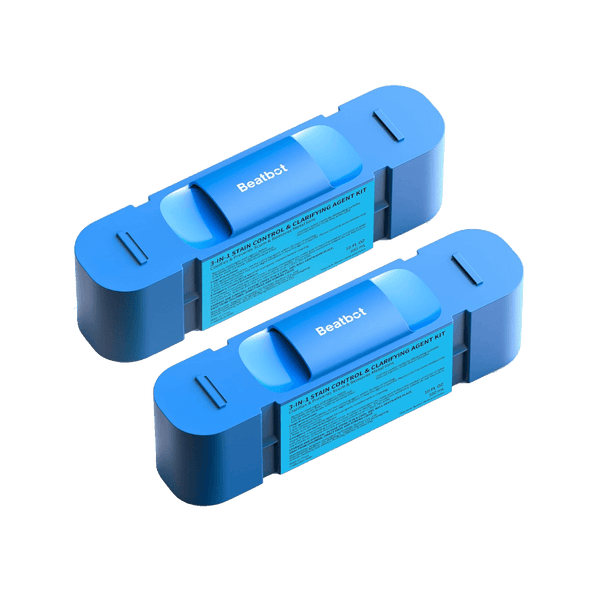
Higher gallon counts also make water clarity harder to maintain through chemistry alone. The Beatbot AquaSense 2 Ultra automated pool cleaner covers pools up to 3,875 sq ft and uses its onboard ClearWater™ system to release a natural, skin-safe clarifier — derived from chitosan in recycled crab shells — that binds dirt, oils, and fine organic particles into clumps the filter can capture, automating the clarifier step on high-volume pools.
What Affects Your Pool's Actual Gallon Count
Actual water depth. A 54-inch wall typically holds 48 inches of water once filled to safe level, and a partially filled pool holds proportionally less. Measure floor-to-waterline before dosing chemicals.
Nominal versus actual diameter. A "24-foot" pool can measure anywhere from 23.5 to 24.5 feet, depending on the manufacturer and how taut the liner sits. On a 52-inch wall pool, that range spans about 1,150 gallons.
Liner type and bottom shape. Pools with a flat bottom hold the calculated volume. Dished or compression-formed bottoms hold 3 to 5 percent more, since the center sits lower than the edges.

FAQs
What is the most accurate way to find my pool's exact gallonage?
Measure actual water depth at three points, average them, and plug the result into the formula for your pool's shape. Direct measurement beats manufacturer charts for partially filled pools or pools with non-flat bottoms.
What size above ground pool holds about 10,000 gallons?
A 20- to 21-foot round pool with 52-inch walls holds close to 10,000 gallons, and a 15' × 30' oval lands in the same range. For a 12' × 24' pool, the rectangular version holds about 8,600 gallons while the oval holds about 6,800.
Does adding salt or stabilizer change the volume?
No. Dissolved chemicals do not meaningfully change volume. A pool dosed to 3,000 ppm salt holds the same gallon count for dosing purposes.
How long does it take to fill a 10,000-gallon above ground pool, and what does it cost?
A standard garden hose flows about 8 to 12 gallons per minute, so 10,000 gallons takes 14 to 21 hours of continuous filling. At typical US municipal water rates around $0.005 to $0.015 per gallon, expect $50 to $150 for a single fill. Water-truck delivery runs $200 to $400 for the same volume but finishes in a few hours.