Most Popular


 Sora Series


 AquaSense Series

 Skimmer & Bundle

 Retail Edition


 Accessories


To protect pool equipment from freezing weather, you have two safe options. Keep water moving through the whole system for the entire freeze, or shut everything down and drain the water out of your pump, filter, heater, and pipes. Freezing water expands, and when it has nowhere to go inside sealed equipment, it splits pump housings, filter tanks, and PVC plumbing. This matters most in normally mild climates, where a hard freeze only shows up once or twice a winter. In regions with long, continuous freezing, closing the pool for the season is the safer route.

What Happens to Pool Equipment When It Freezes?
When water inside your equipment freezes, it expands and pushes outward with enough force to crack whatever contains it. The real risk is standing water that turns to ice inside a pump volute, a filter tank, a heater header, or a length of capped pipe. Once ice forms in a sealed space, the pressure has nowhere to escape, and something breaks.
Water that keeps flowing rarely freezes, which is why circulation is the core of every freeze plan. A pipe with water running through it stays safe long after a still pipe beside it has iced over.
Freeze repairs are expensive. Pumps, filters, and heaters can each run into the hundreds or thousands of dollars, and after a regional freeze the replacement parts get back-ordered fast. Prevention costs far less than sourcing parts and waiting for a technician once the whole neighborhood needs one.
How Do You Prepare Your Pool Before a Freeze?
Before a freeze arrives, balance your water chemistry, hold the water level at the middle of the skimmer, clean or backwash the filter, and remove anything that traps water and can be lifted out. Getting this done early leaves you with a system that circulates freely once the cold arrives.
Aim for standard target ranges before the temperature drops: pH around 7.4 to 7.6, total alkalinity around 80 to 120 ppm, calcium hardness around 200 to 400 ppm, and free chlorine around 2.0 to 4.0 ppm. Balanced water protects your surfaces and equipment through a long stretch of continuous circulation. A clean or freshly backwashed filter matters just as much, since a dirty filter chokes the flow that keeps water moving.
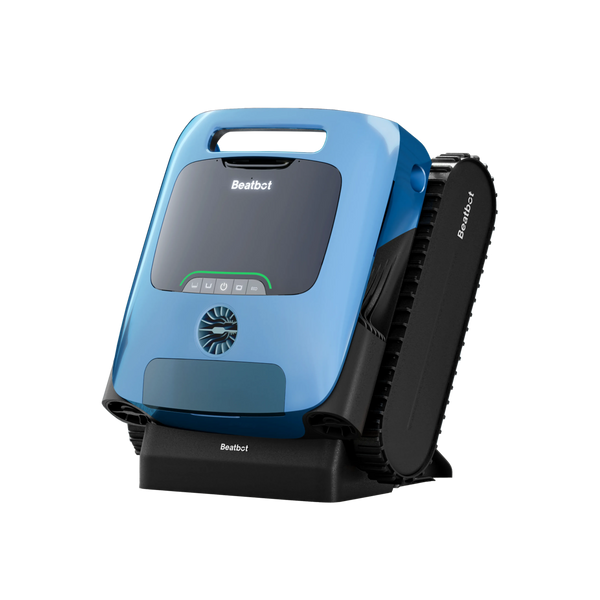
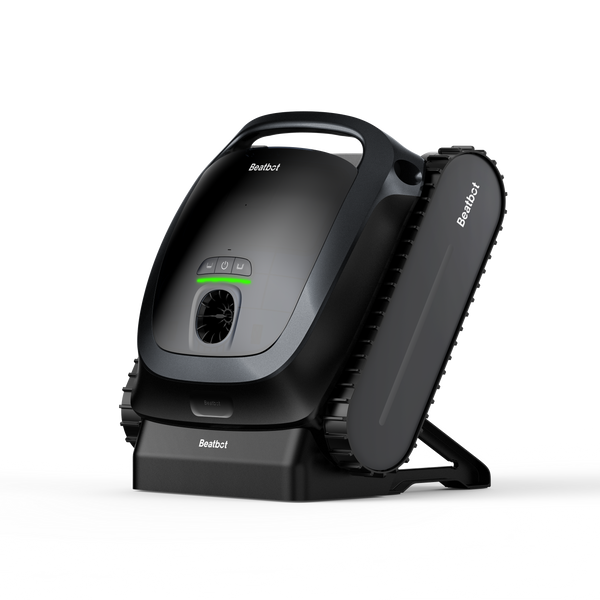
A cordless robotic pool cleaner is one of the easiest pieces to protect, since it sits in the water and connects to nothing on your equipment pad. The Beatbot AquaSense 2 Pro robotic pool cleaner is rated to operate in water down to about 43°F, so a freezing pool falls well outside its working range. Lift it out before the cold arrives, let the water drain from it, and store it somewhere protected within its storage range. The Beatbot AquaSense 2 Pro runs on a battery and charges on a wireless dock, so pulling it out takes a minute and leaves one less thing at the pad to freeze.
Should You Run Your Pool Pump During a Freeze?
Yes. If you have power, the simplest protection is to run your pump continuously through the entire freeze so water never sits still anywhere in the system. Start the pump before the water begins to ice over, and leave it running until the temperature climbs safely back above freezing.
Set a variable-speed pump to a higher speed during the freeze so flow stays strong through every pipe. Turn on every pump you have, including separate pumps for a spa, waterfall, or other water feature, so no line sits still. Open all your valves as well, since a closed valve leaves that pipe without flow and exposed to freezing.

Many modern automation systems include a freeze protection mode that uses an air temperature sensor to kick the pumps on automatically, often around 36°F. Confirm that mode is enabled before the freeze, since it is not always on by default. You usually do not need to run the pool heater, since the continuous flow of water through it is enough to keep its internal pipes from bursting. If you do choose to run the heater, start it before freezing begins and avoid long operation with water below about 50°F.
Running the pump carries one real risk. If the power fails partway through the freeze, water can freeze inside your equipment fast, so be ready to drain everything the moment circulation stops.
What Should You Do if the Power Goes Out During a Freeze?
If the power goes out during a freeze, act fast to get water out of your equipment before it can freeze in place. Standing water in a pump or heater can freeze within hours in a hard freeze, so drain the system as soon as you lose circulation.
-
Turn off the pool equipment breakers so nothing restarts dry when the power flickers back on.
-
Open the air relief valve on top of the filter, then remove the drain plug at the bottom of the filter tank.
-
Take the lid off the pump and pull the pump drain plugs so the basket and housing empty out.
-
Pull the drain plugs on the heater manifold, and on the heat pump too if you have one.
-
Set multiport and Jandy-style valves to a mid position, roughly 45 degrees, so trapped water can move out of the pipes instead of freezing solid.
Store the removed plugs in the pump basket and rest the lid on loosely so nothing gets lost. Once power returns, do not force water through a system that is still frozen. Let the ice thaw first, inspect for cracks, and only then restart. Blasting water against an ice plug is a reliable way to burst a pipe or crack a component.
How Do You Protect the Skimmer, Surface, and Pipes?
Protect the skimmer and surface by giving expanding ice somewhere to go, and protect exposed pipes by insulating them. A single unbroken sheet of ice or a sealed column of water is what causes damage, so the goal is to interrupt that pressure before it builds.
Place a skimmer protection device, such as a Gizzmo or a partially filled, weighted plastic bottle, into the skimmer throat so it absorbs the force of freezing water. On the pool surface, float capped empty jugs or air pillows so any ice pushes against them and spares the tile and walls. Weigh each jug slightly with a little sand or a small rock so it breaks the surface without sinking.

Wrap exposed above-ground pipes, outdoor valves, and the backflow preventer on an auto-fill line with towels, blankets, or pool noodles. Resist the urge to smash apart a full sheet of ice on the pool surface. Standing on an icy deck swinging at ice is dangerous, and the sharp edges can gouge pool surfaces. Never run electric space heaters, heat lamps, or portable gas heaters near the pump and filter, since they create a fire hazard and can melt equipment.

What Should You Check After a Freeze?
After temperatures climb back above freezing, inspect every piece of equipment for cracks before you run the system, because even a hairline split can fail under pressure. Open the filter air relief valve first to release any pressure, then look over the valves, fittings, pump, filter, and heater for visible damage.
Check the poolside too. Tap the waterline tile lightly to listen for loose or cracked pieces, and inspect the skimmer body for splits from ice expansion. When nothing looks damaged, prime the pump carefully with the air relief valve open, stand clear of the filter, and watch for leaks once the system reaches full pressure. If the pump will not prime, or you see water escaping, shut it down and call a pool service professional. Catching a small crack now is far cheaper than running the system and turning it into a flood.
FAQs
Should I drain my pool before a freeze?
No. Draining a pool is one of the worst responses to a freeze. An empty or low pool can shift, float out of the ground, or crack, and the water level itself is not what causes freeze damage. Keep the water at mid-skimmer and put your effort into the equipment.
Can I use a space heater near my pool pump?
No. Electric space heaters, heat lamps, and portable gas heaters near the pump or filter create a fire risk and can melt plastic components. Insulate exposed equipment with towels or blankets, and let moving water do the protecting.
Is pool freeze damage covered by homeowners insurance?
It often is not, since many policies treat freeze damage to outdoor equipment as preventable. Coverage varies by policy and region, so check your specific plan before a freeze so you know where you stand.
At what temperature should I start protecting my pool?
Start before the air temperature reaches 32°F, since air drops below freezing well before the water does. Getting your pump running and your outage plan ready ahead of the cold gives you room to react if the power fails.