Most Popular


 Sora Series


 AquaSense Series

 Skimmer & Bundle

 Retail Edition


 Accessories


Pool care looks more complicated than it actually is. Once you have a system, it's mostly habit. A normal pool cleaning routine for a new owner runs on three tempos: daily quick checks, weekly deeper cleaning, and monthly equipment care.
On a typical week, that means skimming the surface and checking water level most days, testing water chemistry two to three times, brushing the walls and waterline once, vacuuming the floor once, and emptying the skimmer and pump baskets when they fill. Once a month, you rinse or clean the filter, inspect the pump, and shock the pool if needed.
What Does a Daily Pool Cleaning Routine Look Like?
Most days, skim floating debris off the surface, glance at the water level, and check that the water looks clear. It takes five minutes. Skip it for a few days during a heat wave, and you're dealing with a green pool by Friday.
Anything floating will sink within 24 to 48 hours: leaves, pollen, insects, sunscreen residue. Once it's on the floor, it stains, decomposes, and feeds algae. Getting it while it floats is far easier than vacuuming it off the bottom. A pool net on a telescopic pole is all you need, and most owners are done in two to five minutes.
Water level should sit roughly halfway up the skimmer opening. Drop below that, and the pump starts pulling air, loses prime, and can burn out the motor. Rise too high after heavy rain, and the skimmer mouth goes underwater and stops working. Topping off with a garden hose or partially draining takes less than a few minutes either way.
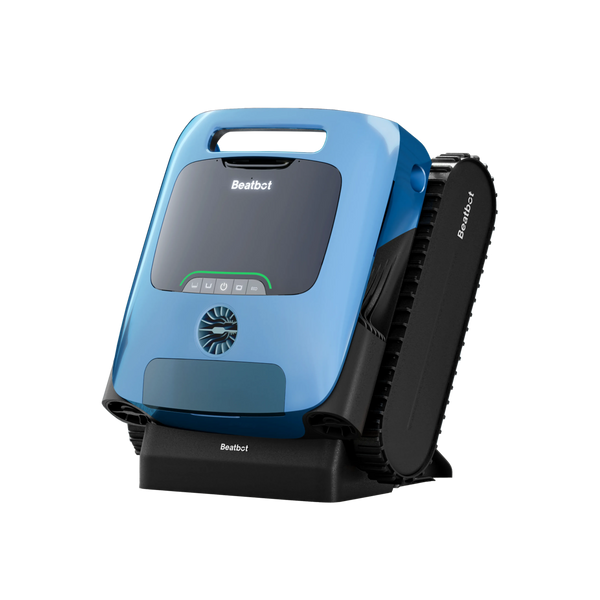
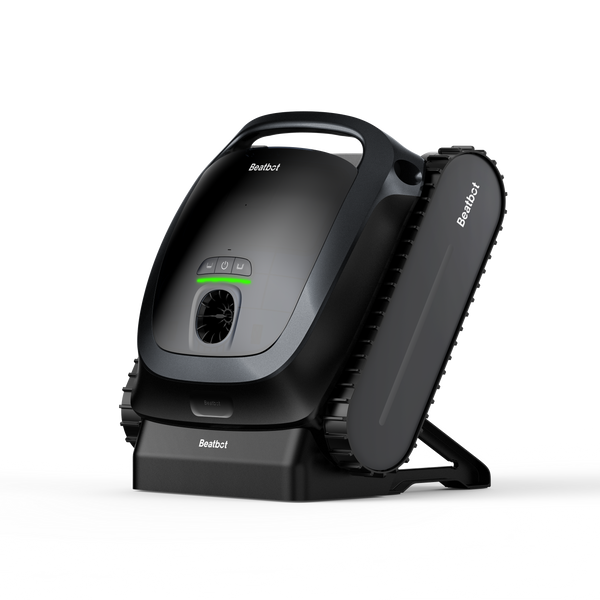
For owners who do not want to skim by hand, a surface-cleaning robot covers this step. The Beatbot Sora 70 robotic pool cleaner uses a JetPulse™ system that pulls floating debris inward with converging water jets, so one pass typically clears leaves and pollen instead of nudging them into the corners.
The Beatbot AquaSense 2 Pro robotic pool cleaner also skims the surface autonomously, with App-controlled navigation if you want to target a specific section of floating debris.

How Often Should You Test and Balance Pool Water?
Test pool water two to three times a week during swim season, and any time something changes the chemistry: a big rainstorm, a pool party, or a stretch of 90-degree days. The CDC and most pool industry sources recommend keeping free chlorine between 1 and 3 ppm and pH between 7.2 and 7.8. The water can look perfectly clear while both numbers are off, which is why testing on a schedule matters.
The three numbers that matter most at the start:
-
Free chlorine (1–3 ppm): kills bacteria and algae. The number most pools chase daily.
-
pH (7.2–7.8): affects how well chlorine works and how comfortable the water feels on skin and eyes. Low pH makes water corrosive; high pH makes chlorine far less effective.
-
Total alkalinity (80–120 ppm): acts as a buffer that keeps pH from swinging. Fix this first before adjusting pH, or your pH readings will keep drifting.
Before any of those numbers mean anything, you need to know your pool's volume in gallons. Your builder records usually have it. If not, length × width × average depth × 7.5 gives a solid estimate for a rectangular pool, or × 5.9 for an oval. Once you have that number, Pool Math, a free app from the TroubleFreePool community, takes your test readings and tells you exactly how much of each chemical to add.
Test strips are fine for a quick daily read; they tell you in 15 seconds if something is clearly off. But for the weekly check that actually drives your chemical additions, use a liquid drop test kit. The Taylor K-2006 and TF-100 are the ones pool owners consistently recommend; both give readings precise enough to dose from.
Most pool stores will also test a water sample for free, which is useful as a second opinion on your own results, just less useful as a shopping guide.
When you do need to adjust, go one chemical at a time. Fix alkalinity first, then pH, then chlorine, in that order, because alkalinity sets the foundation everything else builds on. Add chemicals in the late afternoon or evening so sunlight does not burn off chlorine before it can work, and always pour chemicals into the water, never the other way around.
The actual list of chemicals a chlorine pool needs is a lot shorter than a pool store visit might suggest:
-
Liquid chlorine or chlorine tablets — primary sanitizer
-
Muriatic acid — lowers pH
-
Baking soda — raises alkalinity
-
Cyanuric acid (stabilizer) — added at pool opening to protect chlorine from UV burn-off
-
Calcium chloride — only if your fill water is low in calcium hardness
Everything else on the shelf, specialty clarifiers, weekly "shock plus" blends, enzyme treatments, is a convenience product. You do not need it to have clean water.

What Pool Cleaning Tasks Should You Do Weekly?
Once a week, brush the walls and waterline, vacuum the floor, and empty the skimmer and pump baskets.
Brushing keeps algae from getting a foothold on walls and steps before it becomes visible. The waterline takes the most attention, since that's where sunscreen, body oil, and pollen collect into a greasy ring that gets harder to remove the longer you leave it. A standard pool brush on a telescopic pole handles concrete, plaster, and tile. For vinyl or fiberglass, use a soft-bristle brush, because stainless bristles will scratch the surface.
Vacuuming picks up what brushing knocks loose, along with any silt or sand that settled on the floor. Manual vacuuming with a hose-and-head setup usually takes 20 to 40 minutes for a standard residential pool, longer if you have a lot of debris.
Suction-side and pressure-side cleaners cut the hands-on time but still need to be set up and watched. A cordless robotic pool cleaner drops in and does the job while you do something else.
Skimmer and pump baskets fill up faster than you'd expect, especially in spring during pollen season and fall when leaves are dropping. A clogged skimmer basket cuts circulation, and when water stops moving, chlorine stops distributing. Some areas of the pool end up getting none at all. Check them every couple of days and empty whenever they look halfway full.

Should You Vacuum Your Pool by Hand or Use a Robotic Cleaner?
For most new owners, a cordless robotic pool cleaner is the better call for weekly cleaning. Manual vacuuming is still worth keeping in your toolkit for targeted spot work, cleaning up after a big storm, or getting into stair crevices a robot tends to glide past.
Manual vacuuming gives you the most control over exactly where you clean, but it takes real time, especially in a larger pool. Suction-side and pressure-side cleaners reduce the effort, but they tie into the pool's pump, share its runtime, and still need someone keeping an eye on them.
Cordless robotic cleaners run off their own battery, independent of the pool's pump, so they keep going even when the main system is off. The bigger practical benefit is that they take the physical cleaning off your weekly list entirely, which means you can put that time toward water chemistry, the part that actually needs your attention. Here is how the two Beatbot options compare for a residential pool:
|
Beatbot Sora 70 |
Beatbot AquaSense 2 Pro |
|
|
Pool Coverage |
Up to 3,230 sq ft |
Up to 3,875 sq ft |
|
Floor / Walls / Waterline Runtime |
Up to 4.5 hours |
Up to 5 hours |
|
Surface Cleaning Runtime |
Up to 7 hours |
Up to 11 hours |
|
Shallow Areas |
Yes — down to 8 inches |
No |
|
Water Clarification |
No |
Yes — ClearWater™ |
|
Filter Basket |
6L |
3.7L |
If your pool has a tanning ledge, sun shelf, or beach entry, the Beatbot Sora 70 robotic pool cleaner is the one to look at. Most cleaners can't work shallows below a foot, and it gets down to 8 inches. The Beatbot AquaSense 2 Pro robotic pool cleaner is the better fit for larger pools, and the only one of the two that adds water clarification to the cycle.
Its ClearWater™ system works by binding fine particles into clumps the filter can actually catch, so the water tends to stay noticeably clearer even between chemistry adjustments.
One thing a robot won't fully handle: the waterline. Oil and sunscreen build up there in a way that needs a hand-brush to really break loose. A quick scrub every week or two keeps it from hardening into a stain.
What Maintenance Is Needed Monthly?
Every month, give the filter a proper clean or backwash, do a quick check on the pump and skimmer for wear, and shock the pool if it has been working hard, including after heavy use, a rainstorm, or a stretch where chlorine demand has been creeping up.
Filter care depends on which type you have.
Cartridge filters
Pull out and hose-rinse roughly every four to six weeks during heavy use. Once or twice a season, do a chemical soak in filter cleaner. A rinse alone won't cut the body oils and sunscreen that get embedded in the pleats over time.
Sand filters
Backwash when the pressure gauge reads 8 to 10 psi above its clean baseline. No media replacement needed unless the sand compacts or channels, typically every five to seven years.
DE (diatomaceous earth) filters
Backwash when pressure rises, then recharge with a fresh dose of DE powder. Without the recharge, the filter runs without its filtering medium and loses effectiveness.
If you do not know which filter you have, the pump area should have a label, or your pool builder can tell you.
Shocking the pool means driving free chlorine up to around 10 ppm or higher, enough to wipe out combined chlorine, bacteria, and anything a normal maintenance dose would not touch.
Most owners shock every two to four weeks during heavy season, after a rainstorm, after a pool party, or any time the water looks dull despite good test results. Do it at dusk so sunlight does not burn off the chlorine before it can do its job.
While you are at it, give the pump and skimmer a quick once-over. Listen for any new sounds, squeeze the pump basket lid O-ring to check for cracking, and confirm the pressure gauge is back to its normal range after a filter clean. Small problems caught here are cheap. The same problems found in July when the pump fails are not.
How Should You Adjust the Routine by Season?
Summer takes the most out of a pool. Water above 85°F burns through chlorine faster and gives algae a real foothold, so test three times a week, run the pump 8 to 12 hours a day, and plan to shock more often than you think you need to. Keep cyanuric acid between 30 and 50 ppm. It acts as a sunscreen for chlorine, slowing down how fast UV breaks it down between doses.
Spring and fall bring heavy debris loads. Pollen in spring coats the surface and clogs filters faster than usual. Fall leaves can sink and stain within days if left on the floor. Both seasons benefit from more frequent skimming and filter cleaning.
A robotic cleaner with larger debris capacity reduces mid-cycle basket emptyings: the Beatbot Sora 70 carries a 6L filter basket, the Beatbot AquaSense 2 Pro carries a 3.7L basket, and either is sized to run a full session through peak leaf-fall without stopping.
In winter, northern pools are typically closed: drained to below the skimmer, chemicals balanced for the off-season, equipment winterized, and the pool covered. In southern states like Florida, Arizona, and Southern California, pools stay open year-round at reduced runtime and lower chlorine demand. The brushing and chemistry routine continues, just less often.
Is the Routine Different for a Salt Water Pool?
The physical cleaning routine is identical. A salt water pool still needs skimming, brushing, vacuuming, and filter care on the same schedule as a chlorine pool.
The salt cell generates chlorine, not cleanliness. The chemistry side shifts slightly: check salt level monthly (most systems target 2,700 to 3,400 ppm) and inspect the chlorine generator cell for calcium scale every three months. If it scales up, a 10 to 15 minute soak in diluted muriatic acid usually clears it.
Salt pools do make the chlorine side of maintenance easier. The generator produces a steady, consistent output instead of the peaks and valleys you get from manually adding tablets or liquid, so chlorine and pH tend to stay more stable between tests.
What it does not do is eliminate the need to test and clean. If you are weighing a switch from chlorine to salt, the main things to factor in are the upfront cost of the salt cell and controller, and the fact that the cell itself typically needs replacing every three to seven years.
How Much Time Does a Normal Pool Routine Take?
With a robotic cleaner handling the vacuuming and a test strip kit for quick reads, a weekly routine takes around 30 minutes. Done entirely by hand, with brushing, manual vacuuming, and a full drop-test, plan on 2 to 4 hours a week depending on pool size and how much debris you are dealing with.
The daily check is 5 to 10 minutes. Monthly filter and equipment work runs 30 to 60 minutes. Most people find the routine shrinks as they get familiar with their pool's patterns.
FAQs
Do I need to hire a pool service, or can I really do this myself?
You can handle this yourself. The learning curve is real but short; most new owners feel comfortable within a season. A pool service makes sense if you travel often, manage a rental property, or simply do not want to deal with it. For an owner-occupied home with a standard pool, DIY costs less and keeps you tuned in to what is actually going on with your water.
Can I split the pump runtime into shorter sessions to save on electricity?
Yes. Split the daily runtime into two or three shorter blocks as long as the total still hits 8 to 12 hours in summer. Running during off-peak utility hours is fine, as long as one block falls during the hottest part of the day when algae growth peaks.
Does using a pool cover change the routine?
Yes. A solar or safety cover cuts debris load by 70 to 90 percent and slows chlorine loss from UV, so you can skim less often and stretch testing to twice a week. Weekly brushing and monthly filter care stay the same.
Do I really need to test for cyanuric acid every week?
No. Test cyanuric acid monthly or after adding fresh water. It only drops when you dilute the pool, since the stabilizer does not get consumed the way chlorine does. Levels above 50 ppm start to weaken chlorine's effectiveness.