Most Popular


 Sora Series


 AquaSense Series

 Skimmer & Bundle

 Retail Edition


 Accessories


It depends on the cause. Cloudy pool water from a pH imbalance or a filtration backlog of fine particles after a storm is a nuisance, not a health risk.
Cloudy water from low or absent chlorine, an active algae bloom, or a fecal contamination event is genuinely unsafe and should stop swimming immediately. The color and degree of cloudiness are not reliable guides to which situation you are in. The only way to know is to test the water chemistry and identify the source before making a decision.

What Causes Cloudy Pool Water?
Cloudiness has several distinct causes, and identifying the right one determines the correct fix. Treating for the wrong cause wastes time and chemicals and sometimes makes the underlying problem worse.
Low or absent free chlorine
When free chlorine drops below 1 ppm, the pool loses its primary defense against biological growth. Bacteria, algae spores, and organic matter begin accumulating in the water column faster than the remaining sanitizer can address them.
The result is a milky or dull haze that typically accompanies other warning signs: a faint musty or earthy smell, early algae tinting on walls, or a slippery feel on pool surfaces. This is the most dangerous cause of cloudy water because the same conditions that allow biological haze to develop also allow pathogens to survive at infectious concentrations.
pH out of range
High pH (above 7.8) causes calcium carbonate to precipitate out of solution as microscopic crystals suspended in the water. The result is a white or milky cloudiness that appears even when chlorine is at the correct level.
This type of cloudiness carries no direct health risk from pathogens, but high pH simultaneously reduces chlorine's sanitizing effectiveness, so the two problems often compound each other. Low pH does not typically cause cloudiness but does corrode equipment and irritate skin and eyes.
High calcium hardness or total dissolved solids
Water with calcium hardness above 400 ppm is supersaturated with calcium and prone to precipitation, particularly when temperature rises or pH drifts upward. The cloudiness looks similar to pH-related haze: white or milky, evenly distributed, with no smell.
Total dissolved solids (TDS) above approximately 1,500 ppm (in non-saltwater pools) can also cause a general reduction in water clarity as the cumulative concentration of dissolved material begins to affect light transmission through the water. Neither cause is a direct health risk, but both indicate water that needs chemical correction or partial dilution.
Filtration overload or equipment failure
A filter that is clogged, operating at reduced pressure, or sized too small for the pool volume cannot remove fine particles fast enough to keep the water clear. After a heavy debris event (a windstorm, a large leaf fall, a pool party), the filter can become overwhelmed by particle load even if chemistry is correct.
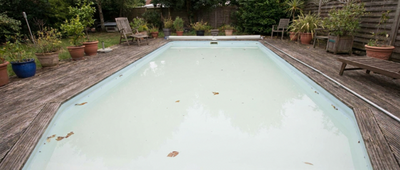
The resulting cloudiness is usually uniform and grey or white rather than green-tinted, and it develops gradually rather than overnight. This type of cloudiness is a maintenance problem, not a chemistry or safety problem, though it does reduce the filter's ability to remove other contaminants if left unaddressed.
Algae bloom
Early-stage algae growth produces a green tint to the water before visible algae appears on the walls or floor. The haze is caused by millions of algae cells suspended in the water column. As the bloom progresses, the water color deepens from slightly hazy to distinctly green and eventually to opaque.
Algae itself is not typically pathogenic, but an active bloom means free chlorine has been substantially depleted, which means the conditions for bacterial growth are also present. Swimming in an active algae bloom is not recommended.
Recent chemical addition
Adding certain chemicals to the pool, particularly calcium chloride to raise hardness or sodium carbonate to raise pH, can temporarily cloud the water as the product distributes and dissolves. This type of cloudiness resolves within a few hours of pump circulation and does not represent a health concern.
It is one of the few cases where cloudy water is entirely benign and self-resolving. If cloudiness appears within a few hours of a chemical addition and the chemistry was in range beforehand, this is the most likely explanation.

When Is Cloudy Pool Water Unsafe to Swim In?
The safety question has a practical threshold: if you cannot see the bottom of the pool at the deepest point, do not swim. This is not an arbitrary rule. It is the standard used by most public pool health codes and the CDC.
At that level of cloudiness, a lifeguard cannot see a submerged swimmer, and a pool owner cannot identify a fecal contamination event or an object on the floor. The visibility requirement exists as much for physical safety as for health reasons.
Below that threshold, the decision depends on the cause. Test the water before making any judgment.
Unsafe: chlorine below 1 ppm
Any degree of cloudiness combined with free chlorine below 1 ppm means the pool is not adequately sanitized. The cloudiness may itself be caused by biological activity that depleted the chlorine, or the chlorine may have dropped for unrelated reasons while the haze has a separate cause. Either way, low chlorine and cloudy water together mean do not swim until both are resolved.
Unsafe: visible green tint
A green tint to the water, regardless of degree, indicates algae growth. Algae growth means chlorine has been insufficient for long enough to allow biological colonization of the water column. The same conditions that allowed the algae bloom likely allowed bacterial growth as well.
Do not swim in green-tinted water. Shock the pool, confirm the algae is dead (water turns grey rather than green), restore chemistry, and allow the water to clear before swimming resumes.
Unsafe: following a known or suspected fecal incident
If a fecal incident occurred in the pool and the water is cloudy, swimming must stop until the incident has been properly treated per CDC protocols and the water has cleared.
Cloudy water following a fecal incident means the filtration and chemistry response has not yet processed the contamination event. Cryptosporidium in particular can survive for days in chlorinated water; a cloudy appearance after a fecal incident indicates the treatment process is still incomplete.
Lower risk but still not recommended: white haze with correct chemistry
White or milky cloudiness in a pool with free chlorine between 1 and 3 ppm and pH between 7.4 and 7.6 is most likely a chemistry or filtration issue rather than a biological one.
The direct health risk from pathogens is lower in this scenario, but the reduced visibility is still a physical safety concern, and the underlying chemistry imbalance (high pH or high calcium) needs correction regardless. Swimming is lower risk than in the scenarios above, but resolving the cloudiness before swimming is the better choice.
How to Clear Cloudy Pool Water
The fix depends on the cause. Applying the wrong treatment extends the problem and adds unnecessary chemical load to the water.
If chlorine is low: shock the pool
Raise free chlorine to shock level (typically 10 ppm or above, depending on the product) to oxidize the organic matter and biological material driving the cloudiness. Use an unstabilized shock (calcium hypochlorite) for most situations. Allow the chlorine to drop back to the 1 to 3 ppm range before swimming, which typically takes 8 to 24 hours with the pump running. Test before re-entry.
If pH is high: lower it before adjusting anything else
Add muriatic acid or sodium bisulfate to bring pH back to the 7.4 to 7.6 range, with the pump running to distribute it. Do not add clarifier or other products until pH is corrected. Adding clarifier to high-pH water is largely ineffective because the calcium precipitation driving the cloudiness continues as long as pH remains elevated. Run the pump continuously after correction and retest in two hours.
If the filter is overloaded: backwash or clean it first
A clogged filter cannot clear the water regardless of what chemistry corrections are made. Backwash a sand or DE filter, or rinse a cartridge filter, before adding any clarifying agents. After cleaning, run the pump continuously for 24 hours and assess whether clarity improves on its own. If the pool remains hazy after 24 hours of clean filtration with correct chemistry, a clarifier dose is appropriate.
If algae is present: shock, brush, and filter in sequence
Shock the pool to kill the algae, brush all surfaces to dislodge algae attached to walls, floor, and waterline, then run the filter continuously to remove the dead algae cells. Dead algae turns grey and settles on the floor or gets captured by the filter. The water will often look worse before it looks better during this process.
A clarifier added after the algae is confirmed dead (chlorine is holding and no green color remains) helps the filter process the fine dead-algae particles faster. Surface brushing is critical here: algae that remains attached to walls and the floor continues releasing cells into the water column even after chlorine has killed the floating population.
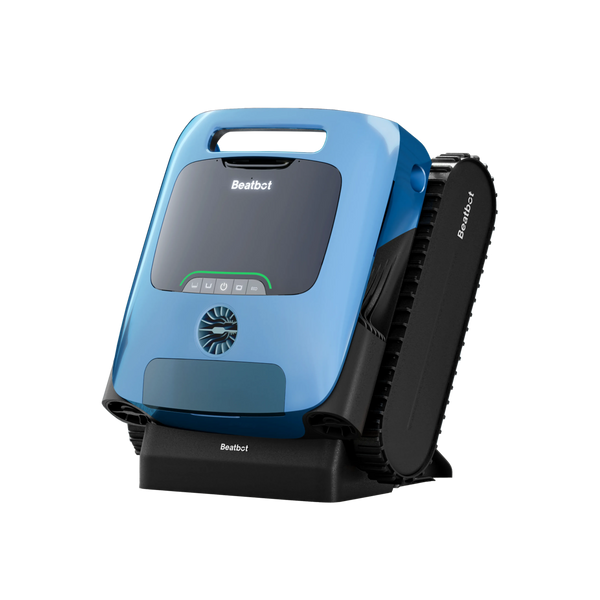
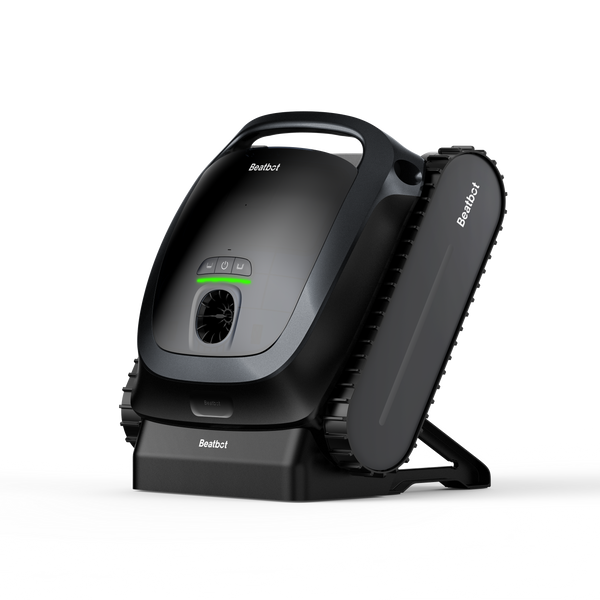
For a pool with significant algae accumulation, running a robotic pool cleaner after the shock treatment accelerates recovery substantially. The Beatbot Sora 70's dual roller brushes dislodge algae from the floor, walls, and waterline in a single automated cycle, and its optional 3-micron ultra-fine filter captures the dead algae cells at a fraction of the size that a standard 150-micron filter basket retains.
This combination removes the physical contamination layer that keeps the water cloudy long after chemistry has been corrected, reducing the recovery window from several days to within a single cleaning cycle.
If the cause is a recent chemical addition: wait and circulate
Run the pump for four to six hours and retest. Chemical-addition cloudiness resolves on its own as the product distributes and the water equilibrates. No additional treatment is needed. If cloudiness does not resolve within six to eight hours of continuous pump operation, the cause is something other than the recent addition and needs investigation.

How to Prevent Cloudy Pool Water
Most episodes of cloudy water are preventable with consistent maintenance rather than reactive treatment. The common thread across nearly all causes is that they develop gradually and become visible only after the underlying condition has been present long enough to accumulate.
Test water chemistry at least twice a week during the swim season. Free chlorine and pH are the two parameters that shift fastest and have the most direct effect on clarity and safety. Catching pH drift before it reaches 7.8 prevents calcium precipitation cloudiness.
Catching chlorine depletion before it drops below 1 ppm prevents biological haze from developing. Testing once a week leaves too large a gap for a pool under regular use.
Clean or backwash the filter on a regular schedule rather than waiting for pressure to build. A filter operating at reduced efficiency allows fine particles to accumulate in the water over days, producing gradual haze that is easy to miss until it becomes noticeable. Check filter pressure weekly and service it before the pressure rise indicates the filter is significantly loaded.
Shock the pool after any event that significantly increases the bather or organic load: large gatherings, heavy rain, windstorms, or sustained periods of very hot weather that accelerate chlorine depletion. Reactive shocking after cloudiness appears is less efficient than proactive shocking that prevents the organic load from building to the point where cloudiness develops.
Physical cleaning of pool surfaces is the maintenance step most often treated as optional but is among the most preventive. Algae spores, biofilm-forming bacteria, and fine organic debris all adhere to pool surfaces and create the reservoir from which water-column contamination originates.
Brushing walls and the waterline weekly and maintaining a consistent robotic cleaning schedule removes that reservoir before it contributes to water quality problems. A robotic pool cleaner running on a scheduled cycle after each period of heavy use maintains the surface cleanliness that water chemistry alone cannot achieve.

FAQs
Can you swim in slightly cloudy pool water?
It depends on the cause and the degree. Slight cloudiness from a recent chemical addition or a minor filtration backlog, with confirmed free chlorine between 1 and 3 ppm and pH between 7.4 and 7.6, presents low direct health risk from pathogens.
Any cloudiness that prevents seeing the pool floor at depth is a physical safety concern regardless of chemistry. And any cloudiness combined with green tint, low chlorine, or a known contamination event means do not swim.
How long does it take for cloudy pool water to clear?
It depends on the cause and the response. High-pH cloudiness typically clears within 24 hours of pH correction and continuous pump operation. Filtration-overload cloudiness clears within 24 to 48 hours after backwashing with continuous circulation.
Algae-related cloudiness after a successful shock treatment can take 2 to 5 days for the dead algae to be fully removed by filtration, though running a robotic pool cleaner and using a clarifier after shocking significantly shortens that window. Chemical-addition cloudiness resolves within a few hours.
Why is my pool cloudy after shocking?
Shocking kills algae and oxidizes organic matter but does not remove the resulting fine particles from the water. Those dead cells and oxidized compounds become the suspended particle load that the filter now has to process, which is why the water often looks worse in the hours immediately following a shock treatment.
Running the pump continuously and using a clarifier 24 to 48 hours after shocking, once chlorine has dropped back into normal range, helps the filter clear the residual haze. If cloudiness persists beyond three to four days after shocking with continuous filtration, test the chemistry again and inspect the filter.
Is cloudy pool water bad for your eyes and skin?
Cloudy water caused by chloramines (combined chlorine) actively irritates eyes and skin and produces the characteristic strong chemical smell that many people associate with over-chlorinated pools.
Paradoxically, that smell and the irritation it causes are signs that free chlorine is too low relative to the organic load, not that it is too high. Cloudy water from pH imbalance or high calcium is less directly irritating but indicates chemistry that is outside the comfortable range for skin and eyes. Any of these causes warrants correction before prolonged swimming.
Does cloudy pool water mean there is algae?
Not necessarily. White or milky cloudiness is more often caused by pH imbalance, high calcium hardness, or filtration overload than by algae. Algae-related cloudiness typically has a green tint, even in early stages.
Greyish cloudiness without any color tint usually points to filtration or chemistry causes rather than biological ones. Test the water before assuming algae is the cause, because the treatments are different and applying an algae-targeted shock to a pool with a pH or filtration problem does not resolve the underlying issue.
Should I run my pool pump continuously when the water is cloudy?
Yes. Continuous pump operation is the baseline requirement for any cloudy water recovery. The filter can only remove particles when water is actively moving through it.
Running the pump for the usual six to eight hours a day while trying to clear cloudy water significantly extends the recovery time compared to running it continuously.
During any active treatment period, whether for chemistry correction, clarifier dosing, or post-shock recovery, run the pump around the clock until clarity is restored.