Most Popular


 Sora Series


 AquaSense Series

 Skimmer & Bundle


 Retail Edition


 Accessories


To clear green pool water with the shock and maintain method: test CYA first and set pH to between 7.2 and 7.5, then raise free chlorine to the SLAM target level (roughly 40 percent of your CYA reading), and hold it there continuously by testing and re-dosing every two to four hours.
Brush the pool daily, run the pump around the clock, and backwash the filter whenever pressure rises 25 percent above baseline. The process is complete only when all three criteria are met at the same time: combined chlorine at or below 0.5 ppm, overnight chlorine loss of 1 ppm or less, and water visibly clear with no algae on any surface. Plan for two to four days minimum.

What to Do Before Starting the Shock and Maintain Process
Three things must be done before raising chlorine: test and record CYA level (it determines your target chlorine level), adjust pH to between 7.2 and 7.5 (the pH test is not reliable at high chlorine concentrations so it must be set before starting), and obtain a FAS-DPD chlorine test kit (standard OTO or DPD strip tests bleach out at the chlorine levels used in this process and give false low readings). Skip any of these and the process either will not work or cannot be confirmed complete.
Test cyanuric acid (CYA) and determine your SLAM chlorine target
CYA level determines how much free chlorine is needed to achieve an effective sanitizing concentration, because cyanuric acid binds with a portion of available chlorine and limits how much is in its active form. The SLAM chlorine target is typically expressed as a ratio: free chlorine should be maintained at approximately 40 percent of the CYA level.
At 30 ppm CYA, the target is 12 ppm free chlorine. At 50 ppm CYA, the target is 20 ppm. At 70 ppm CYA, the target is 28 ppm. If CYA is below 30 ppm, add stabilizer to reach 30 ppm before starting. If CYA is above 70 to 80 ppm, the required chlorine level becomes impractical to maintain, and a partial drain and refill to dilute CYA is necessary before proceeding.
Adjust pH to between 7.2 and 7.5
High pH significantly reduces chlorine effectiveness: at pH 8.0, only about 20 percent of free chlorine is in its active sanitizing form. Setting pH to the lower end of the acceptable range before starting maximizes the killing power of every unit of chlorine added.
Do not test or adjust pH during the SLAM process: the high chlorine concentration makes pH test results unreliable. Set pH first, then start the chlorine treatment and do not revisit pH until the process is complete.
Obtain a FAS-DPD chlorine test kit
Standard pool test strips and OTO test kits are designed for normal chlorine ranges of 1 to 5 ppm. At SLAM chlorine levels of 12 to 28 ppm, these tests bleach out and show a false low or zero reading, making it impossible to confirm whether the correct concentration is being maintained.
A FAS-DPD (ferrous ammonium sulfate with DPD indicator) liquid test kit accurately measures chlorine at high concentrations and is the only test method that reliably measures combined chlorine separately from free chlorine. This test is not optional for completing the process correctly.
Remove visible debris and check the filter
Scoop out leaves and large debris before starting. Large organic matter consumes chlorine rapidly and slows the process. Check that the filter is operating correctly and that you know how to backwash it, because the filter will load heavily with dead algae during the process and will need backwashing whenever pressure rises 25 percent above its clean baseline.
How to Perform the Shock and Maintain Process
Raise free chlorine to the SLAM target level determined by your CYA reading, then test and re-dose every two to four hours throughout the day to hold it there. Run the pump continuously. Brush the entire pool once daily.
Backwash the filter whenever pressure rises by 25 percent. The process continues until all three completion criteria are met simultaneously, which takes at least two days and typically longer for heavier algae loads.

Use liquid chlorine, not tablets or granular shock
Liquid chlorine (sodium hypochlorite, typically 10 to 12.5 percent concentration) is the recommended product for the shock and maintain process. Trichlor tablets add cyanuric acid with every dose, which raises CYA progressively during a multi-day treatment and changes the chlorine target level mid-process. Calcium hypochlorite granular shock raises calcium hardness with each dose.
Liquid chlorine adds only sodium chloride and hypochlorite, with no secondary effects on CYA or calcium hardness. Turn off any automatic chlorinators, salt chlorine generators, or tablet feeders for the duration of the process.
Test and re-dose every two to four hours during daylight
Chlorine at SLAM levels is consumed quickly, particularly in the first day or two when the algae and organic load is highest. Test free chlorine every two to four hours during daylight hours and add liquid chlorine immediately if the level has dropped below the SLAM target.
Do not wait until the next scheduled test time if you add a dose: allow at least two hours between additions to let the chlorine distribute before testing again. Test at sunset and at sunrise to track overnight chlorine consumption, which is the basis for the overnight chlorine loss test used as one of the completion criteria.
Brush the entire pool once daily
Brush the floor, walls, steps, waterline, inside skimmers, under ladder rails, and around any fittings or fixtures every day for the duration of the process. Algae attached to surfaces is significantly more resistant to chlorine than free-floating algae, because the surface provides partial physical shielding from chemical contact.
Brushing dislodges it and exposes it directly to the chlorine in the water. Pools that are shocked without daily brushing take measurably longer to clear and often develop persistent algae spots on walls that survive the chemical treatment.
Run the pump and filter continuously
The pump must run 24 hours a day throughout the entire process. Stopping the pump allows chlorine to stratify and pool in uneven concentrations, which creates zones of under-treatment where algae can survive.
Continuous circulation also ensures the filter is actively removing dead algae cells and organic debris as fast as oxidation produces them. Backwash or clean the filter whenever pressure rises 25 percent above its clean baseline, which may happen multiple times per day during heavy algae treatment.
Track the overnight chlorine loss test (OCLT)
The overnight chlorine loss test measures how much free chlorine the pool consumes between sunset and sunrise when no UV degradation is occurring. Test free chlorine at sunset, add a dose to bring it to SLAM level, then test again at sunrise before the pump has run in sunlight. The difference is the overnight loss.
A loss of more than 1 ppm indicates that biological activity (living algae or bacteria) is still consuming chlorine overnight and the process is not complete. A loss of 1 ppm or less, combined with the other two completion criteria, signals that the process is finished.
How to Know When the Shock and Maintain Process Is Complete
The process is complete only when all three of the following criteria are met at the same time. Meeting one or two but not all three means the process is not finished and swimming should not resume.
Combined chlorine (CC) is 0.5 ppm or lower
Combined chlorine is the portion of total chlorine that has already reacted with organic contaminants and is no longer active as a sanitizer. Elevated CC indicates that oxidation of organic material is still ongoing.
This reading can only be obtained with a FAS-DPD test kit. When CC drops to 0.5 ppm or below, the oxidation demand in the water has been substantially satisfied. This is the chemistry confirmation that the treatment is working as intended.
Overnight chlorine loss is 1 ppm or less
The overnight chlorine loss test, performed between sunset and sunrise as described above, confirms that no significant biological activity remains. Living algae and bacteria consume chlorine even in the absence of UV.
A pool with active biological contamination will consistently show overnight losses above 1 ppm. When loss drops to 1 ppm or below, the biological load has been eliminated to the point where the chlorine demand comes only from normal water chemistry rather than from active organisms.
Water is visibly clear with no algae on surfaces
The water must be clear enough to see the pool floor at the deepest point, with no visible green tint and no algae on walls, floor, or steps. A pool can meet both chemistry criteria before it looks completely clear, because the filter needs time to remove dead algae cells suspended in the water.
If chemistry criteria are met but the water is still slightly hazy, continue running the pump and filtering until clarity improves. Do not stop the SLAM process just because chemistry looks correct if visibility is not yet fully restored.

What to Do After the Shock and Maintain Process Is Complete
Once all three criteria are met, allow free chlorine to drop to the normal maintenance range (1 to 3 ppm) before swimming resumes. Test and rebalance pH, which was not monitored during the process. Then address the physical residue that the chemical treatment leaves behind on pool surfaces.
A completed SLAM leaves dead algae residue on the floor, walls, and waterline even after the water has cleared visually. The filter removes what is suspended but cannot clean what is adhered to surfaces.
Dead algae cells and the organic film they leave on tile and plaster become the seed material for the next bloom if they are not physically removed after treatment. Brushing removes the bulk of it, but a systematic robotic cleaning cycle immediately after the SLAM is the most efficient way to clear the full pool surface in a single pass.
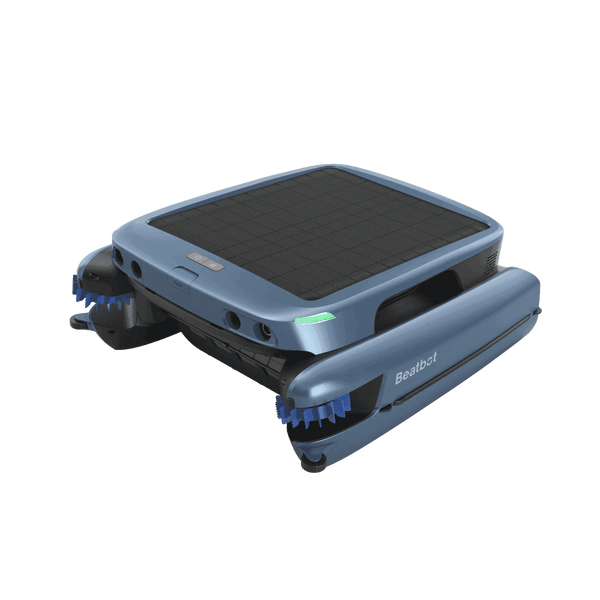
The Beatbot AquaSense 2 Ultra is particularly effective in this post-SLAM window. Its 5-in-1 cleaning system covers the water surface, waterline, walls, and floor in a single automated cycle. The dual-pass waterline cleaning scrubs the waterline tile twice per pass, which is where the heaviest oil and algae residue concentrates after a bloom.
Its ClearWater natural clarification system automatically disperses a skin-safe clarifier during the cleaning cycle that binds any remaining fine dead-algae particles still suspended in the water, allowing the pool's filter to capture them rather than leaving them to settle again on cleaned surfaces.
Running the AquaSense 2 Ultra immediately after SLAM completion removes the physical residue layer that the chemical treatment cannot reach, shortens the window between treatment completion and a fully clean, swimmable pool, and reduces the organic load that would otherwise contribute to the next chemistry imbalance.
After the robotic cleaning cycle, retest full chemistry: free chlorine, pH, alkalinity, CYA, and calcium hardness. Restore any parameters that drifted during the treatment period. Establish a consistent testing and maintenance schedule to prevent the conditions that caused the bloom from recurring.
Why the Shock and Maintain Method Works Where a Single Shock Does Not
A single shock dose raises chlorine to a high level once, then allows it to drop as chlorine is consumed by algae and organic matter. If the chlorine falls below the effective kill concentration before all the biological material has been oxidized, surviving algae and bacteria recover and the bloom continues. The shock and maintain method works because it removes that recovery window entirely by holding chlorine at the kill level continuously until oxidation is confirmed complete.
The chemistry behind it is straightforward. Chlorine kills algae and bacteria through oxidation, breaking down their cellular structures. The rate of oxidation depends on both the chlorine concentration and the contact time.
At standard maintenance levels of 1 to 3 ppm, chlorine inactivates most organisms on contact but cannot sustain the oxidation rate required to overcome a heavy algae or bacterial load before the chlorine is consumed. At SLAM levels (typically 12 to 28 ppm depending on CYA), the oxidation rate is fast enough that even a substantial biological load is eliminated before the chlorine drops below the effective threshold, provided it is re-dosed promptly when levels begin to fall.
The three completion criteria exist because visual clarity and chemistry readings do not always correlate exactly. A pool can look clear while still having elevated combined chlorine from incomplete oxidation of dissolved organic material, or while still losing chlorine overnight to surviving biological activity that is below the level visible to the eye. Requiring all three criteria simultaneously ensures that the pool is clear, sanitized, and chemically stable before it is returned to use.
Common Mistakes That Cause the Shock and Maintain Process to Fail
Stopping when the water looks clear
Visual clarity is reached before chemistry criteria are met in almost every SLAM. Dead algae cells can still be present, combined chlorine can still be elevated, and overnight chlorine loss can still be high even when the water appears clear to the eye.
Stopping the process at the visual clarity stage and allowing chlorine to drop typically results in a renewed bloom within three to seven days as surviving organisms that were below the visible threshold recover.
Not testing frequently enough and letting chlorine drop below SLAM level
Chlorine at SLAM levels is consumed quickly, especially in the first 24 to 48 hours when the biological and organic load is highest. Allowing chlorine to drop below the SLAM target, even for a few hours, gives surviving algae and bacteria a window to recover. Test every two to four hours during daylight and re-dose immediately when levels drop. The faster chlorine is replaced when it falls, the shorter the overall process.
Using stabilized chlorine products instead of liquid chlorine
Adding trichlor tablets or dichlor shock during a multi-day SLAM progressively raises CYA, which raises the required SLAM chlorine target at the same time.
By day three of a SLAM using stabilized products, the CYA may have risen enough to require a significantly higher chlorine concentration than the one the process started with. Using liquid chlorine exclusively for the duration of the process keeps CYA stable and the target level constant.
Skipping the FAS-DPD test and relying on strips
At SLAM chlorine concentrations, standard test strips bleach out and read low or zero, making it impossible to tell whether chlorine is actually at the required level or has dropped significantly. Treating a pool that is already at SLAM level as if it is at zero and adding more chlorine is wasteful and can push chlorine high enough to damage equipment. Using the wrong test method is the most reliable way to either undertreat or overtreat during the process.
Not brushing daily
Algae adhered to pool surfaces has physical protection from chlorine contact that free-floating algae does not. A pool that is shocked but not brushed will clear the water column while leaving surface algae colonies intact, which continue releasing cells into the water after chlorine drops to normal maintenance levels. Daily brushing throughout the SLAM process is not optional.

FAQs
How long does the shock and maintain process take?
Most residential pools with moderate algae blooms take two to four days. Heavily green or opaque pools with dense algae and high organic loads can take five to seven days or longer.
The duration depends on the severity of the bloom, CYA level, how consistently chlorine is maintained at SLAM level, and how frequently the pool is brushed. There is no reliable way to predict the exact duration in advance. The process ends when all three completion criteria are met, regardless of how many days that takes.
Can I swim during the shock and maintain process?
Swimming is technically possible if you can see the pool floor clearly. At SLAM chlorine levels, the water is over-sanitized rather than under-sanitized, and the chlorine concentration itself is not a health risk at SLAM levels.
However, the combination of very high chlorine and elevated combined chlorine from active oxidation can irritate eyes and skin. Most pool owners choose to keep the pool closed until the process is complete and chlorine has dropped back to normal range.
Why is my pool still green after two days of shocking?
The most common causes are: CYA is higher than tested and the actual SLAM target is higher than the chlorine being maintained, chlorine is dropping below SLAM level between doses and not being caught by infrequent testing, the filter is not backwashed frequently enough and is not removing dead algae efficiently, or the pool is not being brushed daily and surface algae is repopulating the water.
Check CYA with a fresh test, test chlorine more frequently, backwash the filter, and brush thoroughly before assuming the process itself is not working.
What is the difference between shocking a pool and the shock and maintain method?
A standard shock raises chlorine to a high level once and allows it to drop naturally. It is effective for breaking down chloramine compounds and minor organic loads but does not sustain the kill concentration long enough to eliminate a significant algae bloom.
The shock and maintain method holds chlorine at the kill level continuously through repeated dosing until testing confirms the process is complete. The key difference is continuous maintenance of the elevated level versus a single large dose.
Do I need to drain my pool to clear green water?
No, in almost all cases. Draining a pool is not necessary to clear algae and carries risks including hydrostatic pressure damage to the shell in high water table areas, and the refill introduces fresh water that still needs to be chemically balanced.
The shock and maintain process clears green water without draining by oxidizing the biological contamination in place. Partial draining may be necessary before the process only if CYA is above 70 to 80 ppm and cannot be reduced chemically.