Most Popular


 Sora Series


 AquaSense Series

 Skimmer & Bundle

 Retail Edition


 Accessories


Concrete and plaster pools need regular cleaning, especially when fine debris settles into textured surfaces or dirt builds up along walls, steps, and ledges. A cordless robotic pool cleaner can handle much of this routine work by scrubbing surfaces, vacuuming debris, and cleaning areas that would otherwise require frequent manual brushing. For pool owners, Beatbot can reduce the time spent on everyday pool maintenance.
Can a Robotic Pool Cleaner Pick Up Fine Dust and Silt?
Yes. Fine dust and silt tend to settle on the floor of concrete and plaster pools, and a robotic cleaner can pick up a good amount of it as it moves across the surface. The brushes loosen the sediment, while the pump pulls it into the onboard filter basket.
The filter is what determines whether that fine debris actually stays there. Most standard baskets are designed for everyday debris such as leaves, insects, and larger grains of sand, typically filtering somewhere around 100 to 200 microns. Finer material, including plaster dust, pollen, silt, and dead algae, can slip through a coarser basket and settle back onto the floor.
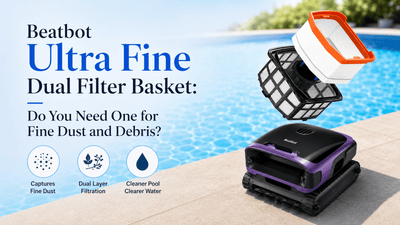
Beatbot’s Sora series uses 150 micron filtration for routine cleaning, and the Sora 70, Sora 30, and Sora 10 can all be fitted with an Ultra Fine Dual Filter Basket. It pairs a 400 micron outer basket with a 3 micron inner nonwoven filter, which is much better suited to the kind of fine sediment that tends to collect in concrete and plaster pools.
If the pool has both leaves and fine dust, clear the larger debris first, then switch to the ultra fine basket for the remaining sediment. That keeps the finer filter from loading up too quickly and usually gives better results on the pool floor.

Will a Robot Just Stir Up Fine Dirt Instead of Removing It?
It’s possible, especially when the debris is extremely light. Fine silt, plaster dust, pollen, and dead algae can lift off the pool floor as soon as the robot’s brushes or water flow disturb them. If those particles stay suspended instead of reaching the intake, some may settle back after the cleaning cycle ends.
The floor looks cleaner after a robot runs, but the water turns cloudy, and a thin layer of dust reappears once the particles settle again. This is especially common with debris that is so fine it forms a visible cloud when brushed.
Beatbot's ultra fine filter can retain smaller particles once they enter the cleaner, but it also loads up faster than a standard basket. Beatbot recommends a two stage approach: use the standard basket first to remove leaves, insects, and larger debris, then switch to the ultra fine basket for the fine dust and sediment that remain. This keeps the finer filter from clogging too quickly and helps maintain stronger water flow during the second pass.
Can a Robotic Pool Cleaner Remove Algae Dust From a Concrete or Plaster Pool?
A robotic pool cleaner can help remove settled algae residue from the floor and walls of a concrete or plaster pool, but it is not a replacement for proper water treatment. The robot’s brushes loosen the residue from the surface, while the filter basket collects the debris during the cleaning cycle.
For plaster pools, this can be especially useful because algae residue can attach to the textured surface and become difficult to remove with circulation alone. A cleaner with active brushing and fine filtration can help pick up the remaining particles after they have been loosened from the pool surface.
However, a robotic cleaner does not eliminate the cause of algae growth. If algae continues to appear, the underlying issues are usually related to water chemistry, circulation, or filtration. The robot is most effective as part of regular pool maintenance, helping remove the physical debris while proper water care prevents it from returning.

Can a Robotic Pool Cleaner Climb Rough Concrete and Plaster Walls?
Yes. A robotic pool cleaner can climb concrete and plaster walls by combining water flow, traction, and active brushing. The pump helps keep the cleaner close to the pool surface, while the drive system and brushes provide the grip needed to move vertically and scrub away dirt and algae buildup.
Suction power plays an important role in moving water and debris through the cleaner, but it is only one part of wall climbing performance. Unlike a household vacuum, a pool robot’s suction rating measures water flow through the cleaning system rather than a simple pulling force. Traction is equally important because the robot needs its wheels, tracks, and brushes to maintain contact with the pool surface, especially on textured finishes such as plaster and concrete.
Beatbot robotic pool cleaners are designed for full pool coverage, including floors, walls, and waterlines. The AquaSense series combines wall climbing, active brushing, and filtration, with the AquaSense 2 delivering 5,500 GPH suction power to help move water and debris through the cleaning system. The Sora series is also built for full pool cleaning, with the Sora 70, Sora 30, and Sora 10 delivering up to 6,800 GPH suction power to support debris collection while cleaning different pool surfaces.
For concrete and plaster pools, this combination of wall climbing ability, brushing action, and filtration can reduce the need for frequent manual brushing. While steps, sharp corners, and unique pool features may still require occasional attention, a capable robotic cleaner can handle much of the routine wall and waterline maintenance automatically.
Will You Still Need to Brush Concrete and Plaster Pool Walls After Using a Robot?
A robotic pool cleaner can significantly reduce how often you need to brush concrete and plaster pool walls, but it will not completely replace manual cleaning in every situation.
The textured surfaces found on many concrete and plaster pools can collect dirt, pollen, and algae residue along walls and waterlines. A robotic cleaner with wall climbing and active brushing can regularly scrub these areas, helping prevent buildup before it becomes a larger cleaning task.
However, some parts of a concrete or plaster pool are still difficult for any robot to reach. Steps, tight corners, benches, and irregular surfaces can limit coverage because the cleaner follows the shape and layout of the pool. These areas may still require occasional manual brushing.
For concrete and plaster pool owners, the main benefit of a robotic cleaner is reducing repetitive maintenance rather than removing every cleaning task. Regular robotic cleaning can help keep floors, walls, and waterline areas cleaner while reducing the time spent on manual brushing and vacuuming.

Can a Robotic Pool Cleaner Clean Steps, Corners, and Ledges in Concrete Pools?
Robotic pool cleaners can handle many areas of a concrete or plaster pool, but steps, corners, and shallow ledges are still some of the most challenging areas to reach. This is why some pool owners find that a robot that performs well on open floor areas may struggle around steps, tight corners, or sudden changes in depth.
These limitations are usually related to the pool’s design rather than the cleaner itself. Built-in steps, tanning ledges, benches, and shallow shelves can interrupt the robot’s normal cleaning path, making it harder to maintain consistent contact with the surface.
Beatbot’s Sora series is designed to address these challenging areas with shallow water cleaning capability. The Sora 70, Sora 30, and Sora 10 can continue cleaning in shallow areas, helping cover sections of concrete and plaster pools that many robotic cleaners may not reach effectively. This is especially useful for pools with sun shelves, built-in seating, or gradual transitions between different depths.
While no robotic cleaner can guarantee perfect coverage in every pool design, the ability to clean shallow areas can reduce the amount of manual brushing needed around steps, ledges, and other areas that are difficult to clean manually.
Can a Robotic Pool Cleaner Damage a Plaster Pool?
In most cases, a robotic cleaner with rubber brushes and tracks should not damage a properly cured plaster finish during normal operation.
When pool owners notice marks or changes after running a robot, the cause is not always the cleaner itself. Dirt trapped in the brushes or tracks, worn components, an aging plaster surface, or existing surface issues can all contribute to visible marks.
New plaster pools require more caution. Fresh plaster goes through a curing and startup process, and many pool professionals recommend waiting until the surface has properly cured before using a robotic cleaner. The exact timing depends on the plaster finish and the instructions from the pool builder.
For established concrete and plaster pools, a robotic cleaner can help maintain the surface by removing debris and reducing manual brushing without adding unnecessary wear when used correctly.
How Much Manual Cleaning Can a Robotic Pool Cleaner Replace?
A robotic pool cleaner can significantly reduce the amount of manual cleaning required for a concrete or plaster pool, but it is not designed to replace every part of pool maintenance.
For many pool owners, the biggest time savings come from repetitive tasks such as removing settled debris from the floor, brushing large wall areas, and cleaning along the waterline. By running a robot regularly, these tasks can be handled automatically instead of waiting until dirt and algae buildup become noticeable.
However, a robotic cleaner does not replace water testing, chemical balancing, filter maintenance, or occasional cleaning of areas that are difficult for the robot to reach. Steps, corners, and unusual pool features may still require some manual attention depending on the pool design.
How Often Should You Run a Robotic Pool Cleaner in a Concrete or Plaster Pool?
For most concrete and plaster pools, running a robotic cleaner 2 to 3 times per week is a practical starting point for routine maintenance. If the pool collects a lot of dust, pollen, leaves, or algae residue, increasing that to 4 to 5 times per week can help prevent debris from settling and building up on the floor and walls.
After a storm, heavy wind, or a period of high pollen, it can also be useful to run an extra cleaning cycle rather than wait for the next scheduled session. Pools with very little surrounding debris may need less frequent cleaning, but concrete and plaster surfaces generally benefit from regular cleaning before dirt becomes more difficult to remove.
If you are using an ultra fine filter for silt, plaster dust, or algae residue, check the basket more often. Fine debris can load the filter quickly and reduce water flow, so cleaning the basket between cycles may be necessary when the pool is especially dirty.
Can a Robotic Pool Cleaner Handle a Large Concrete or Plaster Pool?
Yes, but the practical limit depends on the robot’s rated coverage and runtime. Most Beatbot cordless robotic pool cleaners are designed for large residential pools. For example, the AquaSense 2 is rated for pool bottom areas up to 3,230 sq ft (300 m²) on a single charge, while the Sora 70 is also rated for up to about 3,230 sq ft (300 m²), with up to 5 hours of floor cleaning. The AquaSense 2 Ultra goes even further, with coverage up to about 3,875 sq ft (360 m²).
For most residential concrete and plaster pools, that is more than enough coverage. The bigger issue is often not the pool size itself, but how much debris enters the water. A large pool surrounded by trees may collect leaves, pollen, seeds, and flowers faster than one underwater robot can deal with them, especially because much of that debris starts on the surface before it sinks.
In that situation, a bundle can make more sense. Beatbot pairs an underwater robotic cleaner with a dedicated surface skimmer so the two machines can work at the same time: the cleaner handles the floor, walls, and waterline, while the skimmer continuously collects floating leaves and other surface debris. Beatbot specifically recommends this type of setup for tree lined pools and other high debris environments.
Final Thoughts
Concrete and plaster pools need regular cleaning across the floor, walls, waterline, and shallow areas. A cordless robotic pool cleaner can take over much of that routine work, especially when it combines strong suction, fine filtration, wall climbing, and shallow water cleaning.
Beatbot’s robotic pool cleaners are built around those needs, helping reduce manual vacuuming and brushing while keeping more of the pool covered during each cleaning cycle.
FAQs
Do robotic pool cleaners really clean corners and steps in concrete pools?
Not always. Most robotic cleaners do well on open floors and walls, but tight corners, edges, and some steps can still be difficult to cover. Brushing debris from those areas toward the main floor can make it easier for the robot to collect.
Do I still need to brush a plaster pool if I use a robot?
Usually, yes, but much less often. A wall climbing robot can handle much of the routine cleaning on plaster walls and waterlines, while corners, steps, and occasional buildup may still need manual brushing.
Should I use an ultra fine filter for dirt in a plaster pool?
Yes, if the main problem is fine sediment rather than leaves or larger debris. An ultra fine filter can capture smaller particles such as silt, plaster dust, pollen, and algae residue that may pass through a standard basket.
How long should I wait before using a robot in a newly plastered pool?
There is no single waiting period that applies to every plaster finish. Some installers recommend waiting about a week, while others recommend closer to 30 days. The safest approach is to follow the startup instructions from your pool builder or plaster manufacturer.
Can a robotic pool cleaner handle a plaster pool surrounded by trees?
Yes, but heavy leaf loads can make cleaning more demanding. A robotic cleaner can handle debris that reaches the floor, while a separate surface skimmer can collect leaves, pollen, and other debris before they sink. For pools surrounded by trees, using both can provide more complete coverage.