Most Popular


 Sora Series


 AquaSense Series

 Skimmer & Bundle

 Retail Edition


 Accessories


Pool steps collect debris, algae, and oils just like the floor and walls do, but most robotic pool cleaners are not designed to clean them. Some can, most cannot, and the difference comes down to specific hardware, not the number of cleaning zones a robot advertises.
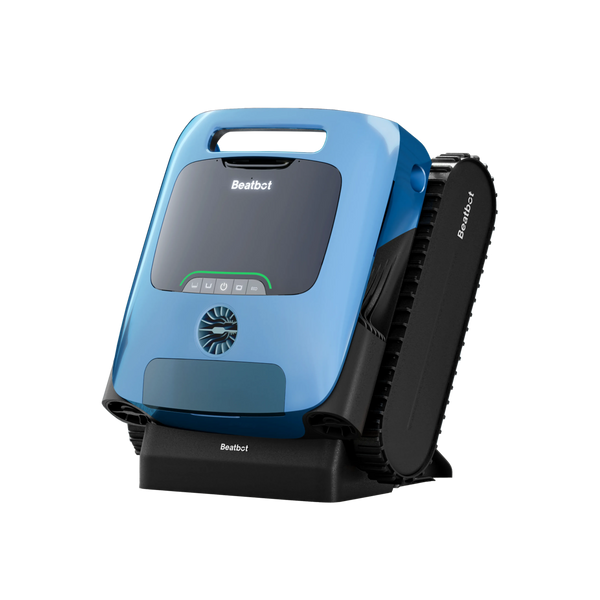
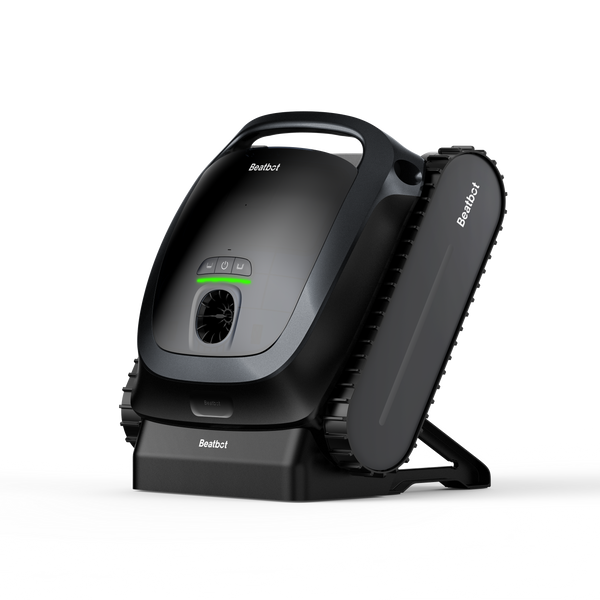
A newer generation of robotic pool cleaners with downward-facing ultrasonic sensors has started to close this gap: the Beatbot Sora 70 cleans platforms and steps in water as shallow as 8 inches, and the Beatbot AquaSense 2 Ultra detects and cleans elevated platforms autonomously.
Why Most Robotic Pool Cleaners Cannot Clean Pool Steps
The fundamental problem is geometry. Pool steps form raised horizontal platforms that standard robots cannot detect or navigate onto. A robot designed for a flat pool bottom assumes a continuous surface, and steps break that assumption.
Standard robots detect walls and change direction, but they carry no sensors that measure floor elevation changes. When a robot reaches the base of a step, it treats it like a wall: it redirects and moves on. The step surface itself goes untouched, leaving algae-prone surfaces in the shallow end without automated coverage.
Suction is the second limitation. A robotic pool cleaner draws water in from the bottom to grip the surface it is cleaning. On a step covered by only a few inches of water, the water column above the robot is too thin to maintain that grip.
The robot loses suction, loses traction, and can slide or flip backward off the step into deeper water. This is why shallow steps and tanning ledges defeat most cleaners even when the robot physically reaches them.
Why Pool Steps Collect Algae and Debris
Shallow water means more sunlight reaches the step surface, which accelerates algae growth. Body oils, sunscreen, and lotions concentrate at the waterline and on the first submerged step. Water circulation is also weaker in shallow areas, so fine debris and sand settle there instead of moving toward the skimmer. Most automatic cleaners skip these zones entirely, leaving debris to accumulate between manual sessions.
When a robot cannot reach the steps, brushing at least once per week is the standard recommendation, with twice weekly more effective during peak season. A robot that does clean steps brings those surfaces onto the same automated schedule as the rest of the pool.
How Robots Detect and Climb Pool Steps
Step cleaning requires two things: sensors that detect platform height changes, and a design capable of climbing onto elevated surfaces.
Dual ultrasonic sensors are the enabling technology. One sensor faces forward for obstacle detection; the other faces downward to measure the surface below the robot. When the bottom sensor detects a step edge or elevation change, the robot recognizes a platform and can calculate whether climbing is possible. Without both sensors, a robot has no way to distinguish a wall from a step.
The robot also needs sufficient traction and suction to climb onto a step without slipping, plus edge-detection to prevent itself from falling off a narrow ledge.
Depth sets the hard limit on what any of this can reach. Robots with platform cleaning capability typically require a minimum water depth of around 8 inches to stay buoyant and maintain suction contact.
Below that threshold, automated cleaning is not possible. Tanning ledges, beach entries, and baja shelves that sit shallower than a robot's published minimum are outside its range regardless of its other capabilities.

How the Beatbot Sora 70 Handles Steps and Shallow Areas
The Beatbot Sora 70 robotic pool cleaner addresses step cleaning through its SonicSense™ Obstacle Avoidance system, which uses dual ultrasonic sensors.
The front sensor handles obstacle detection and edge cleaning precision; the bottom sensor reads platform heights and slope angles, enabling the robot to identify step transitions and navigate onto them. The same sensing also lets the robot recognize and free itself from obstacles like drains and ladders without getting stuck.
The Sora 70 cleans platforms and steps in water deeper than 8 inches, provided the step measures at least 3.3 ft x 3.3 ft (1 m x 1 m). That covers standard entry steps, swim-out platforms, and tanning ledges in most residential pools.
Once on a platform, the robot follows an AI-planned S-shaped path rather than moving randomly, so coverage is systematic rather than dependent on repeated passes. Step and platform cleaning runs as part of the Standard and Pro cleaning modes, so no separate setup is required.
The Sora 70 is the more accessible choice for pools with standard entry steps or single-level tanning ledges, where the priority is reliable shallow-area coverage without a complex configuration.
How the Beatbot AquaSense 2 Ultra Handles Pool Platforms
The Beatbot AquaSense 2 Ultra robotic pool cleaner uses a more advanced sensor array for platform cleaning. Its HybridSense™ Pool Mapping system combines an AI camera, infrared sensors, and ultrasonic sensors to map the entire pool, including elevated platforms, before and during the cleaning cycle.
For platform floor cleaning, the AquaSense 2 Ultra requires a minimum water depth of 13.7 inches on the platform, and the platform must measure at least 3.3 ft x 3.3 ft (1 m x 1 m) in area.
When those conditions are met, the robot completes main floor cleaning first, then detects the platform edge, climbs to the elevated surface, scans it, and cleans it independently. For platform wall cleaning, the minimum required depth is 19.7 inches.
The robot can store up to four different platform levels in its map, handling pools with stacked or multi-tier step systems. The AquaSense 2 Ultra also includes a MultiZone Mode, activated through the Beatbot app, which covers the floor, walls, waterline, large steps, and platforms in one cycle. This mode is built for bowl-shaped pools or unusually large step areas that standard modes might not fully reach.
The AquaSense 2 Ultra is the better fit for pools with multi-tier platforms, irregular layouts, or where AI-mapped cleaning paths and full cycle transparency matter.
Sora 70 vs. AquaSense 2 Ultra for Step Cleaning
Both robots clean pool steps, but at different depth thresholds and with different levels of mapping capability:
|
Feature |
Beatbot Sora 70 |
Beatbot AquaSense 2 Ultra |
|---|---|---|
|
Min. Depth for Platform Cleaning |
8 in |
13.7 in floor; 19.7 in wall |
|
Min. Step Size |
3.3 ft x 3.3 ft (1 m x 1 m) |
3.3 ft x 3.3 ft (1 m x 1 m) |
|
Sensor System |
Dual ultrasonic (SonicSense™) |
AI camera + infrared + ultrasonic (HybridSense™) |
|
Multi-Tier Step Handling |
Real-time path adaptation |
Stores up to 4 platform levels |
|
App-Based MultiZone Mode |
No |
Yes |
|
Best For |
Standard steps & single-level ledges |
Multi-tier platforms & irregular layouts |
The depth threshold is the deciding factor. The Sora 70 reaches shallower steps and ledges, while the AquaSense 2 Ultra trades shallow reach for AI mapping and multi-tier platform handling.

What to Check Before Buying a Robot for a Pool With Steps
-
Minimum operating depth for platform cleaning. If your ledge sits at 6 inches, a robot rated for 8 inches still cannot reach it.
-
Downward-facing sensors specifically. Forward-facing obstacle avoidance sensors protect the robot but do not enable platform detection.
-
Whether platform cleaning is part of the standard cycle or a mode requiring manual activation.
-
Minimum step size. Both the Sora 70 and AquaSense 2 Ultra require steps of at least 3.3 ft x 3.3 ft (1 m x 1 m).
-
Pool geometry. Multi-tier platforms and bowl-shaped entries have different requirements than a standard three-step shallow end.
FAQs
Can the Beatbot Sora 70 clean tanning ledges?
Yes, in water deeper than 8 inches, as long as the ledge is at least 3.3 ft x 3.3 ft. Its dual ultrasonic sensors detect platform edges and slope angles in real time, and the robot navigates onto accessible surfaces automatically as part of its standard cleaning cycle.
My pool has a tanning ledge that's only 5 to 6 inches deep. Can any robot clean it?
No. Robotic pool cleaners need a minimum water depth of around 8 inches to maintain suction and stay submerged. A ledge shallower than that has to be brushed by hand. Keeping the pool water level toward the top of the skimmer can help by adding usable depth on a borderline ledge.
What happens if the robot gets stuck or loses suction on a step?
Robots with ultrasonic obstacle sensing, including the Sora 70 and AquaSense 2 Ultra, can detect when they are caught and adjust their path to free themselves. Brief pauses on a step are normal as the robot recalculates. Persistent sticking usually means the step is too small or too shallow for that robot's published limits.
Do I still need to brush my steps if I buy a robot that cleans platforms?
Occasional brushing is still worth doing. Robots cover steps that meet their size and depth requirements, but tight corners, the back edges of stairs, and very shallow ledges may still need a manual pass. A robot reduces step brushing from a weekly task to an occasional one rather than eliminating it entirely.