Most Popular


 Sora Series


 AquaSense Series

 Skimmer & Bundle

 Retail Edition


 Accessories


Pool vacuums come in five main types: manual, suction side, pressure side, cordless robotic, and corded robotic. The best one for your pool depends on four factors: pool type (in ground concrete, fiberglass, vinyl liner, or above ground), pool size, debris load, and how much manual effort you are willing to invest each session. For most residential pool owners, a robotic cleaner delivers the best long term value because it runs independently of the pool's pump, cleans more surfaces than any other type, and adds no wear to the pool's existing filtration equipment. Cordless robotic cleaners have become the mainstream choice as battery capacity and coverage have caught up with corded models.

The Five Main Types of Pool Vacuums
Pool vacuums split into five categories based on how they generate power and connect to the pool. Manual vacuums are hand operated. Suction side and pressure side cleaners connect to the pool's plumbing and use its pump. Battery powered cordless cleaners run on internal batteries with no external connections. Corded robotic cleaners run on their own motor with a thin low voltage power cable but no hose to the pool's plumbing. Each type has a different balance of cost, effort, and cleaning coverage.
Manual vacuums
A telescopic pole with a vacuum head, connected to the pool's skimmer via a hose. The owner walks the head across the pool by hand. Cheapest option ($30 to $100) but requires 20 to 45 minutes of active work each session. Suitable for very small pools, spot cleaning, or as a supplemental tool. Most owners abandon manual vacuuming as their primary cleaning method after one season.
Suction-side cleaners
An automated cleaner that connects to the skimmer line and uses the pool's own pump for movement. Debris passes through the pool's filter. Prices range from $100 to $400. Setup is simple but performance depends on pump strength, and the cleaner adds continuous load to the pool's pump and filter. A middle ground option: cheaper than robotic, but not as thorough.
Pressure-side cleaners
An automated cleaner that connects to a return line and uses water pressure (often from a dedicated booster pump) for movement. Collects debris in an attached bag rather than routing it through the pool's main filter. Prices range from $300 to $800 for the cleaner alone, plus $300 to $600 for a booster pump if not already installed. Best suited for pools with heavy debris where the bag capacity helps, but the equipment footprint is significant.
Battery-powered cordless cleaners
Robotic cleaners running entirely on internal batteries, with no cable of any kind. Prices range from $300 to $2,500+. Entry level cordless units deliver 60 to 90 minute runtime and 1,200 to 1,800 GPH; premium cordless with high capacity batteries (10,000mAh+) reach 5 to 7 hours per charge and 6,800 GPH, matching corded specifications in most performance areas. Suits pools from small to large, with the specific tier determined by pool size and coverage needs.
Corded robotic cleaners
Robotic cleaners running on their own motor and filtration, with a thin low voltage cable connecting to a poolside power supply. Prices range from $400 to $2,500+. Suction reaches 3,000 to 6,800 GPH, runtime is unlimited, and premium units cover floor, walls, waterline, and water surface in one automated cycle. The trade-off is managing a power cable in the water and requiring a GFCI outlet within reach of the pool.
How to Choose the Right Vacuum for Your Pool
Work through four questions in order to narrow the choice: what type of pool do you have, how big is it, what does your debris load look like, and how much do you want to spend upfront versus over the equipment's service life. Each question eliminates categories or tiers that do not fit, leaving a specific recommendation at the end.
Question 1: What type of pool do you have?
Concrete and plaster pools tend to have more scale and staining issues, so fine filtration matters more here. Fiberglass pools often have tanning ledges that need shallow-water capability and freeform shapes that benefit from mapping navigation. Vinyl liner pools require lightweight cleaners to reduce liner stress during placement and retrieval. Above-ground pools have flat floors, flexible walls, and typically weaker pumps that limit suction-side cleaner performance. Confirm the cleaner is explicitly rated for your pool surface type on the product page. The pool type sets the constraints; the size and debris load determine the tier within those constraints.
Question 2: How big is your pool?
Small pools (under 15 feet or under 8,000 gallons): Any type works. Battery-powered cordless is a strong match if setup simplicity matters. Manual vacuuming is still viable at this size.
Medium pools (15 to 25 feet or 8,000 to 20,000 gallons): Robotic cleaners become the value choice. Suction-side works if the pump is 1 HP or higher. Manual vacuuming becomes a meaningful time commitment.
Large pools (25 feet and above, or over 20,000 gallons): Corded robotic is effectively required for practical maintenance. Manual and cordless options do not have the coverage capacity or runtime to keep up efficiently.
Question 3: What is your debris load?
Light debris (open yard, minimal trees, low bather use): Basic robotic or suction-side handles the load. Filter fineness and basket capacity are less critical.
Moderate debris (some tree cover, suburban setting, normal bather use): Mid-tier robotic with 10-micron filtration and adequate basket capacity is the target. This is where most residential pools fall.
Heavy debris (mature trees, autumn use, storm-prone areas, or high bather load): Premium robotic with high suction (5,000 GPH or above) and fine filtration (3 to 10 microns) is the practical requirement. Cordless units and standard suction-side cleaners typically cannot keep up.
Question 4: What is your budget horizon?
Short horizon (2 to 3 years, expect to replace): Any tier works within budget constraints. Lower-tier equipment reaches end-of-life within this window but does the job while it works.
Long horizon (5 to 8 years, want one purchase to last): Mid to premium robotic (cordless or corded) is the value tier. Longer service life amortizes the higher upfront cost across more seasons, often costing less per season than replacing lower-tier equipment every 3 to 4 years.
Key Features That Matter Across All Pool Vacuum Types
Regardless of vacuum type, seven features have the biggest impact on cleaning results and equipment longevity: suction power, filtration fineness, coverage tier, navigation intelligence, debris capacity, pool surface compatibility, and independent operation from the pool's plumbing. A cleaner weak on any of these will underperform in ways the spec sheet may not make obvious.
Suction power (GPH)
Measured in gallons per hour of water flow through the cleaner. Higher suction lifts debris more effectively on the first pass. For most residential pools, 3,000 to 4,000 GPH is adequate. Heavy debris loads or larger pools benefit from 5,000 to 7,000 GPH. Basic cordless units deliver 1,200 to 2,500 GPH; premium cordless and corded units reach 3,000 to 6,800 GPH.
Filtration fineness (microns)
Standard filter baskets capture debris down to 150 microns, which handles leaves and larger debris but passes fine particulate (calcium scale, pollen, dead algae, fine organic matter) back into the water. Fine filtration (10 microns) captures most of this material. Ultra-fine filtration (3 to 5 microns) captures single-cell algae and fine mineral particulate that would otherwise stay in the water column and produce a persistent haze.
Coverage tier
Basic cleaners cover the floor only. Mid-tier units add walls. Premium units cover floor, walls, waterline, and sometimes water surface in a single cycle. Pools with heavy bather use, hard water, or persistent waterline buildup benefit most from full coverage; pools with light use and stable chemistry can be adequately cleaned with floor coverage alone.
Navigation intelligence
Random-path cleaners (bumper-sensor pivoting) statistically leave gaps in coverage, especially on freeform pool shapes. Mapping or AI navigation plans efficient paths and covers the pool systematically. For freeform pools or pools with obstacles (tanning ledges, benches, dive platforms), navigation intelligence has the biggest impact on whether the cleaner actually cleans the full pool or only accessible zones.
Debris basket capacity
Determines how often the cleaner needs to be emptied mid-cycle. Small baskets (1 to 2 liters) require mid-cycle emptying during heavy debris cleaning, effectively doubling the cleaning time. Larger baskets (5 to 9 liters) handle a full cycle without interruption. Top-loading baskets are noticeably faster to empty than side-loading or bottom-loading designs.
Pool surface compatibility
Most robotic pool cleaners use PVC or rubber brushes that are safe across all common pool surfaces. What varies is what the manufacturer officially rates the cleaner for. Confirm the product page lists your specific pool type (concrete, fiberglass, vinyl liner, above-ground, or salt water) in its compatibility specifications before purchase.
Independent operation from the pool's plumbing
Robotic cleaners (corded and cordless) run on their own motor and filtration, adding no load to the pool's pump or main filter. Suction-side and pressure-side cleaners depend on the pool's plumbing, add continuous load, and route captured debris through the pool's own filter. Over a season, independent operation extends the service intervals on the pool's pump, filter media, and multiport valve.
Best Pool Vacuum by Pool Type
The right vacuum tier changes based on the pool's surface material and structural design. The recommendations below assume standard conditions within each pool type; unusual conditions like extreme debris exposure or persistent algae history may warrant a higher tier.
Best for in ground concrete and plaster pools
Corded robotic cleaner with full coverage (floor, walls, waterline), fine filtration (10 microns or below), and strong suction (4,000+ GPH). Concrete pools tolerate more aggressive brushes than fiberglass or vinyl, and they benefit most from fine filtration because plaster surfaces show mineral haze more visibly than smoother surface types. Recurring calcium scale at the waterline is a common issue, so active waterline scrubbing pays off. Price range: $800 to $2,500.
Best for fiberglass pools
Cordless robotic cleaner with mapping navigation for freeform geometry, shallow-water capability for tanning ledges, and lightweight construction to reduce gel-coat impact during placement and retrieval. Confirm the product is explicitly rated for fiberglass or gel-coat surfaces on the specification sheet. Freeform pool shapes benefit from AI navigation more than rectangular pools. Price range: $700 to $2,500.
Best for vinyl liner pools
Cordless robotic cleaner with lightweight construction (under 25 pounds) and adequate suction without being overly aggressive. Weight and handling matter most for vinyl liner pools because heavy equipment can stress the flexible pool wall during removal and place undue load on the liner during operation. Confirm the manufacturer explicitly rates the cleaner for vinyl liner use before purchase. Price range: $500 to $2,000.
Best for above ground pools
Lightweight cordless robotic. Above ground pools have flat floors and flexible walls, and typically weaker pumps that limit suction side options. Lightweight construction matters both for handling and for reducing stress on the flexible pool wall during removal. Shallow water depth (48 to 52 inches) also affects which robotic cleaners can maintain stability. Price range: $300 to $1,500.
Best for salt water pools
Corded robotic cleaner with fully non-metallic construction, sealed cable connectors rated for salt water, and fine filtration to handle calcium particulate. Salt water accelerates corrosion of exposed metal components, so salt water-rated equipment is a specific requirement rather than a preference. The Beatbot Sora 70 is one example of a robotic cleaner built for this environment: 6,800 GPH suction with a 3 micron ultra-fine filter for calcium and fine particulate, non-metallic construction throughout, and 5 in 1 coverage (floor, walls, waterline, water surface, shallow zones) that handles the full pool in one cycle. For salt water pools where waterline scale and calcium particulate are ongoing problems, this coverage tier addresses both simultaneously. Price range: $800 to $2,500.

Best Pool Vacuum by Pool Size
Pool size sets the floor on which types make economic and practical sense. Very small pools do not justify premium robotic cleaners; very large pools do not work well with manual or basic cordless equipment. The recommendations below assume typical debris loads within each size range.
Small pools (under 8,000 gallons or under 15 feet)
Cordless robotic is sufficient at this size. Runtime is comfortably within limits, and the setup simplicity delivers real value. Manual vacuuming is still viable if budget is tight. Suction-side cleaners work if pump strength is adequate but often stall in very small pools. Price range: $200 to $700.
Medium pools (8,000 to 20,000 gallons or 15 to 25 feet)
Mid-range robotic cleaner (cordless or corded) is the value sweet spot. This is where robotic cleaners deliver the most improvement over manual alternatives and where the coverage tier matters most. Wall climbing and waterline scrubbing add meaningful value for pools with moderate to heavy bather use. Price range: $600 to $1,200.
Large pools (over 20,000 gallons or over 25 feet)
Premium robotic with full coverage (5-in-1), high suction (5,000+ GPH), fine filtration (3 to 10 microns), and smart mapping navigation. Cordless models with 10,000mAh+ batteries handle pools up to 3,230 square feet on a single charge; corded models offer unlimited runtime. At this size, manual and mid-tier suction-side cleaners struggle to keep up with the debris volume. The productivity gap between premium robotic and any alternative typically pays back the cost difference within one to two seasons. Price range: $1,200 to $2,500+.

Best for Most Pools: Beatbot Sora 70
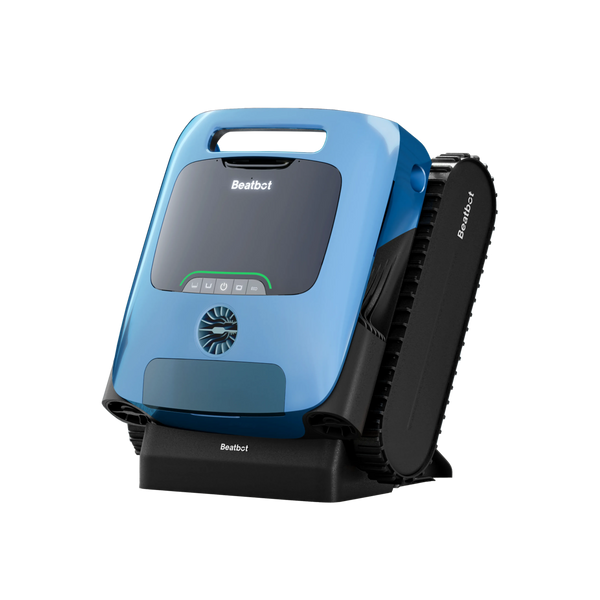
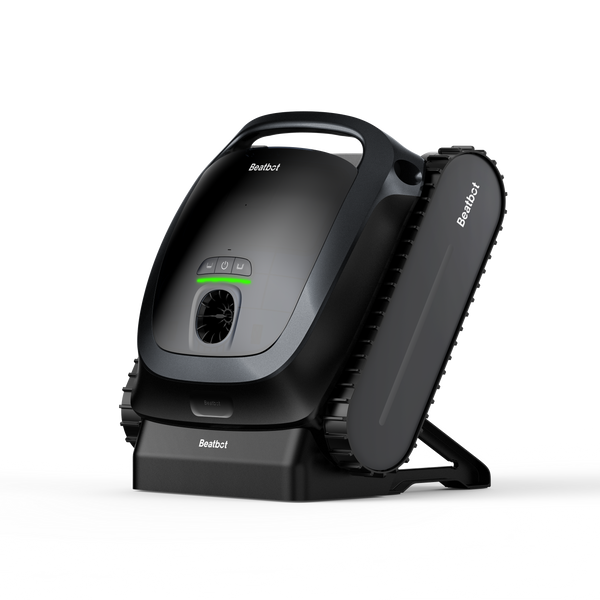
The Beatbot Sora 70 is a cordless robotic pool cleaner that matches most of the criteria for medium to large residential pools: full 5-in-1 coverage, high water flow, fine filtration, and complete cable-free operation. It runs on a 10,000mAh battery with up to 7 hours of continuous water-surface cleaning, 5 hours of floor cleaning, or 4.5 hours of combined floor, walls, and waterline cleaning per charge, covering pools up to 3,230 square feet in a single session. It fits most pool types (concrete, fiberglass, vinyl liner, saltwater) that need thorough cleaning across the full pool without cables, hoses, or connection to any pool equipment.
Water flow and filtration: The Sora 70 delivers 6,800 GPH water flow with a large 6L filter basket, which is one of the biggest in cordless robotic pool cleaners. It ships with a 150-micron standard filter for daily use and supports a replaceable 3 micron ultra fine filter for a deeper clean when the pool needs to capture pollen, algae spores, dust, or fine sediment. This handles heavy debris loads (autumn leaves, storm debris) and fine particulate (calcium scale, pollen) in the same cycle.
Coverage tier: 5-in-1 cleaning covers water surface, waterline, walls, floor, and shallow zones in a single automated cycle. This is the top coverage tier available in current residential pool cleaners, and it handles all the zones where debris and residue actually accumulate rather than only the pool floor.
Navigation: Sensor-based mapping plans efficient paths across pool shapes, including freeform designs. The systematic floor cleaning pattern combined with wall and waterline coverage produces complete coverage rather than random-path repetition.
Fully cordless operation: The Sora 70 runs entirely on an internal 10,000mAh battery with no cables, hoses, or connection to any pool equipment. There are no cords to tangle, no outlets to reach, and no wet ports to connect. When cleaning is complete or the battery runs low, its submarine-inspired floating technology automatically brings it to the water surface and navigates it to the pool edge, so retrieval requires only walking over and picking it up. A one-tap app retrieval feature returns it to the pool edge on demand, and the SmartDrain system automatically releases internal water before pickup to reduce lifting weight.
Surface compatibility: Rated for use in concrete, fiberglass, vinyl liner, and salt water pools with brush materials matched to each surface type. Titanium safe-charging contacts resist chlorine and pool chemicals, and the unit has been tested through 480 hours of salt-spray exposure, making it well suited to salt water pools without accelerated corrosion.
The Sora 70 is best matched to residential pool profiles, it delivers the coverage and filtration tier that keeps ongoing maintenance minimal across the pool's full service life.
Common Mistakes When Buying a Pool Vacuum
Five specific mistakes drive most disappointed pool vacuum purchases: matching to specs rather than to pool, buying based on lowest upfront cost, ignoring the pool's surface material, overlooking coverage tier, and choosing cordless to avoid cable management without understanding the trade-offs. Knowing the patterns helps avoid buying equipment that fails to deliver on the specific problem it was bought to solve.
Matching to specs instead of matching to pool
Higher GPH, larger filter, and more features are not automatically better. A cleaner rated for a 30,000-gallon pool is not the best choice for a 12,000-gallon pool; it costs more, wastes power, and may be too aggressive for the smaller volume. Match the cleaner's rated pool size to the pool's actual dimensions, not to the largest rating within budget.
Buying based on lowest upfront cost only
A $200 cleaner that lasts 2 seasons costs the same over 6 years as a $600 cleaner that lasts 6 seasons, but with three purchase cycles and three periods of degrading performance. For pool cleaners specifically, the mid-range tier often delivers better lifetime value than either extreme (lowest cost or highest premium). Calculate the amortized cost per season, not just the sticker price.
Ignoring pool surface material
Not every robotic cleaner is officially rated for every pool surface. A cleaner marketed generically for in-ground pools may not be explicitly compatible with fiberglass gel coat or vinyl liner. This affects warranty coverage more than day-to-day performance, but it matters if damage does occur. Always confirm the manufacturer explicitly lists your pool surface type in the compatibility specifications.
Overlooking coverage tier
Floor-only cleaners leave walls and waterline to weekly manual brushing, which defeats the labor savings the automation was supposed to provide. If waterline buildup or wall algae are recurring issues, floor-only cleaning at any price tier will disappoint. Match coverage tier to actual pool needs, not just to the pool's floor area.
Choosing cordless to avoid cable management
Entry-level cordless cleaners have real limits: 60 to 90 minute runtime, 1,200 to 1,800 GPH suction, and 15 to 25 percent battery capacity loss over 3 to 4 years. If runtime or suction margin matters for your pool, either step up to a premium cordless with a 10,000mAh+ battery (5 to 7 hours per charge, 6,800 GPH) or consider a corded model. Do not assume all cordless cleaners perform the same.
What to Expect at Each Price Tier
Pool vacuums fall into four price tiers, each with a typical service life and feature set. Understanding what you get at each level helps decide whether to spend more upfront or accept faster replacement cycles.
Under $100: manual and basic handheld
Manual telescopic vacuums and basic battery-powered handheld units. Service life is 2 to 4 seasons. Requires active use each session. Suitable for small pools, spot cleaning, or as a supplemental tool alongside an automated cleaner.
$100 to $400: suction-side and entry cordless
Suction-side automatic cleaners and entry-level battery-powered cordless robotics. Service life is 3 to 5 seasons. Adequate for small to medium pools with light debris and moderate coverage needs. Cordless units at this price typically deliver 1,200 to 1,800 GPH and 60 to 90 minute runtime.
$400 to $1,200: mid-range robotic
Robotic cleaners with floor and wall coverage. Service life is 4 to 6 seasons. Cordless models at this tier reach 2,000 to 2,500 GPH with 120 to 180 minute runtime; corded models deliver 3,000 to 4,000 GPH with unlimited runtime. Both use 10-micron filtration. This is the value sweet spot for most residential pools.
$1,200 to $2,500+: premium robotic
Robotic cleaners with full 5-in-1 coverage (floor, walls, waterline, water surface, shallow zones), fine filtration (3 to 10 microns), high suction (5,000 to 6,800 GPH), and smart mapping navigation. Cordless models at this tier use 10,000mAh+ batteries for 5 to 7 hours per charge; corded models offer unlimited runtime. Service life is 5 to 8 seasons with proper maintenance. Justified for larger pools, heavier debris loads, hard water regions, or owners who want fully hands-off maintenance.
FAQs
What is the best type of pool vacuum overall?
For most residential pool owners, a robotic cleaner (cordless or corded) delivers the best combination of cleaning thoroughness, coverage, service life, and total cost of ownership. It runs independently of the pool's pump, cleans more surfaces than any other type, and reaches a longer service life than manual or suction-side alternatives. Choose cordless for setup simplicity and no cable management; choose corded for unlimited runtime and lowest per-cycle cost. Very small pools may not justify a robotic cleaner at all, and specific pool profiles (heavy debris, salt water, freeform shapes) benefit from premium features.
How much should I spend on a pool vacuum?
Between $600 and $1,200 is the value sweet spot for most residential pools. Below this range, service life is short enough that total cost of ownership is often higher than mid-tier equipment. Above this range, the premium features (full coverage, ultra-fine filtration, smart mapping) are justified for larger pools, heavy debris, or specific pool types where the additional capability pays back over a longer service life.
How often should I run my pool vacuum?
Two to three times per week for most residential pools in regular use. More frequent cleaning (every one to two days) is helpful during periods of heavy bather use, hot weather, or after storms. Scheduled robotic cleaners with weekly timers make this practical without owner involvement.
How long should a pool vacuum last?
Depends on the type and price tier. Manual vacuums: 2 to 4 seasons. Suction-side cleaners: 3 to 5 seasons. Entry-level cordless robotic: 3 to 5 seasons (limited by battery degradation). Mid-range robotic: 4 to 6 seasons. Premium robotic (cordless or corded): 5 to 8 seasons with proper maintenance.
Do I need a vacuum if I have a pool filter?
Yes. Filters and vacuums do different jobs. The pool's filter captures suspended particulate that circulates through it, but it does not remove debris settled on the pool floor, adhered to walls, or accumulated at the waterline. A vacuum handles these zones. Without physical cleaning, filtration alone leaves pool surfaces to accumulate debris, biofilm, and mineral deposits over time.
Can one pool vacuum work for both above ground and in ground pools?
Some robotic cleaners are rated for both pool types, but they are less common than models rated for one or the other. The engineering constraints are different: above ground pools have flexible walls, flat floors, and shallow depths, while in ground pools have rigid shells, variable geometry, and deeper zones. If a future pool change is likely, look specifically for a dual-rated model; otherwise, choose equipment optimized for the current pool type.