Most Popular


 Sora Series


 AquaSense Series

 Skimmer & Bundle

 Retail Edition


 Accessories


Above ground pools are not a single category. They range from portable inflatables that set up in an afternoon to reinforced semi-inground structures that look nearly identical to in ground pools from street level. The type you choose determines not just your upfront cost but also how long the pool will last, what cleaning equipment works with it, and whether it can be winterized.
Soft-Sided and Inflatable Above Ground Pools
Soft-sided pools are the most accessible entry point into pool ownership. They require no tools, no assembly crew, and no permanent commitment to a spot in your yard. Two main configurations exist within this category.
Easy-Set inflatable pools use a ring around the top perimeter that inflates first. As the pool fills with water, the ring rises and lifts the walls to their full height. Intex popularized this design, and it remains common for round pools in the 8-to-18-foot diameter range. Setup typically takes under an hour.
Frame-supported soft-sided pools swap the inflatable ring for a lightweight metal or plastic frame that holds a three-ply PVC liner in place. They tend to be sturdier than ring-top models and come in a wider range of shapes, including rectangular. With proper care, a quality frame-supported pool can last more than one season.
The trade-off is durability. Soft-sided pools are vulnerable to punctures, UV degradation, and liner fatigue over time. They are also shallower, with most models topping out around 36 to 52 inches. For families who want a summer pool without a multi-year commitment, they are a practical starting point.

Steel Wall and Aluminum Wall Above Ground Pools
Steel wall above ground pools are the most widely installed permanent option in the United States. They use corrugated galvanized steel panels to form the pool wall, supported by upright posts and a top rail system, with a vinyl liner on the interior.
The corrugation in the steel panels is structural. It significantly increases resistance to outward pressure from the water, which allows manufacturers to use thinner gauge steel while maintaining rigidity. Most panels are coated or galvanized to slow rust, though steel pools are more susceptible to corrosion in salt water environments than aluminum or resin alternatives.
Steel wall pools are available in round, oval, and rectangular shapes and commonly range from 48 to 54 inches in depth. They can be fully winterized and, with proper maintenance, last 15 to 20 years or longer. Installation typically requires leveled ground, a sand or foam cove base, and proper liner sizing.
Steel wall pools come in round, oval, and rectangular configurations, and oval and rectangular builds in particular create corners, long walls, and irregular edges that most robotic cleaners navigate inconsistently.
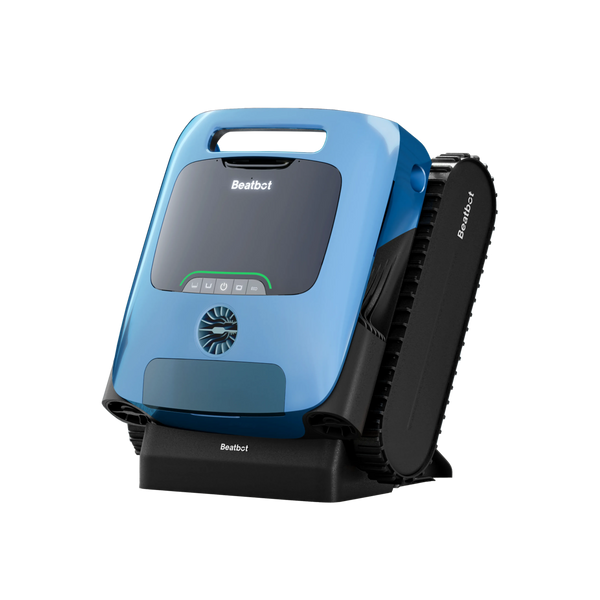
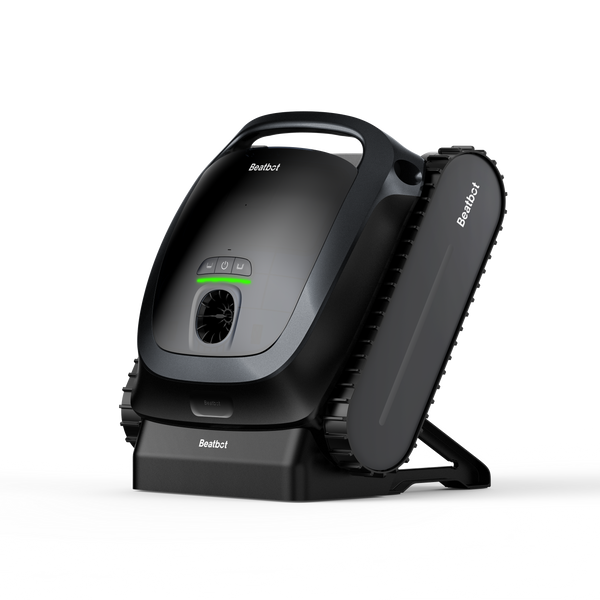
The Beatbot Sora 70 robotic pool cleaner adapts to any pool shape through dual ultrasonic sensors that map the layout in real time, achieving a 100% wall climbing success rate across all surfaces including vinyl. Its 6,800 GPH suction and 10-inch cleaning path mean one pass is typically enough, even along the long straight walls of a rectangular steel build.
Aluminum wall pools operate on the same structural principle as steel but replace the steel panels with aluminum. The primary advantage is that aluminum is rust-proof, which makes it the better choice for homeowners running a saltwater chlorination system. Aluminum wall pools tend to cost more than steel but hold up better in coastal or high-humidity environments.

Resin Above Ground Pools
Resin pools use a steel wall for the structural core but replace the frame components, specifically the top rails, top ledgers, and upright posts, with high-density resin.
Metal frame components that are exposed to sunlight, pool chemicals, and water fluctuations will eventually show rust, fading, or heat stress.
Resin does not rust and does not conduct heat the way metal does, so the top rails and ledgers stay cooler on hot days. This is not just a comfort issue: metal that repeatedly heats and cools expands and contracts, which can eventually loosen connections and degrade the frame over time.
Resin pools are also better suited for saltwater systems. Because the parts most exposed to salt-laden air and splash are non-metallic, corrosion is less of a concern. Pool owners who want a saltwater setup but are not ready to invest in an aluminum wall pool often find resin a cost-effective middle ground.
The vinyl liner inside a resin pool is interchangeable with liners from steel-wall pools of the same size, so replacement costs are comparable. Resin pools do carry a higher purchase price than basic steel models, but the reduced maintenance cost for the frame over a longer lifespan can offset that difference.
Semi-Inground Above Ground Pools
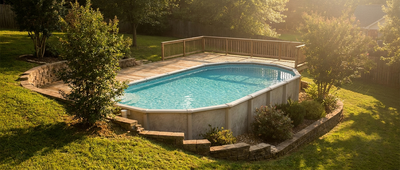
Semi-inground pools are the most structurally capable type in the above ground category. They are built with reinforced, thicker-gauge walls specifically designed to withstand lateral soil pressure, which allows them to be installed partially or fully below grade.
A standard above ground pool cannot be buried because its walls are engineered only to resist outward water pressure. When you excavate and place it in a hole, the surrounding soil pushes inward, causing the walls to collapse or buckle.
Semi-inground pools eliminate this limitation with structural wall panels that handle both water pressure from inside and soil load from outside. The pool can be set at any depth from fully above grade to fully below it, which homeowners with a sloped yard often use to level the installation across the grade, with one side buried and the other raised.
Semi-inground pools also support coping and deck systems similar to in ground pools, which means the finished product can be nearly indistinguishable visually. They represent the highest cost within the above ground category, and installation typically requires professional excavation and grading.

Above Ground Pool Shapes
Most above ground pools come in three shapes: round, oval, and rectangular. Shape determines which support systems are required, how the liner fits, and how much the total installation cost shifts.
Round pools are the most structurally efficient design. The circular geometry distributes water pressure evenly across the wall, which reduces the number of upright supports needed. They are available across all frame types and tend to be more affordable at equivalent volumes.
Oval pools require a different support system. Outward pressure concentrates at the long ends of the oval, so oval pools use end buttresses, supports that extend outward from the curved ends, to counter that force. This adds to the footprint and the cost but gives a pool shape that many owners find easier to swim laps in.
Rectangular above ground pools most closely replicate the feel of an in ground pool for swimmers. They are less common in soft-sided form but appear frequently in hard-sided steel, resin, and semi-inground configurations. Rectangular pools also make it easier to define swimming lanes and accommodate features like volleyball nets or lap dividers.
Vinyl Liner Types
Almost every above ground pool uses a vinyl liner. Three liner attachment styles exist, and each affects how the liner is installed and replaced.
Overlap liners drape over the pool wall and are held in place by the top coping strip. They are the most common and least expensive option, and they fit a wide range of pool sizes. The visible lip of liner over the wall is covered by the coping, so the finished appearance is clean.
Beaded liners attach via a bead receiver channel mounted at the top of the pool wall. The liner snaps into the channel and hangs down, which means it does not overlap the wall at all. Beaded liners are easier to replace without disassembling the top rail system, which makes future liner swaps faster.
Unibead liners, also called J-hook liners, are dual-purpose. They can be installed as a beaded liner by locking into a bead receiver, or converted to an overlap liner by folding a lip over the wall. This versatility makes them a popular choice because the same liner works regardless of whether your pool has a bead receiver installed.
Vinyl liner thickness is measured in mils. A thicker liner resists punctures and UV degradation better, though all vinyl liners eventually require replacement, typically every 8 to 12 years depending on care and chemical balance.
Pool Depth and Robotic Cleaner Compatibility
Standard above ground pools are built to 48 or 52 inches of depth, though actual water depth is typically 6 to 8 inches less than the wall height. Some models reach 54 inches, and certain semi-inground configurations go deeper once partially buried.
For a robotic pool cleaner, depth determines whether it can cover the full pool wall up to the waterline, and whether shallow areas like tanning ledges or entry platforms can be reached automatically.
Above ground pools with entry steps, tanning ledges, or platform areas create cleaning dead zones that standard robotic cleaners skip entirely.
The Beatbot Sora 30 robotic pool cleaner actively seeks and cleans these shallow zones down to 8 inches deep, covering the floor, walls, and waterline in the same cycle. Its 10,000mAh battery runs up to 5 hours on a single charge, handling pools up to 3,200 sq ft without interruption.
For standard above ground pools without platforms, the Beatbot Sora 10 robotic pool cleaner covers floors, walls, and the waterline across pools up to 3,299 sq ft on a single charge. At the end of each cycle it navigates to the waterline and holds position for pick-up within 10 minutes, so retrieval never requires reaching down into the water.
The table below compares each type across the dimensions that most affect buying decisions.
|
Pool Type |
Wall Material |
Durability |
Salt Water Compatible |
Can Be Buried |
Best For |
|
Inflatable / Easy-Set |
PVC / Fabric |
1–3 seasons |
No |
No |
Seasonal, low commitment |
|
Frame Soft-Sided |
PVC with metal frame |
2–5 seasons |
No |
No |
Seasonal with more stability |
|
Steel Wall |
Galvanized steel |
10–20 years |
Limited |
No |
Budget permanent install |
|
Aluminum Wall |
Aluminum |
15–25 years |
Yes |
No |
Salt water, long-term use |
|
Resin |
Steel wall, resin frame |
15–25 years |
Yes |
No |
Low-maintenance permanent pool |
|
Semi-Inground |
Reinforced steel or resin |
20+ years |
Yes |
Yes |
Landscaping integration, in-ground look |
If salt water compatibility is non-negotiable and full burial is not, a resin pool typically offers the best balance. If landscaping integration matters and budget is flexible, semi-inground is the only type built for it.
For most first-time buyers on a moderate budget who want a pool that lasts more than a few seasons, a round or oval steel wall pool with a resin top rail is the most practical starting point. It installs without professional help, winterizes cleanly, and replacement liners are widely available.
Buyers who want the pool to serve as a long-term backyard feature and already plan to run a saltwater system should step up to a full resin or aluminum wall model. Semi-inground pools are worth the extra cost only when the yard grade or landscaping integration makes a flush installation necessary.
FAQs
Can you partially bury a regular above ground pool?
No. Standard above ground pools are only engineered to resist outward water pressure. Burying them exposes the walls to inward soil pressure, which the structure is not built to handle and can cause collapse. Semi-inground pools are the only above ground pool type with walls reinforced for burial.
What is a cowboy pool?
A cowboy pool is a galvanized steel stock tank, the kind originally made for watering livestock, repurposed as a backyard swimming pool. They typically hold 100 to 300 gallons and measure 6 to 8 feet in diameter, making them suitable for one or two adults.
Because the tank is not designed for pool use, owners usually add a small pump filter, a drain valve, and occasionally a propane heater to extend the season. Cowboy pools are not rated for the water volume or structural demands of conventional above ground pools, but their low cost and small footprint make them popular in urban backyards and on patios where a full pool installation is not practical.
Are resin pools really better than steel for salt water?
Yes, in most cases. Steel wall pools can develop rust when exposed to salt water, especially at seams and joints. Resin frame components do not corrode, which makes them more reliable in salt water systems over the long term. Aluminum wall pools offer similar corrosion resistance at the wall level but are typically more expensive.
What is a Texas pool?
A Texas pool is a regional term used primarily in the southern United States for a large, freeform in ground pool with a shallow beach entry and a broad tanning shelf, rather than a vertical step system. The design is influenced by resort-style pools and favors gradual depth transitions over the standard deep-end layout.
While the term is sometimes applied loosely to above ground pools built with a generous tanning ledge, a true Texas pool is an in-ground or semi-inground structure. The defining feature is the zero-entry or near-zero-entry shallow area, which also appears in some semi-inground above ground builds when paired with a wide platform section.