Most Popular


 Sora Series


 AquaSense Series

 Skimmer & Bundle

 Retail Edition


 Accessories


An above-ground pool does not have to look like a temporary fix. With the right framing, materials, and details, it can anchor your backyard the same way an in ground pool would. The ideas below range from structural upgrades like decks and pavers to quick visual wins like tile trim and string lights, with a few maintenance picks at the end, because a clean pool is a better-looking pool.
1. Build a Surrounding Deck
A deck built to pool height is the single most effective upgrade you can make. It hides the pool walls entirely, creates a safe transition in and out of the water, and gives you functional outdoor living space at the same time.
Round pools work well with wraparound deck designs; rectangular pools pair naturally with a deck along one or two sides. Pressure-treated lumber is the standard choice, though composite decking holds up better in wet environments and requires less annual maintenance.

2. Add a Gravel Border
A gravel ring around the pool base defines the perimeter cleanly, prevents mud from splashing onto the pool walls after rain, and simplifies mowing. River rock and pea gravel are the two most common choices. River rock reads as more designed; pea gravel is softer underfoot for barefoot traffic. Either way, lay landscape fabric underneath first to block weeds.

3. Frame It With Stone Pavers
Pavers bring more permanence than gravel. A paver surround creates a solid walkway, reduces slipping hazards, and anchors the pool visually. Concrete pavers are the most affordable; natural flagstone and bluestone read as more upscale. Keep the edge flush or slightly raised to prevent runoff from draining into the pool.

4. Wrap the Sides in Wood Cladding
Cedar and redwood are popular for cladding because they resist moisture and insects. For a more tropical feel, bamboo cladding works well in mild climates. Attach horizontal boards with hidden fasteners and leave small gaps between planks for airflow and moisture escape.

5. Cover the Sides in Rock or Stone Veneer
Stone veneer panels give the pool walls a masonry feel without the weight of real stone. They bond directly to the pool exterior using construction adhesive and hold up well outdoors with proper sealing. Dry-stack limestone and river rock patterns are the most popular, and both work especially well when the surrounding landscape includes stone walls, rock gardens, or a stone-faced fire pit.

6. Hide the Walls With Shrubs and Hedges
Dense shrubs planted close to the pool perimeter conceal the walls over a season or two. Arborvitae grows fast and stays narrow, making it practical for tight side yards. Boxwood gives a more formal, sculpted look. Holly provides year-round coverage and a clean structure. Leave at least 18 to 24 inches of clearance between the plants and the water to minimize debris dropping in.

7. Plant Flowering Borders
Flowers around an above-ground pool soften the edges without requiring structural work. Low-maintenance perennials like black-eyed Susans, coneflowers, and ornamental grasses return each year without much intervention. Avoid anything that drops heavy petals or seeds prolifically. Keep flowering plants set back from the water and pair them with a clean mulch or rock border between the plants and the pool.

8. Install String Lights
String lights are the fastest way to make a pool look intentional after dark. Hung from a pergola frame, stretched between two poles, or draped from the house to a nearby tree, they turn evening swims into something people actually plan around. Use waterproof-rated fixtures and ensure any extension cords are rated for outdoor use.

9. Add Underwater or Perimeter Lighting
Most above ground pools have a returns port that accepts an aftermarket LED light fitting. Installing one adds a glow that reads more like an in-ground installation. Solar-powered perimeter lights along the deck edge or pool pathway serve both a safety and visual function. Low-voltage landscape lighting integrated into the surrounding garden adds depth without electrical complexity.

10. Put in a Pergola or Shade Structure
A pergola positioned over part of the pool deck creates a defined outdoor room, adds shade, and gives you somewhere to attach string lights, ceiling fans, or outdoor curtains for privacy. A simple four-post pergola with a louvered or slatted roof is a weekend project for most homeowners. A freestanding gazebo next to the pool is a lower-effort alternative that accomplishes most of the same thing.

11. Create a Dedicated Seating Area
Outdoor sectionals, a bistro table, or Adirondack chairs arranged on a paver pad give people somewhere to land when they're out of the water. Built-in bench seating along the perimeter of a deck uses space efficiently and does not require dragging furniture around. Position the seating so it faces the pool and gets afternoon shade from a fence or structure.

12. Decorate With Coordinating Planters
Planters at pool corners or flanking the entry steps add vertical structure without modifying the pool. Choose planters in a material that matches your deck or cladding: cedar, concrete, or painted metal. Tall ornamental grasses or a trained topiary give height. Keep the planting light on anything that drops debris into the water.

13. Add Decorative Tile Accents
Adhesive-backed waterproof tile strips applied to the pool rim or along the top of exterior cladding add color and pattern. Mosaic tile, terracotta, and cement tile patterns all hold up well outdoors. This works especially well on rectangular pools where tile along the waterline mimics what you would see in a tiled in ground pool.

14. Build a Pool Entry Staircase
A built-in entry staircase makes getting in and out easier for children, older swimmers, and anyone with mobility concerns. A two- or three-step box built from deck lumber and anchored to the pool deck is a manageable DIY project. Add a handrail for safety and paint or stain it to match the rest of the deck.

15. Install a Privacy Screen
A privacy screen on one or two sides makes the pool area feel more enclosed without requiring a full fence. Cedar lattice panels, bamboo roll screens, outdoor fabric on a cable frame, and slatted wood fencing all work depending on the style. Keep the screen high enough to block sightlines but positioned so it does not cast afternoon shadow over the water.

16. Lay a Brick or Paver Walkway
A defined path from the house to the pool reduces grass and mud tracked into the water and gives the yard a sense of intentional layout. Brick pavers, stepping stones, and poured concrete all work. Edge the walkway with border pavers or a low-growing ground cover to keep the lines clean.

17. Go All White
A monochromatic white palette creates a clean, resort-like look that photographs well and does not go out of style. White deck paint or stain, white planter boxes, white outdoor furniture, and white string light posts tie the whole area together. The pool liner provides color contrast. This works especially well in smaller spaces where a mix of materials can feel crowded.

18. Keep It Minimalist
A clean deck in a single material, no planters, no extra furniture, no trim details. Just the pool, well-maintained, with even grass around it and a simple ladder entry. The execution has to be tight: a minimalist design only reads as intentional when the pool water is clear and the lawn is trimmed.

19. Work With a Sloped Backyard
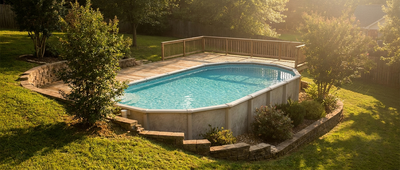
Pools installed into a hillside can have the deck flush with the uphill edge while the pool wall remains visible and cladded on the lower side. This creates a semi-raised aesthetic that looks more architecturally considered than a flat-yard installation. Retaining walls on the downhill side double as a visual base for the pool and can be built from stone, concrete block, or timber.

20. Match the Pool to an Outdoor Fireplace or Fire Pit
A fire feature near the pool creates a gathering zone for the hours after swimming when the air cools down. Matching materials between the two features pulls the yard together. If the fire pit uses stacked fieldstone, use the same stone veneer on the pool walls. If the fireplace is built with brick, bring brick into the pool deck.

21. Add a Water Feature
A small waterfall, a scupper, or a deck-mounted jet that spills water into the pool adds sound and motion to the space. Deck-mounted water features are the simplest to add since they do not require plumbing into the pool itself. Fountain-style jets mount in the pool return and arc water back into the pool.

22. Create a Pool Skirt
Decorative paneling installed around the pool's lower exterior gives it a finished foundation look. Lattice panels, corrugated metal, painted wood planks, and composite siding panels all work. A skirt is a lighter commitment than full cladding and can often be installed and removed seasonally in climates where pools are winterized.

23. Design It for Entertaining
A solid deck with space for a grill or outdoor kitchen nearby, weatherproof speakers, a drink station, and enough seating for the group turns the pool into the center of a functional outdoor room. Position the cooking area close enough to the pool for easy access but far enough that heat and smoke do not blow over the water.

24. Install Outdoor Lighting Fixtures
Wall-mounted sconces on a fence or nearby structure, post-mounted lanterns at the deck corners, or recessed deck lights built into the boards all bring more architectural quality to pool lighting than generic solar stake lights. Hardwired fixtures last longer and perform more consistently than solar options. Plug-in weatherproof pathway lights on a timer are a solid middle ground.

25. Build a Pool House or Storage Shed
A small structure near the pool, whether a proper pool house with a changing room or a painted shed repurposed for towels and float storage, gives the whole setup an organized, permanent quality. A bench with a hook rail and a small cabinet built into the fence line accomplishes much of the same thing in a much smaller footprint.

26. Try an Octagonal or Unique Pool Shape
Octagonal pools are widely available and often easier to install in odd-shaped yards than standard rounds. An octagonal pool pairs well with a matching deck that creates a unified platform. Oval pools offer a middle ground between round and rectangular. Either shape anchors the yard more convincingly than a generic circle and tends to pair more naturally with built deck structures.

27. Use Color Strategically
Liner color matters more than most people expect. A darker liner makes the pool look deeper and more sophisticated in natural light. Exterior color matters too: painting the pool wall charcoal, deep green, or warm sand rather than leaving it in its stock color makes the pool look more considered. Carry that color into the furniture, the planter boxes, or the deck finish for a cohesive result.

28. Add a Curved Deck
A deck with a curved or sweeping edge softens the geometry of the pool area and creates more interesting transitions from deck to lawn. Curved decking is more labor-intensive to build than a simple rectangle, but it is the stronger design move for round pools in particular, since the curve of the deck echoes the curve of the pool and makes both feel like a unified structure.

29. Build It Up to Meet the House
Extending the deck from the pool to the back door creates a continuous outdoor platform that connects the pool to the home's living space. A floating or freestanding deck section bridging the gap works even when the pool is 10 or 15 feet from the house. Match the deck stain or paint to the home's trim color to tighten the connection visually.

30. Organize With Pool Noodle and Towel Storage
A cedar towel rack with hooks mounted to a fence post, a wooden pool noodle holder built from simple lumber, or a waterproof deck box at the entry steps keeps floats, noodles, and towels off the lawn and out of the water. Dedicated storage is often the difference between a pool area that looks well-designed and one that looks abandoned an hour after anyone uses it.

31. Keep the Water Visibly Clean
Every design upgrade in this list competes with cloudy or greenish water. A pool that is chemically balanced and debris-free looks better from every angle regardless of what surrounds it. Regular skimming and consistent filtration handle the baseline, but above ground pools that see heavy use or sit near trees accumulate surface debris — leaves, pollen, insects — faster than a standard filter basket can keep up with.
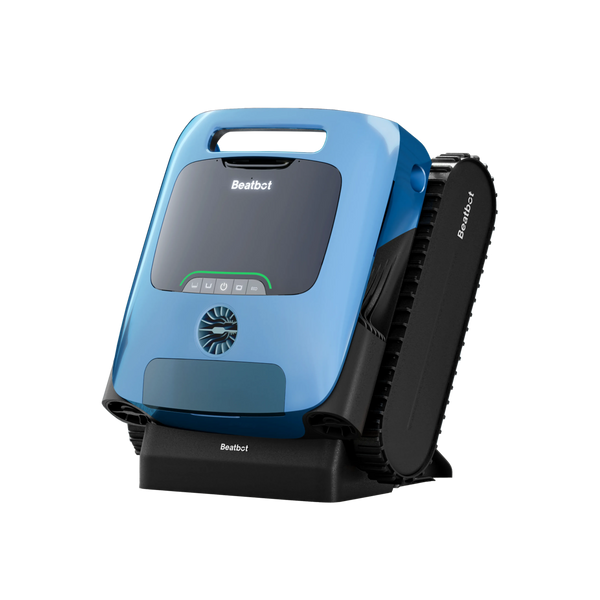
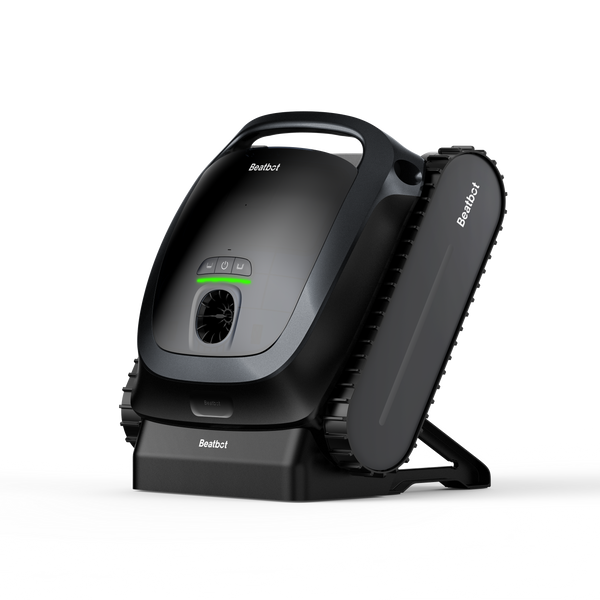
A robotic pool cleaner on a regular schedule removes that manual work. The Beatbot Sora 70 robotic pool cleaner covers floor, walls, waterline, and water surface in a single cycle. Its JetPulse system uses four coordinated water streams — two inward flows that guide floating debris toward the suction inlet, two outward flows that block debris from bypassing the robot — delivering active surface capture rather than passive skimming.
With 6,800 GPH suction, a 6L debris basket, and up to 7 hours of water surface runtime per charge, it handles pools up to 3,230 square feet without mid-session intervention.
For pools that do not need surface cleaning, the Beatbot Sora 30 robotic pool cleaner covers floor, walls, waterline, and shallow platform areas at the same 6,800 GPH suction with a 5L debris basket and a 2-year warranty.
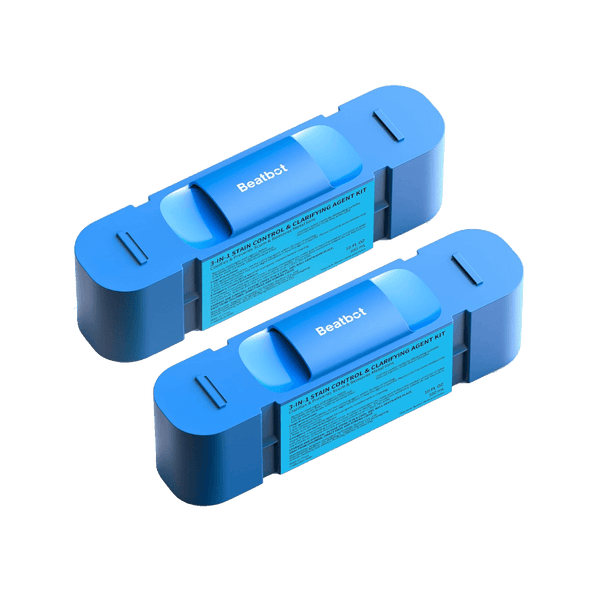
For larger or more complex above-ground and in ground pools, the Beatbot AquaSense 2 Ultra robotic pool cleaner adds HybridSense Pool Mapping with an AI camera, dual-side brushes for edge cleaning, and an integrated ClearWater clarification system — loaded with a clarifier kit, it automatically disperses a chitosan-based clarifier that binds fine particles into larger clumps for easier filtration, keeping the water visibly clear between manual water treatments.

FAQs
What can I put around my above-ground pool instead of grass?
Stone pavers, concrete, decomposed granite, artificial turf, and rubber mulch all work well around an above-ground pool. They reduce mud and debris tracked into the water and give the area a more finished appearance. Avoid fine gravel that gets carried in easily by wet feet.
Is it cheaper to put concrete or pavers around a pool?
Poured concrete generally costs less upfront than natural stone pavers, but more than basic concrete pavers. A standard concrete pad runs roughly $6 to $10 per square foot installed; concrete pavers fall in a similar range; natural flagstone and bluestone typically run $15 to $30 per square foot. Concrete is harder to repair if it cracks; individual pavers can be replaced without redoing the entire surround.
How much does it typically cost to deck an above-ground pool?
A basic pressure-treated wood deck generally runs between $3,000 and $8,000 depending on size and region for a professional installation. A two-side deck costs less than a full wraparound. DIY material costs can come in below $2,000 for modest setups.
What should I not plant next to an above-ground pool?
Avoid anything that drops seeds, fruit, or heavy petals into the water: mulberry, cottonwood, and sweet gum are common offenders. Thorny shrubs like roses and pyracantha create safety hazards near barefoot traffic.
Plants with invasive root systems, including bamboo and some willows, can shift the ground under the pool over time. Fast-shedding conifers like Leyland cypress are also poor choices since needles clog filters quickly.
What's the best thing to put underneath an above-ground pool?
A purpose-made pool pad or ground cloth is the standard first layer: it cushions the liner, blocks sharp objects, and resists moisture. On bare ground, a 2-inch layer of compacted sand underneath the pad provides a level, debris-free surface. Avoid pea gravel, mulch, or grass directly under the pool, as they shift, decompose, or create uneven spots that stress the liner.
How far away from a house should an above-ground pool be?
Most local codes require a minimum of 5 to 10 feet from any structure, but requirements vary by municipality. Check with your local building department before installation. Beyond code, a practical minimum of 6 to 8 feet gives enough clearance for deck construction, equipment access, and emergency egress without the pool wall touching or trapping heat against the house.
Does homeowners insurance require a fence around an above-ground pool?
Many insurers require or strongly recommend a fence as a condition of coverage, and some will increase premiums or decline coverage without one.
Requirements vary by policy and state. Above ground pools with a removable ladder meet the barrier requirement in some jurisdictions since removing the ladder cuts off access. Verify the specific terms with your insurer before installation, since non-compliance can affect a liability claim.