Most Popular


 Sora Series


 AquaSense Series

 Skimmer & Bundle

 Retail Edition


 Accessories


A pool's water volume equals surface area times average depth times 7.5 gallons per cubic foot. A 16 ft × 32 ft rectangular pool with an average depth of 5 ft holds about 19,200 gallons. A 24 ft round pool at 4 ft deep holds around 13,560 gallons.
Most residential spas sit between 300 and 500 gallons. This number drives every chemical dose you'll calculate, since chlorine, shock, stabilizer, and salt are all measured per 10,000 gallons.
The Basic Formula: Cubic Feet to Gallons
Find the volume in cubic feet, then multiply by 7.5 to get US gallons. One cubic foot of water holds 7.48 gallons, and pool industry guides round to 7.5.
Gallons = Surface Area × Average Depth × 7.5
Surface area depends on the pool shape. Rectangular pools use length × width. Round pools use π × radius². Ovals use (π ÷ 4) × long diameter × short diameter. Freeform shapes use an approximation factor.
Measure everything in feet, and always use the water depth, not the pool wall height.
How to Calculate Gallons in a Rectangular Pool
Multiply length by width by average depth by 7.5.
Length (ft) × Width (ft) × Average Depth (ft) × 7.5 = Gallons
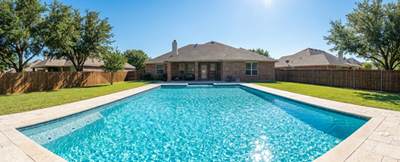
A 20 ft × 40 ft pool with a 3 ft shallow end and an 8 ft deep end has an average depth of 5.5 ft. The math runs 20 × 40 × 5.5 × 7.5, or 33,000 gallons. A 12 ft × 24 ft pool with a uniform 4 ft depth comes to 12 × 24 × 4 × 7.5, or 8,640 gallons.

How to Calculate Gallons in a Round Pool
Multiply 3.14 by the radius squared by the average depth by 7.5. The radius is half the diameter.
3.14 × Radius² (ft) × Average Depth (ft) × 7.5 = Gallons
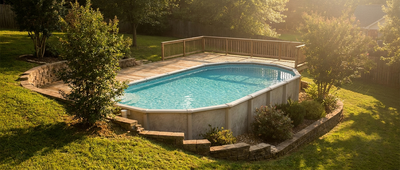
An 18 ft round above-ground pool at 4 ft deep has a 9 ft radius. The math runs 3.14 × 81 × 4 × 7.5, or 7,630 gallons. A 24 ft round pool at 4 ft deep runs 3.14 × 144 × 4 × 7.5, or 13,560 gallons. Doubling the diameter roughly quadruples the volume.
How to Calculate Gallons in an Oval Pool
Multiply long diameter by short diameter by average depth by 5.9. The 5.9 factor folds π ÷ 4 and the 7.5 conversion into one number.
Long Diameter (ft) × Short Diameter (ft) × Average Depth (ft) × 5.9 = Gallons
A 15 ft × 30 ft oval at 4 ft deep works out to 15 × 30 × 4 × 5.9, or 10,620 gallons. At 5 ft average depth it reaches 13,280 gallons. An oval holds less than a rectangle of the same outer dimensions because the rounded ends cut off corner volume.
How to Calculate Gallons in Freeform and Kidney Pools
Freeform pools use 0.85 × length × average width × average depth × 7.5. Kidney-shaped pools use 0.45 × length × (width A + width B) × average depth × 7.5.
Freeform: 0.85 × Length × Avg Width × Avg Depth × 7.5 = Gallons
Kidney: 0.45 × Length × (Width A + Width B) × Avg Depth × 7.5 = Gallons
A freeform pool 35 ft at its longest and 16 ft wide on average at 5 ft deep runs 0.85 × 35 × 16 × 5 × 7.5, or 17,850 gallons. The 0.85 factor estimates that a freeform pool holds about 85 percent of what a rectangle with the same outer dimensions would hold.
For pools with attached spas, tanning ledges, or multi-level floors, split the pool into two or three simpler sections, calculate each separately, and add the results. A pool with a tanning ledge becomes a main deeper pool plus a shallow rectangle for the ledge.
These same multi-level layouts tend to defeat standard robotic cleaners, which either skip elevated sections or get stuck transitioning between depths.
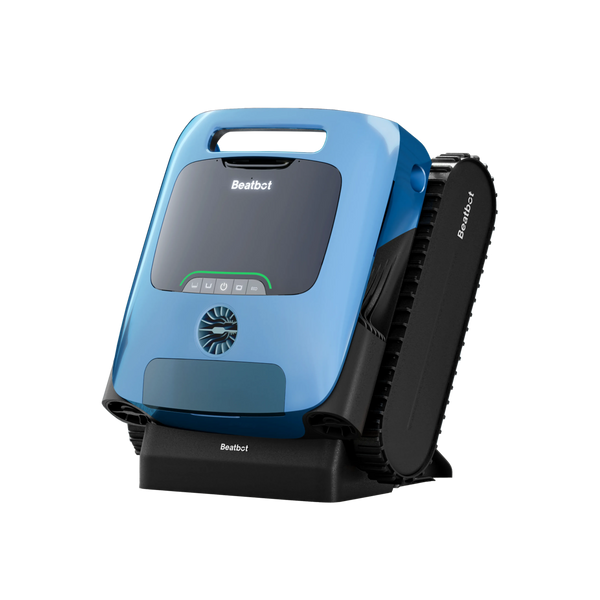
The Beatbot AquaSense 2 Ultra robotic pool cleaner uses an AI camera paired with two downward-facing ultrasonic sensors to detect platforms submerged in at least 13.7 inches of water, climb onto them, and clean them before returning to the main floor, so the same zone-by-zone logic you use for volume also carries over to cleaning coverage.
How to Calculate Average Pool Depth
Average depth equals shallow-end depth plus deep-end depth, divided by two. A pool with a 3 ft shallow end and an 8 ft deep end has an average depth of 5.5 ft. This works for pools with a gradual, even slope.
Average Depth = (Shallow Depth + Deep Depth) ÷ 2

Hopper-bottom pools, where the floor drops steeply in the center, and split-depth pools with a flat shallow zone before a sudden transition, need zone-by-zone math. Divide the pool into a shallow zone, a transition slope, and a deep zone, calculate each with its own average depth, and sum them.
Pool Gallons by Standard Size
The table below covers common residential pool sizes at typical depths. Verify with your own dimensions before dosing chemicals.
|
Pool Size |
Shape |
Average Depth |
Estimated Gallons |
|
12 ft × 24 ft |
Rectangle |
4 ft |
8,640 |
|
14 ft × 28 ft |
Rectangle |
4.5 ft |
13,230 |
|
15 ft round |
Round |
4 ft |
5,300 |
|
16 ft × 32 ft |
Rectangle |
5 ft |
19,200 |
|
18 ft × 36 ft |
Rectangle |
5.5 ft |
26,730 |
|
20 ft × 40 ft |
Rectangle |
5.5 ft |
33,000 |
|
24 ft round |
Round |
4 ft |
13,560 |
|
15 ft × 30 ft |
Oval |
4 ft |
10,620 |
Deep ends beyond 8 ft push gallons higher, shallow play pools come in lower. Larger volumes also raise the bar for any cleaner: a 25,000-gallon pool demands enough battery to finish a cycle without a recharge, enough suction to move fine debris across long floor runs, and enough basket capacity to avoid mid-cycle interruptions.
The Beatbot Sora 70 cordless robotic pool cleaner hits all three with a 10,000 mAh battery rated for up to 5 hours of continuous floor cleaning in eco mode, 6,800 GPH suction that handles everything from fine sand to wide leaves, and a 6 L debris basket. It covers pools up to 3,230 sq ft in a single cycle.
For smaller pools, or pools where large tanning ledges and Baja shelves matter more than total water volume, the Beatbot Sora 30 cordless robotic pool cleaner is the closer match. It covers floor, walls, waterline, and platforms as shallow as 8 inches on a 10,000 mAh battery, backed by a 2-year warranty.
How Many Gallons Are in a Spa or Hot Tub?
A typical residential hot tub holds between 300 and 500 gallons. A two-person spa holds 150 to 220 gallons. Swim spas fall between 1,450 and 2,500 gallons.
Hot Tub Gallons = Length × Width × Avg Depth (inches) ÷ 1,728 × 7.5
An 80-inch × 60-inch tub with 30 inches of water works out to about 625 gallons before seat displacement. Seats, footwells, and jets reduce that by 15 to 25 percent.
For spas with bowl-shaped footwells, measure seat-level depth and footwell depth separately and add the two volumes. The fill test is faster: time how long the hose takes to fill the spa and how long it takes to fill a five-gallon bucket, divide, and multiply by five.
Common Mistakes That Throw Off Your Gallon Estimate
Measuring wall height instead of water depth is the largest error. Most pools carry 6 to 12 inches of unfilled wall above the water line. A 20 ft × 40 ft pool measured by wall height can come out 1,000 to 2,000 gallons too high. Vinyl pools especially carry several inches of dry wall above the waterline.
Confusing diameter with radius on round pools produces a volume four times too large, since the radius gets squared in the formula.
Tanning ledges, swim-up benches, and sun shelves displace water. A large tanning ledge can subtract 500 to 1,500 gallons from a pure rectangular estimate, which is why complex pools should be calculated as separate zones rather than one rectangle.
Carrying over a gallon count from a previous pool or a manufacturer spec sheet introduces drift. Vinyl liners stretch, concrete pools get resurfaced, and water levels shift across a season. Remeasure once a year or after any water-level change.
FAQs
How many gallons are in a 16 × 32 pool?
A 16 ft × 32 ft rectangular pool holds about 19,200 gallons at a 5 ft average depth. Drop to a 4 ft uniform depth and it comes to 15,360 gallons. Add a deeper end (6 ft average) and it reaches 23,040 gallons.
Do saltwater pools need a different formula?
No. Saltwater pools use the same volume formulas. The calculation drives how much salt to add to reach the target salinity, usually 3,200 parts per million.
How long does it take to fill a 10,000-gallon pool?
A standard garden hose flows at 8 to 12 gallons per minute, which fills a 10,000-gallon pool in 14 to 21 hours. Running two hoses in parallel cuts the time to 7 to 10 hours. A water truck delivery (typically 6,000 gallons per truck) fills the same pool in under 4 hours, minus the trip.
How much water should a pool lose in 3 days?
Evaporation alone accounts for about 0.25 inches of water loss per day, or 0.75 inches over three days. On a 20 ft × 40 ft pool, that works out to roughly 375 gallons. Anything beyond 1.5 inches over three days points to a leak, not evaporation.
What gallon figure should I use for the starting chlorine dose?
Round up to the nearest 1,000 gallons when dosing sanitizer. A 19,200-gallon pool should be dosed as 20,000 gallons. Chlorine demand fluctuates with heat, UV, and bather load, and a small overdose is safer than repeated under-treatment.