Most Popular


 Sora Series


 AquaSense Series

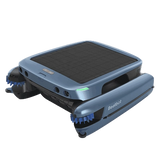 Skimmer & Bundle


 Retail Edition


 Accessories


Calcium scaling appears as white, crusty, or gritty deposits on tile, plaster, and equipment when the water is oversaturated with calcium carbonate, a condition measured by the Langelier Saturation Index (LSI). Defeating scale takes two steps run in parallel: correct the chemistry so new scale stops forming, and physically remove what is already on the surfaces.

What Causes Calcium Scaling in a Pool?
Calcium scaling happens when the water holds more dissolved calcium than it can keep in solution, so the excess precipitates onto surfaces as calcium carbonate. The trigger is a positive LSI value, typically above +0.3.
Three chemistry factors push the LSI up: elevated pH (above 7.6), high total alkalinity (above 120 ppm), and high calcium hardness (often above 400 ppm). Warmer water holds less dissolved calcium, which is why scale appears first around heaters, salt cells, and sunny waterlines.
Evaporation concentrates the problem. Every gallon that leaves the pool as vapor leaves its calcium behind, so hardness climbs over a season even without chemical dosing. Cal-hypo shock adds calcium directly. Hard fill water adds it on every top-off. None of these causes scale on its own; together they push the LSI into the scaling zone and the water precipitates the rest.
Plaster and concrete pools scale differently from vinyl and fiberglass. Plaster surfaces contain calcium and tolerate hardness in the 200 to 400 ppm range. Vinyl and fiberglass do best at 175 to 225 ppm, since those surfaces contribute no calcium and gain no protection from higher levels.
Scaling damages equipment before it becomes visible on pool surfaces. A layer of calcium on a heater exchanger insulates the coil, slows heat transfer, and eventually burns out the unit. In salt cells, calcium coats the plates and cuts chlorine output. In circulation piping, scale narrows the internal diameter, reduces flow, and raises pump pressure.
How Can You Tell Calcium Scaling from Other Deposits?
Calcium carbonate scale feels rough, looks chalky white or grayish, and sits in a thin film or layered crust, most often at the waterline and on tile grout. A drop of muriatic acid on a sample will fizz. If the deposit does not react to acid, it is likely calcium silicate or calcium sulfate, which are denser, harder, and require different removal methods.
Waterline rings that appear gradually on a heated pool point to carbonate scale tied to temperature. White flakes on the pool floor after winter usually indicate winter dust, which is caused by low calcium at closing, not high calcium.
Sharp, nearly transparent crystals that cut skin or swimsuits suggest calcium sulfate. A full water test (pH, total alkalinity, calcium hardness, temperature) feeds into an LSI calculation and settles the diagnosis.
Scale is rare on vinyl pools because the liner contributes no calcium, so any deposit worth investigating usually signals hard fill water, heavy cal-hypo dosing, or heat-driven LSI drift near a heater return. A pumice stone will tear the liner; use a vinyl-rated scale eraser pad for spot work. Heavy coverage on vinyl almost always points to lowering calcium hardness through a partial drain.

How Do You Remove Existing Calcium Scale?
Remove scale in this order: mechanical first, chemical second. A pumice stone works on tile, concrete, and plaster as long as both the stone and the surface stay fully wet. For softer surfaces like vinyl liners and fiberglass, use a scale eraser pad rated for that finish; a pumice stone will damage them.
When scrubbing is not enough, sequestering agents (also called chelators) bond with calcium ions and pull them back into solution so the filter can carry them away. Products built around SC-1000, Scale Free, Stain Away, or similar phosphate-free chelators are dosed weekly or biweekly at the skimmer, and work over two to three weeks. Heavy waterline rings on tile often need bead blasting, which strips scale without damaging grout, or a careful muriatic acid wash with the water partially drained.
None of the above lowers calcium hardness itself. Only dilution does that, which is why a partial drain-and-refill of one quarter to one third of the water is a standard annual step in hard-water regions, and a required step once hardness passes 500 to 600 ppm.
How Do You Prevent Calcium Scaling from Returning?
Prevention is LSI management. Keep the index between -0.3 and +0.3, test weekly in season, and most scale events never start. For most residential pools that means pH at 7.4 to 7.6, total alkalinity at 80 to 100 ppm, calcium hardness at 200 to 400 ppm for plaster and 175 to 225 ppm for vinyl or fiberglass, and cyanuric acid held in a controlled range so it does not inflate alkalinity readings.
Two habits cut LSI drift at the source. Switch away from calcium hypochlorite shock once calcium hardness is mid-range; liquid chlorine (sodium hypochlorite) and dichlor add no calcium. Pre-filter fill water when it tests above 300 ppm hardness out of the tap, using a hose-end filter or a whole-home softener dedicated to top-offs.
Physical disturbance of vulnerable surfaces closes the loop. Waterline tile, steps, the area just above the returns, and any platform or tanning ledge scale first because they see the most evaporation and sun. Weekly brushing of these zones knocks off micro-deposits before they layer into visible scale.

How Does a Robotic Pool Cleaner Help Control Calcium Scale?
A robotic pool cleaner handles two jobs inside a scale-prevention routine: weekly physical disturbance of the surfaces where scale starts, and filter capture of fine calcium particles that precipitate during minor LSI excursions.
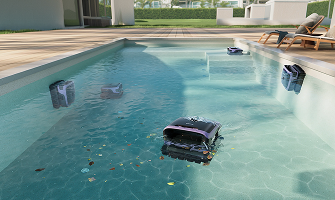
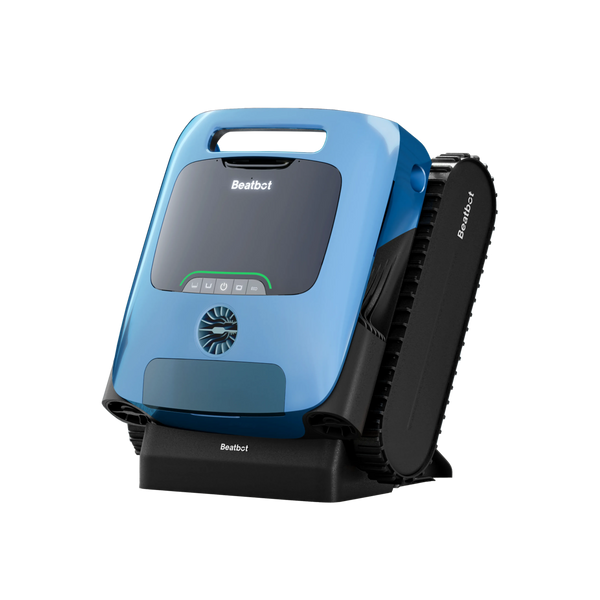
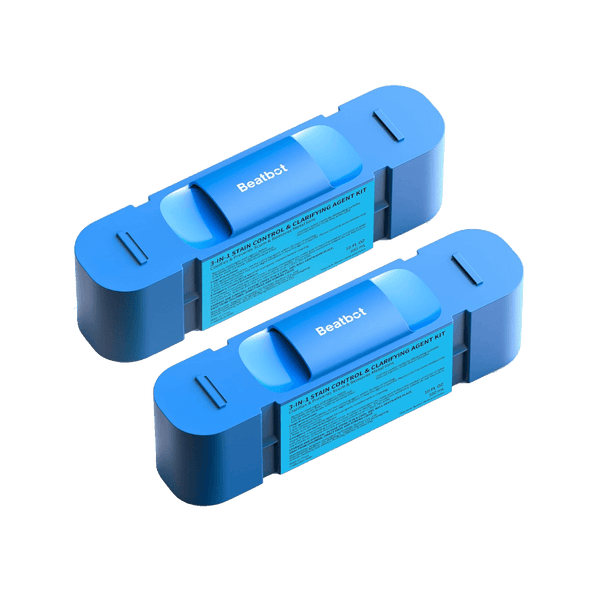
The Beatbot AquaSense 2 Ultra is the most active waterline defense. Its Dual-Pass Waterline Cleaning scrubs the waterline twice on every pass, breaking up calcium deposits before they can layer. Industry-first dual side brushes sweep loose calcium dust from edges and corners, and the ClearWater™ Clarification System releases a chitosan-based clarifier kit that binds fine calcium particles into clumps the filter can capture.
AI adaptive platform cleaning reaches tanning ledges deeper than 13.7 inches autonomously, covering the high-evaporation zones where scale starts first.
The Beatbot AquaSense 2 Pro brings the same ClearWater™ particle-binding mechanism to standard rectangular and freeform pools, paired with dual-layer 150 μm / 250 μm filtration for the resulting clumps.
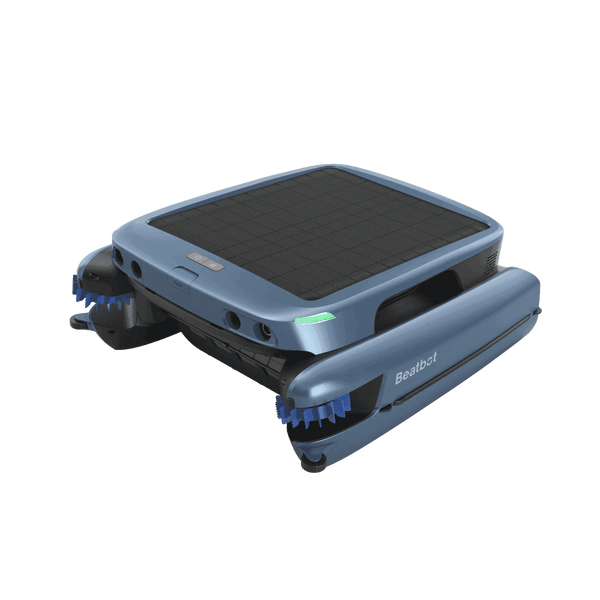
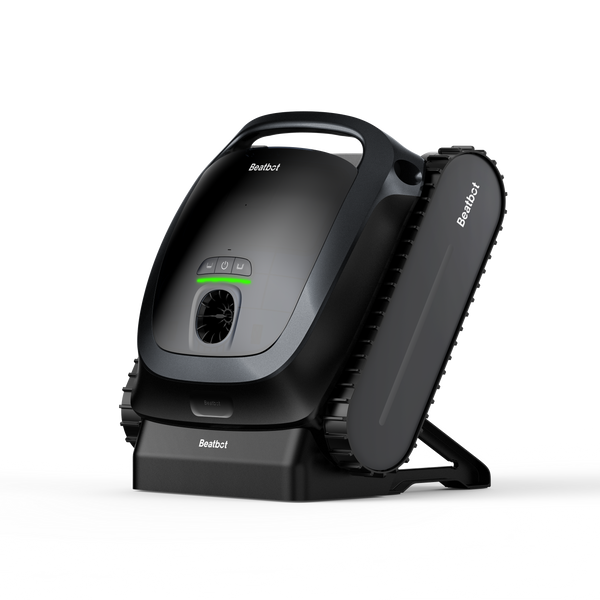
The Beatbot Sora 70 delivers the finest particle capture of the three when fitted with its optional 3-micron ultra-fine filter, which catches microscopic calcium dust the 150 μm filters leave behind. Twin 5-inch roller brushes create a 10-inch cleaning path that keeps walls and waterline continuously scrubbed throughout a 6,800 GPH cycle.
When Should You Call a Pool Professional?
Call a pool professional when the deposit does not react to acid, when calcium hardness reads above 600 ppm and a drain is required, when scale covers large areas of plaster or has formed inside the heater or salt cell, or when a sequestering treatment has run for three to four weeks with no visible change. Calcium silicate and calcium sulfate almost always require professional removal, and a lab water sample confirms which compound before any removal work starts.
FAQs
Will lowering my pool's pH dissolve existing calcium scale?
Dropping pH into the low 7s with alkalinity at the low end pushes the LSI slightly negative and lets some thin scale redissolve over time. Thick, cured deposits will not shift in any reasonable timeframe. Visible scale needs a corrected LSI plus sequestering agents plus mechanical removal; chemistry alone rarely clears a waterline ring.
Does a saltwater pool scale more than a chlorine pool?
Saltwater pools are more prone to scaling around the salt cell, where the electrolysis process raises pH locally and heats the water slightly, reducing calcium solubility. The rest of the pool is not inherently more scale-prone than a traditional chlorine pool at the same LSI. Inspect and clean the cell on the manufacturer's recommended schedule.
Does muriatic acid get rid of calcium buildup?
Muriatic acid dissolves calcium carbonate on contact, which is why a diluted acid wash (with the water partially drained) is a standard fix for heavy waterline rings on tile and plaster. It will not work in a full pool at safe dosing levels, and it etches plaster and strips grout if overapplied. Acid-magic and dry acid dissolved in water are milder alternatives for spot treatment.
How do I lower calcium hardness without draining?
There is no chemical way to lower calcium hardness in a full pool. Sequestering agents hold calcium in solution so it cannot precipitate, but the calcium is still there and still counts toward LSI. Reverse-osmosis mobile treatment is the only alternative to a partial drain, and it is typically only cost-effective at hardness levels above 800 ppm or in regions under drought restrictions.