Most Popular


 Sora Series


 AquaSense Series

 Skimmer & Bundle

 Retail Edition


 Accessories


Maintaining an above ground pool takes five recurring tasks: running the pump 8 to 12 hours a day, testing and balancing the water two or three times a week, skimming and brushing the interior, cleaning the filter, and shocking the pool once a week or after heavy use. Above ground pools hold less water than in ground pools, so chemistry shifts faster and debris concentrates near the waterline, which is why a consistent weekly routine matters more than individual products.

How often should the pump run?
Run the pump 8 to 12 hours a day during swim season, and extend that to continuous circulation during heat waves or heavy use. The target is to turn the full pool volume over at least once every 24 hours, which for most above ground pools falls inside the 8 to 12 hour range on a single-speed pump.
Circulation moves sanitizer through the water, pulls debris toward the skimmer, and feeds the filter. Without it, chlorine stratifies, algae settles in dead zones, and everything else on this list stops working.
Keeping the Right Water Level
Keep the water level at the middle of the skimmer opening. Below the opening, the skimmer pulls air and the pump loses prime; above it, surface debris stops getting drawn in.
Top off with a garden hose as needed, and retest chemistry after any top-off of more than a few inches. After heavy rain, use a submersible pump or the filter's waste setting to drop the level back to the skimmer line.
A few hours empty in mild weather is usually fine for repairs, but do not leave a vinyl liner empty in direct sun or on a hot day. An exposed liner can shrink within hours and no longer fit the pool walls when you refill.
Skimming the Pool Surface
Skim the surface every day or every other day, especially under trees or after wind, and empty the skimmer and pump baskets any time you pass them. Floating leaves, pollen, and suntan residue form a film that sinks within hours, and a full basket chokes flow to the filter.
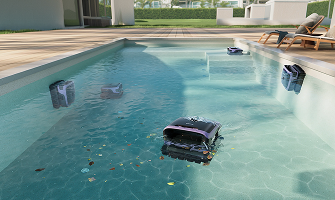
For heavy leaf load or hands-off operation, the Beatbot Sora 70 robotic pool cleaner adds JetPulse water surface cleaning. Twin jets on each side of the robot project water streams both inward and outward.
The inward streams funnel floating leaves, pollen, and insects toward the central suction inlet; the outward streams block debris from slipping past the sides, which is how surface skimmers typically lose material. App-controlled targeting lets you direct the robot to corner leaf accumulation without lifting a net.
Balancing the Water
Test the water two to three times per week and keep pH between 7.4 and 7.6, total alkalinity between 80 and 120 ppm, and free chlorine between 1 and 3 ppm. Test strips are fine for weekly checks; a liquid test kit or digital tester gives more reliable readings once a month. Always test alkalinity before adjusting pH, since alkalinity buffers pH swings.

For adjustments, use sodium bicarbonate (plain baking soda) to raise total alkalinity, soda ash to raise pH, and muriatic acid or dry acid to lower either. Baking soda raises alkalinity with a small bump in pH, which is why pool owners reach for it most often during weekly balancing.
Keep cyanuric acid (stabilizer) between 30 and 50 ppm so sunlight does not strip chlorine within hours. Above 80 ppm, partial draining is usually the only way to bring it down.
Brushing and Vacuuming the Walls and Floor
Brush the walls, waterline, and floor once a week, then vacuum what you loosened. Algae anchors in the microscopic film on the liner before it is visible, which is why weekly brushing is the single cheapest algae prevention step.
Use nylon bristles on vinyl and resin-framed pools; stainless or hybrid brushes will tear a vinyl liner. Pay extra attention to corners, ladder bases, and the waterline, where oils and organics concentrate. When manually vacuuming, set the filter to "waste" if your system allows, so fine sediment does not cycle back through.
The Beatbot Sora 30 cordless pool robot replaces the manual vacuum step. It runs 6,800 GPH of suction through a 5L debris basket that holds more than 650 leaves in a single cycle, which is enough to clear a full autumn-drop load without a mid-cycle empty. Smart surface parking brings the robot to the water surface when the cycle is done, so retrieval does not mean reaching into the deep end with a hook.

Cleaning the Filter
Rinse cartridge filters once a week, soak them monthly in a dedicated filter cleaner, and backwash sand filters when the pressure gauge reads 8 to 10 psi above the clean baseline.
Pull the cartridge and hose it in a fan pattern from top to bottom. Replace cartridges every one to two swim seasons; the pleats compress and lose surface area with age even when they look clean. Sand filters need a backwash followed by a short rinse to reseat the bed, and the sand itself lasts three to five years before the grains round off. DE filters need full grid teardowns a few times per season.
Skip household dish soap, including Dawn. The surfactants foam aggressively in pool water and keep foaming every time the pump runs for weeks afterward. Use a filter cleaner designed for cartridges, or a muriatic acid soak for heavy calcium scaling.
How to Shock an Above Ground Pool
Shock the pool once a week during swim season, and always after heavy rain, a pool party, or noticeable cloudiness. Shocking raises free chlorine to roughly 10 ppm, high enough to break down chloramines and oxidize organic waste that regular chlorine cannot handle.
Balance pH and alkalinity first, since shock works best at a pH near 7.4 and can cloud water or bleach liners at high pH. Shock at dusk so sunlight does not burn it off before it can work, dissolve granular shock in a bucket of pool water first, and let the pump run through the night. Wait at least 6 to 8 hours after shocking before adding algaecide or clarifier, because high free chlorine levels deactivate most of them.
Use calcium hypochlorite (cal hypo) for most vinyl-lined above ground pools, or non-chlorine shock if you need to swim within a few hours. For persistent green tint or slick walls, a double dose combined with brushing is more effective than repeated single shocks.
Monthly and Seasonal Tasks
Weekly tasks (testing, brushing, vacuuming, emptying baskets, rinsing the filter, shocking) are covered above. Monthly and seasonal work is what keeps the pool structurally sound between swim seasons.
Monthly tasks: test calcium hardness (target 200 to 400 ppm), test cyanuric acid, deep-clean the cartridge in a chemical soak, inspect the liner for small tears or wrinkles, and check hoses and fittings for soft spots or leaks.
Seasonal tasks: open the pool in spring with a thorough chemical balance and shock, replace cartridges or sand when due, and close the pool for winter in freeze-prone climates.
For owners who want the daily cleaning cycle itself automated, the Beatbot AquaSense 2 Ultra robotic pool cleaner runs HybridSense AI Pool Mapping, which combines an AI camera with ultrasonic and infrared sensors to scan the pool and plan an optimized path based on the actual shape.
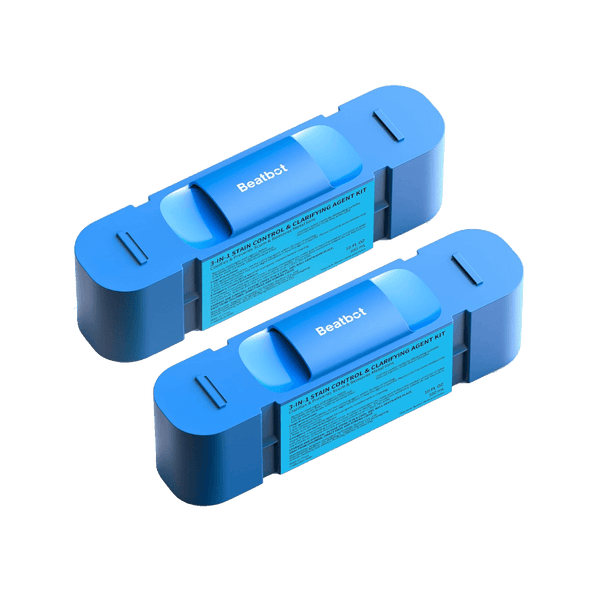
It matters most in above ground pools with built-in benches, corner steps, or non-round footprints, where traditional random-pattern robots miss sections and rerun others. Its integrated ClearWater clarifying box accepts a chitosan-based clarifier kit that the robot dispenses while cleaning, which binds oils and fine particles into larger clumps the filter can then capture. One kit treats up to 99,000 gallons and lasts roughly a month of weekly use.
Closing the Pool for Winter
In freeze-prone climates, close the pool in fall before the first hard frost. Brush, vacuum, and shock a week before closing so the water is crystal clear when you cover it. Balance chemistry one final time, add a winterizing chemical kit sized for your pool, drop the water level just below the skimmer opening, drain and store the pump, filter, and hoses indoors, and put a tight-fitting winter cover on with a water bag or cover seal around the rim.
For pools that stay open year-round, skip the closing but keep the pump running long enough each day to circulate water below 60°F.
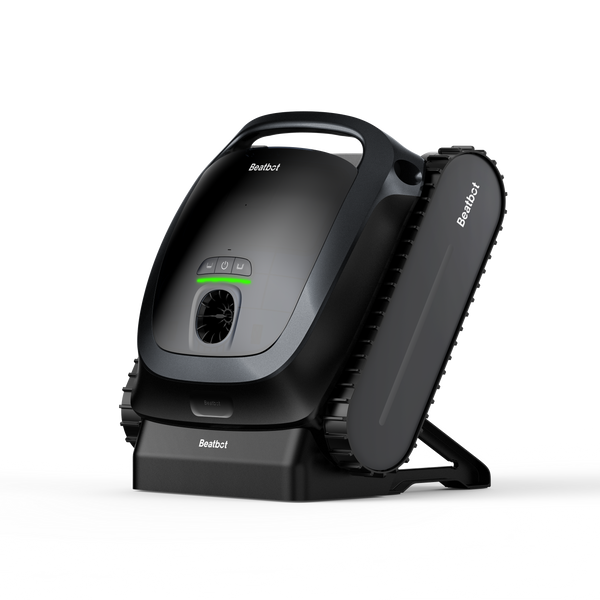
Above ground pools sit at or near ground level, so reaching into the water to retrieve a cleaning robot is a daily friction point most in-ground owners never think about. The Beatbot Sora 10 cordless pool robot solves this with smart waterline parking: at the end of every cycle, it navigates itself to the waterline and positions itself for pickup within 10 minutes, so you walk over and lift it out by the handle rather than fishing for it with a hook.
It cleans floor, walls, waterline, and shallow areas in one cycle and comes with a 2-year warranty, which makes it a practical fit for owners who want above-ground-first automation without stepping into a premium tier.
FAQs
How long do I need to wait to swim after shocking an above ground pool?
Wait until free chlorine drops back to 1 to 3 ppm, which usually takes 8 to 24 hours with cal hypo. Non-chlorine shock generally allows swimming within 15 minutes of application. Always retest before anyone gets in the water.
My pool looks clear but smells strongly of chlorine. Why?
Strong chlorine smell means chloramines, not free chlorine. Chloramines form when chlorine binds to sweat, urine, and organic waste, and they signal that your free chlorine is actually too low to keep up. Shock the pool and the smell goes with it.
Is liquid chlorine or chlorine tablets better for an above ground pool?
Tablets (trichlor) are easiest for steady daily dosing through a floater or chlorinator, but every tablet also adds cyanuric acid that builds up over the season. Liquid chlorine (sodium hypochlorite) gives an instant boost with no CYA added, which is useful once stabilizer levels climb past 50 ppm. Many owners use tablets as the base and switch to liquid mid to late season.
Do I need to add algaecide every week?
Not usually. Weekly shocking and balanced chemistry handle most algae risk. A maintenance dose of algaecide is most useful during heat waves, long rainy stretches, or if the pool has repeatedly turned green in past seasons.
Can I use household bleach instead of pool chlorine?
Unscented liquid bleach at 6% to 8.25% sodium hypochlorite works in a pinch, but it has no stabilizer, so sunlight burns it off quickly outdoors. Dedicated pool chlorine gives longer outdoor life and more predictable dosing.