Most Popular


 Sora Series


 AquaSense Series

 Skimmer & Bundle

 Retail Edition


 Accessories


Calcium hardness is the amount of dissolved calcium in your pool water, and it decides whether that water sits politely in the pool or starts eating your plaster, etching your tile grout, or coating everything in chalky white scale.
It controls whether the pool surface, the heater, and the equipment behind the wall stay protected or get damaged over time. Keep it balanced, and you barely notice it. Let it drift too low or too high, and the repair bills show up faster than the algae ever would.

What Is Calcium Hardness in Pool Water?
Calcium hardness is the measurement of dissolved calcium ions in your pool water, expressed in parts per million (ppm). It is one of the three core water balance parameters, alongside pH and total alkalinity, and unlike chlorine, it does not get consumed by sunlight or swimmers. Once it is in the water, it stays until you dilute it out or evaporation concentrates it further.
Calcium enters the pool from three main places. Your tap water already contains some, and in hard-water regions of the U.S. like Arizona, Nevada, southern California, and parts of Texas, that starting number can be high. Plaster and concrete pool surfaces also leach calcium into the water, especially when they are new. And calcium-based shock products like Cal Hypo add a small amount with every dose.
What Does Calcium Hardness Actually Do?
Calcium hardness controls whether your pool water is chemically stable, corrosive, or scale-forming. Too little calcium and the water becomes aggressive, leaching minerals from any surface it touches. Too much and it drops calcium back out of the solution as scale.
The industry calls this balance the Langelier Saturation Index, or LSI. The index folds in pH, alkalinity, calcium hardness, temperature, and total dissolved solids to predict whether water will corrode or scale a given surface. Calcium hardness is one of the biggest variables in that equation, which is why it carries so much weight.
In practice, calcium hardness is the parameter that protects long-term capital. Chlorine protects swimmers. Calcium hardness protects the pool itself.
What Is the Ideal Calcium Hardness Level for a Pool?
For most U.S. residential pools, calcium hardness should sit between 200 and 400 ppm, with 250 to 350 ppm as the sweet spot for plaster and concrete pools. Vinyl liner and fiberglass pools tolerate a lower range, generally 150 to 250 ppm, because their surfaces do not contain calcium and do not need it for protection.
|
Pool Surface |
Recommended Calcium Hardness |
|---|---|
|
Plaster or concrete |
250 to 400 ppm |
|
Tile and grout |
200 to 400 ppm |
|
Fiberglass |
150 to 250 ppm |
|
Vinyl liner |
150 to 250 ppm |

What Happens When Calcium Hardness Is Too Low?
When calcium hardness drops below roughly 150 ppm, the water turns corrosive and starts dissolving calcium from whatever surface it can find. In a plaster or concrete pool, that means etched, pitted, and rough plaster that feels like sandpaper underfoot.
Grout between tiles softens and washes out. Pool heaters with copper or steel components corrode from the inside, which is one of the fastest ways to shorten heater life.
Vinyl liner pools are not immune. The liner itself contains no calcium, but soft water can leach plasticizers out of the vinyl over time, causing the liner to stiffen and crack early. Fiberglass gel coats can lose their gloss and develop a slightly etched look.
Low calcium hardness is fixed by adding calcium chloride. A common rule of thumb is about 1.25 pounds of calcium chloride per 10,000 gallons to raise hardness by 10 ppm. Dissolve it in a bucket first, broadcast it across the deep end, then run the pump for several hours and retest after 24 hours.
What Happens When Calcium Hardness Is Too High?
When calcium hardness climbs above 400 ppm, the water becomes scale-forming. Calcium starts precipitating out of solution and depositing as a hard, chalky white crust on tiles, the waterline, ladders, salt cell plates, and inside heaters. Heater scaling is the most expensive consequence. A thin coating of calcium on a heat exchanger reduces efficiency and can crack the unit if scale builds up unevenly.
Cloudy or hazy pool water that does not respond to shock or filtration is often a calcium issue, not an algae issue. Salt chlorine generator owners see it as a white powder on the cell plates that has to be cleaned off with diluted acid.
Unlike low calcium, high calcium cannot be lowered with a chemical. The only practical fix is partial drain-and-refill with lower-hardness water, sometimes combined with a sequestering agent to keep dissolved calcium in solution while you work the level down. In hard-water regions, some owners install a pre-filter on the fill hose to slow the rise.

How Do You Test and Adjust Calcium Hardness?
Calcium hardness is tested with either a liquid drop test or test strips, and a drop-based reagent kit gives a more accurate reading. Test monthly under normal conditions, or sooner after a fresh fill, partial drain, heavy rainfall, or a calcium hypochlorite shock treatment.
When you adjust, do it gradually. Calcium chloride raises hardness quickly, so add it in smaller doses over 24 to 48 hours rather than dumping everything in at once. Always confirm that pH and total alkalinity are also in range, because the LSI balance depends on all three working together. The standard companion targets are pH 7.4 to 7.6 and total alkalinity 80 to 120 ppm.
If your water is naturally hard, the best long-term strategy is preventing buildup rather than chasing it down. That means topping off carefully, keeping pH on the lower end of the acceptable range to discourage precipitation, and keeping the water moving and filtered so dissolved minerals stay in solution.
How Regular Cleaning Helps Prevent Calcium Problems
Calcium scale almost always starts in the same place: a soft, faint film along the waterline, where evaporation concentrates minerals, and the air-water boundary lets them precipitate first. Catch that film in the first few days, and a brush wipes it away.
Leave it for a couple of weeks, and it hardens into a crust that needs acid washing or a pumice stone, plus the labor that comes with both. The single most useful habit for a hard-water pool is scrubbing the waterline often, before soft buildup gets a chance to set.
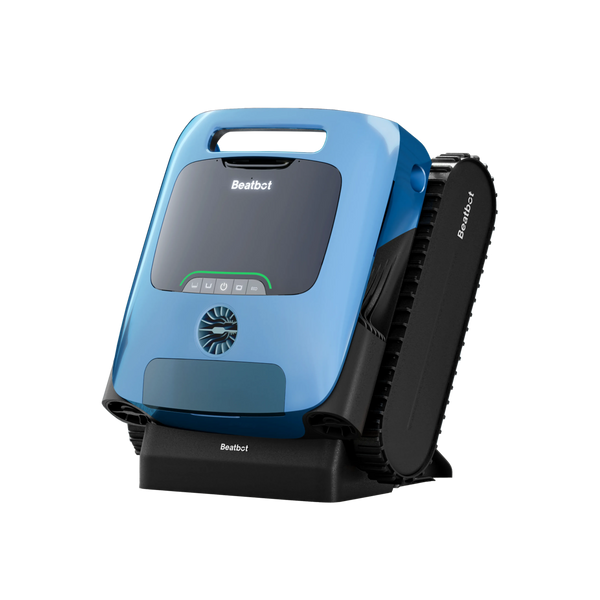
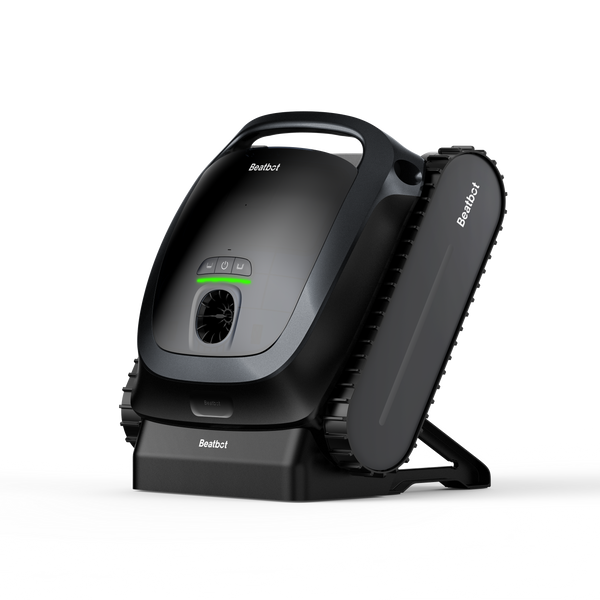
The Beatbot AquaSense 2 Ultra handles this with its dual-pass waterline cleaning, scrubbing the entire waterline twice on every cycle so soft film gets worked off before it has time to harden.
A 200W brushless motor pulls loose particles into a 150 μm dual-layer filter on the same pass, so what gets brushed off stays out of the water rather than drifting back to deposit elsewhere. Set on a daily or every-other-day schedule through the Beatbot app, the waterline stays ahead of buildup on its own.
FAQs
Does Rainwater Lower Calcium Hardness?
Yes, heavy rain dilutes calcium hardness because rainwater contains almost no calcium. After a major storm or several days of rain, calcium hardness typically drops in proportion to how much fresh water entered the pool. Retest within a week and adjust if you have fallen below your target range.
Will High Calcium Hardness Damage My Salt Cell?
It can. Calcium scale builds up on the titanium plates inside salt chlorine generators and reduces their ability to produce chlorine. Most salt cell manufacturers recommend cleaning the cell with a diluted acid solution every three to six months when calcium hardness is on the higher end of the acceptable range.
Can I Use a Softener-Fed Hose to Fill My Pool?
You can, but it is usually not the right call for plaster or concrete pools. Softened water has almost no calcium, which means the fresh fill will be aggressive and will pull calcium out of your plaster. For top-offs and refills, unsoftened tap water or a pre-filtered hose is the safer option.
How Often Does Calcium Hardness Need Adjusting?
For most pools, only a few times a year. Calcium hardness is one of the slowest-moving parameters in pool chemistry, so once you are inside the target range, testing monthly is enough. The exceptions are after partial drains, heavy storms, or repeated calcium hypochlorite shock treatments.