Most Popular


 Sora Series


 AquaSense Series

 Skimmer & Bundle

 Retail Edition


 Accessories


A quick algae bloom usually traces back to one of two things. Free chlorine got wiped out, often after a bright, hot day, a storm that drags in debris, or a night when leaves and pollen keep falling in.
The second issue is slow circulation and weak filtration. A short pump run, return jets aimed poorly, or a filter packed with gunk can leave calm pockets of water in corners and on steps.
Get those two problems under control and you can turn green back to blue inside a day.

Step 1 Brush and Scoop to Get Rid of Algae
Brushing is the fastest way to stop green water from clinging to the pool. Algae likes to hang on to walls, steps, and shady corners. When you brush it loose, chlorine can reach it and the filter has a chance to catch the fallout.
Brush the walls, floor, steps, corners the returns don't reach, behind ladders and handrails, and around fittings and equipment. Then scoop out anything floating, plus any leaves sitting on the bottom. The less junk in the water, the longer your shock holds.
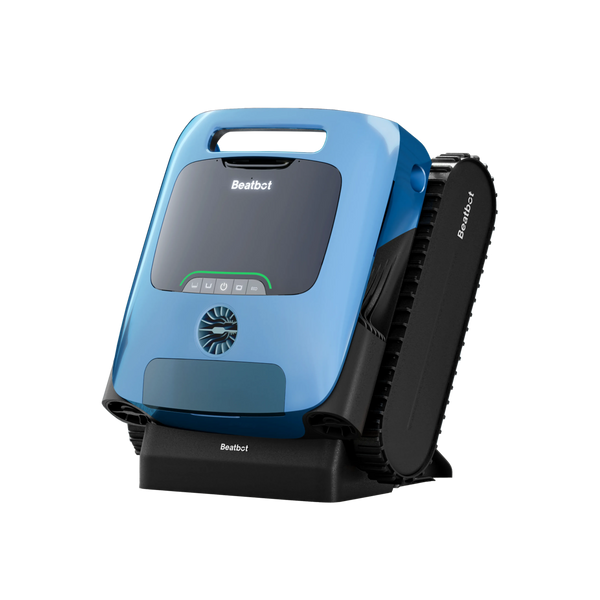
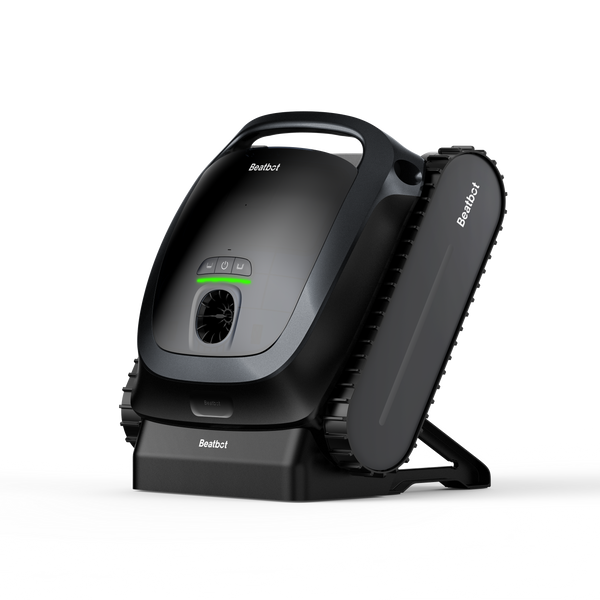
Leaves and pollen chew through chlorine fast, and that can derail a 24-hour cleanup. If your pool is loaded with debris, Beatbot AquaSense X fits this stage.
It moves up to about 113 gallons per minute (25.7 m³ per hour) and pairs a 1.2-gallon onboard basket (4.5 L) with a 5.3 gallon dock (20 L), which cuts down the stop-and-empty routine during heavy leaf cleanup. It covers pools up to 3,875 sq ft and cleans the floor, walls, and waterline with dual waterline scrubbing.
If the biggest headache is small surface debris that keeps drifting back, AquaSense 2 Ultra is built around tight coverage with HybridSense mapping that uses an AI camera plus ultrasonic and infrared sensors. Side brushes help push floating debris toward the intake.

Step 2 Clean the Filter so a Green Pool Can Clear Faster
A green pool clears faster when the filter starts clean. Dead algae loads a dirty filter fast, the flow drops, and the pool keeps recirculating cloudy water.
Empty the pump basket and the skimmer basket first. Then handle the filter based on its type.
With a sand filter, set the multiport valve to Backwash and run it until the sight glass clears. Switch to Rinse for a short run, then return the valve to Filter.
With a DE filter, backwash or open the tank and clean the grids. After cleaning, add fresh DE powder back into the system or filtration drops off.
With a cartridge filter, pull the cartridges and hose them down. During an algae cleanup, dead algae can mat the pleats quickly, so a second rinse later in the day is common.
|
Filter Type |
What to Do |
Key Follow-Up |
|
Sand Filter |
Backwash, then Rinse, then return to Filter |
Watch the sight glass and restore normal flow before moving on |
|
DE Filter |
Backwash or clean grids |
Add fresh DE powder after cleaning so fine filtration stays strong |
|
Cartridge Filter |
Remove cartridges and hose clean |
Plan on more frequent rinses during dead-algae cleanup |

Step 3 Run the Pump and Filter Nonstop for the Next 24 Hours
Nonstop circulation is what turns dead algae into clear water. Shock kills algae. Filtration removes what's left behind. Water has to keep moving for both jobs to finish.
Keep the valve on Filter and let the system run day and night. Aim return jets to keep water moving across the surface and into corners. Keep an eye on the pressure gauge and the return flow. A pressure jump or a weak return stream is often the filter telling you it's filling up with dead algae.
Step 4 Set pH so Shock Works Faster
Shock hits harder when pH sits on the low side of the normal range. A target of 7.2 to 7.4 helps chlorine stay more active, and many shock products push pH up after dosing.
If pH reads high, add a pH reducer that fits your pool and retest after it circulates. If pH reads low, add a pH increaser and retest. Small corrections beat big swings.
Step 5 Shock a Green Pool at Dusk to Wipe Out Algae
If your goal is to clean a green pool in 24 hours, shock has to be strong and it has to hold. Shock means raising free chlorine well above the normal daily level for a short window so algae breaks down fast.
Shock does two things. It wipes out algae when chlorine stays high long enough. It then brings the pool back under control by burning through the junk in the water that keeps eating chlorine, which helps stop that next-day rebound.
Shock Options and What They Change
Calcium hypochlorite, often called cal-hypo, hits hard and works well on obvious green water. It adds calcium, which can raise calcium hardness over time and increase scale risk in pools that already run high.
Liquid chlorine, usually sodium hypochlorite, acts fast and is easy to measure. It does not add calcium, yet pH can rise after dosing. Fresh jugs matter since stored chlorine loses strength with age.
Dichlor is a fast-dissolving granular shock that adds stabilizer, often called CYA. High CYA can make chlorine feel less punchy, so frequent use can make algae cleanup tougher later.
Trichlor tabs raise chlorine, yet they dissolve slowly and add a lot of CYA. pH can drop too. Tabs fit routine dosing far better than a green-water rescue.
|
Shock Type |
Works Well For |
What It Adds or Shifts |
Watch For |
|
Cal-Hypo |
Strong green-water cleanup |
Adds calcium |
Can raise scale risk in high-calcium pools and salt systems |
|
Liquid Chlorine |
Fast action and easy dosing |
Can push pH upward |
Strength drops as jugs age, fresh product matters |
|
Dichlor |
Quick chlorine boost |
Adds CYA |
Repeated use can push CYA high and make chlorine feel weaker |
|
Trichlor |
Routine chlorination |
Adds a lot of CYA, can lower pH |
Slow dissolve, not a great fit for a fast green-water rescue |
Pick the Right Shock for Your Pool
For a non salt pool over 10,000 gallons, cal-hypo is often the first pick when the water is clearly green. For smaller pools, liquid chlorine is easier to dose with tight control.
For saltwater pools, liquid chlorine or a limited dose of dichlor is usually a safer route since cal-hypo can raise scale risk on the salt cell.
If you buy liquid chlorine, look for 12% or higher strength and choose the freshest jugs you can find.
Dose Guidelines by How Green the Water Looks
A practical baseline is about 1 pound of cal-hypo per 10,000 gallons, or about 1 gallon of liquid chlorine per 10,000 gallons. From there, match the dose to the color.
Light green or more blue than green, yet cloudy, often needs about double the baseline. Medium green often needs triple. Very dark green, close to black-green, can need around four times the baseline. A light dose is one of the top reasons a pool turns green again.
|
What the Water Looks Like |
Dose Multiplier |
Baseline Reference |
|
Light Green or Mostly Blue but Cloudy |
2x |
Per 10,000 gallons, about 1 lb cal-hypo or 1 gal liquid chlorine |
|
Medium Green |
3x |
Per 10,000 gallons, about 1 lb cal-hypo or 1 gal liquid chlorine |
|
Very Dark Green, Near Black-Green |
4x |
Per 10,000 gallons, about 1 lb cal-hypo or 1 gal liquid chlorine |

Add Shock Without Wasting It
Dose at dusk so sunlight doesn't burn off chlorine right away. Pour liquid chlorine slowly around the perimeter with the pump running.
For cal-hypo, follow the label directions. Vinyl liner pools need extra care since undissolved granules can sit on the floor and damage the liner. Pre-dissolve in a clean bucket when the product label allows, then add the solution evenly.
Step 6 Check Color and Free Chlorine the Next Day and Decide on a Second Shock
Cloudy blue water is the sign you want. It usually means algae is dead and floating where the filter can catch it. Green or teal water points to algae that's still hanging on, or chlorine that dropped too low too soon.
Test free chlorine in the morning. Don't let it hit zero. If it's near zero, bring it back up right away. If the pool still looks green, clean the filter again, then repeat the shock step with a stronger dose.
Step 7 Clean the Filter Again so Vacuuming Goes Faster
Dead algae can clog a filter in a hurry, and a second cleaning often flips the pool from blue-but-milky to clear enough to finish the job. This step is about keeping flow strong.
Use your clean filter pressure as the baseline. When pressure climbs about 10 psi above that starting point, backwash or rinse again based on your filter type.

Step 8 Scoop, Brush, and Vacuum Out What You Can See
Once the water lightens up, the pool floor starts to show what shock knocked loose. At that point, removal beats more chemicals.
Start with a leaf rake to pull out piles, then brush again to lift any remaining film. Vacuum next. If debris is heavy, vacuum to Waste so it leaves the pool instead of clogging the filter. If debris is light, vacuum through the filter, then plan on cleaning the filter again right after.
Step 9 Run Another 24 Hours to Clear the Cloudiness
After algae is dead, the job turns into removing fine particles. Continuous filtration clears haze faster than extra shock. Keep the pump running and clean the filter as needed. At this point the water often looks cloudy blue. The algae is dead, yet fine particles keep floating and settling back on the floor.
Beatbot AquaSense 2 Ultra can help in this polish phase by running long passes on the floor, walls, and waterline, giving the filter more chances to catch what's suspended. HybridSense mapping supports consistent coverage across the pool, and the ClearWater water clarification feature can help the haze break faster as filtration keeps up.
Start a robot run once you can see part of the floor. In very cloudy water, the basket can load up fast, so empty it more often during cleanup runs.
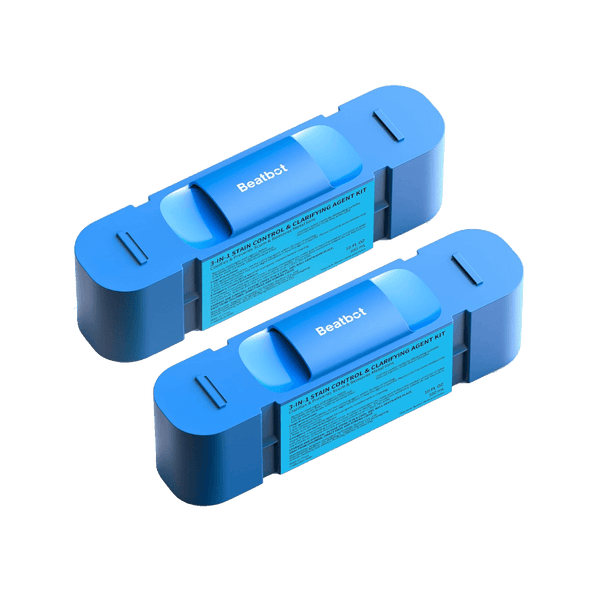
A clarifier can speed up clearing by helping tiny particles clump together, yet it isn't required. If you use one, follow the label dose and keep the system running.
Step 10 Restore Normal Balance and Keep the Pool From Turning Green Again
The simplest way to stop a green pool from coming back is keeping chlorine from bottoming out. When free chlorine stays stable, algae struggles to restart.
Test chlorine, pH, and total alkalinity, then bring them back into your normal targets. Keep an eye on CYA and match your chlorine level to it. Once the pool is clear, stick with steady circulation, empty baskets on schedule, and brush the usual trouble spots on a routine cadence.
Green Pool FAQ
Still green after 24 hours?
Most of the time, shock was too light or filtration fell behind. Clean the filter, bring free chlorine back up, and keep the pump running until the water turns cloudy blue.
Do I need algaecide?
No. Brushing, nonstop filtration, and a shock level held long enough clears green water. Algaecide can help in some cases, yet it isn't required for this plan.
Do I need to drain?
Usually no. Draining is mainly for extreme contamination, major equipment failure, or water that's far out of range and can't be corrected safely.
Can a saltwater pool use cal-hypo?
It can, yet cal-hypo adds calcium and can raise scale risk on the salt cell. Liquid chlorine is often the easier choice for a one-time algae cleanup.
When can I swim again?
Swim when the water is clear, pH is back in range, and free chlorine drops into a safe level for your pool. Many owners wait until chlorine is back in the normal daily target range.