

 Flagship


 Sora Series


 AquaSense Series


 Skimmer & Bundle

 Retail Edition


 Accessories



 Extended Warranty


For most pool owners, yes — a robotic pool skimmer is worth it. The device removes leaves, pollen, insects, and oily residue from the water surface before any of it has a chance to sink, which means less work for your pump filter, fewer manual skimming sessions, and noticeably cleaner water with less chemical demand. Whether it earns that cost depends on your pool environment, and that answer is not the same for everyone.
What Does a Robotic Pool Skimmer Actually Do?
A robotic pool skimmer floats on the water surface and uses propellers to draw debris into an onboard filter basket. Unlike your built-in wall skimmer, which only collects what drifts within a few feet of the intake, a robotic skimmer actively navigates the entire surface, including edges, corners, and the open center, on a continuous or scheduled basis.
The debris it targets is surface debris: leaves, flower petals, pollen, dead insects, sunscreen films, and fine dust. Once any of that material sinks to the floor, it becomes a job for a separate robotic pool cleaner. A robotic pool skimmer does not replace your floor cleaner; it works alongside it to stop the surface problem before it becomes a floor problem.
Most current models are solar-powered and run autonomously, staying in the pool around the clock without requiring you to plug them in. They are compatible with pools of any shape made from vinyl, fiberglass, ceramic tile, or concrete. The main exception is infinity pools, where the robot cannot detect the edge and defaults to a modified cleaning mode.
When Are Robotic Pool Skimmers Most Useful?
Pools near trees deal with continuous debris. Leaves, seed pods, catkins, and bark land on the surface all day, and a manual skim in the morning means nothing by afternoon.
Users in these situations consistently report near-daily skimming practically eliminated once a robotic skimmer is in the water full-time. A commonly cited side effect is that the built-in wall skimmer basket stays significantly cleaner when a surface robot handles the load first.
Pollen is a less obvious but equally significant use case. In spring, a single night can deposit a visible film across the entire surface. Pollen is fine enough to pass through coarser filters and can cloud pool water and throw off water chemistry within days. A solar-powered skimmer running continuously captures it before it disperses into the water column, with a measurable effect on clarity and chlorine consumption.
Bather traffic brings sunscreen, body oils, and cosmetics to the surface, forming a visible oily film near the waterline. Robotic skimmers collect this material before it breaks down and creates added demand on your sanitizers.

Limitations of Robotic Pool Skimmers
The most consistent frustration is obstacle entanglement. Steps, ladders, pool cleaner cords, and shallow tanning ledges are the main culprits. Entry-level and mid-range skimmers can get pinned against a ladder or stuck in a corner and stay there for hours. This is the single most common complaint across Reddit pool communities, Facebook pool groups, and independent review sites.
Debris capacity is the other realistic constraint. A skimmer with a small filter basket during a heavy leaf fall (oak catkins are a particularly cited example) can fill up quickly and lose suction effectiveness before the basket gets emptied. Capacity matters more the heavier your debris environment.
Robotic pool skimmers do not handle underwater debris. Algae, sand, and anything that has already sunk to the floor requires a separate solution. A surface skimmer addresses one layer of the maintenance picture.
For solar-only models, extended overcast periods drain the battery without replenishment. How well a unit handles this depends primarily on battery capacity.
What Separates Entry-Level from Premium Pool Skimmers?
The performance gap shows up in four areas: how the skimmer navigates and avoids obstacles, how much debris it can hold, how completely it covers the surface, and what it does beyond basic skimming.
Navigation and Obstacle Handling
A capable skimmer needs more than a bumper. It needs to sense steps, ladders, and tanning ledges before contact, plan a path that systematically covers the surface, and recover when it does get caught. Without these capabilities, the user ends up walking out to the pool to reposition the robot, which defeats the autonomous use case.
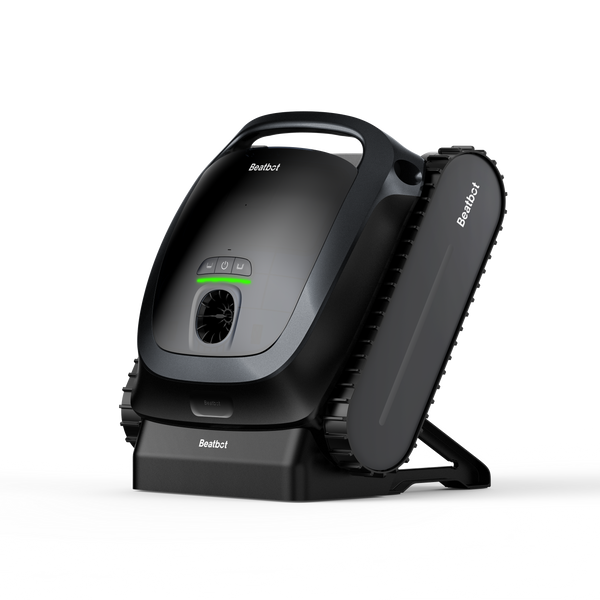
The Beatbot iSkim Ultra robotic pool skimmer addresses this with a 20-sensor system, including an industry-first tri-ultrasonic configuration: two above-water sensors for obstacle avoidance and one underwater sensor for precise edge detection.
A high-performance six-axis IMU sensor supports the path-planning algorithms. The result is the kind of anti-stuck performance entry-level units, which rely on basic bumper hardware, cannot match.
Debris Capacity
Filter basket capacity is what determines whether a skimmer runs unattended through a heavy debris day or fills up by mid-morning. Most entry-level baskets hold 2 to 3 liters, which is fine for light pollen and the occasional leaf but inadequate during autumn drop or after a windstorm. Once the basket is full, suction effectiveness drops and remaining debris stays on the surface.
The iSkim Ultra includes a 9L filter basket capable of holding 400 to 800 medium-sized leaves before emptying is needed. For pools under heavy tree canopy, that capacity is the difference between a skimmer that keeps working and one that needs intervention before lunch.
Surface and Edge Coverage
Entry-level skimmers tend to navigate randomly. They drift across the open surface but miss corners, edges, and the narrow band along the waterline, which is exactly where wind pushes debris to collect. Random navigation also means uneven coverage, with some areas cleaned multiple times while others get skipped entirely.
The iSkim Ultra runs a systematic S-shaped cleaning pattern across the full surface, then automatically locates the wall and runs a dedicated edge-and-corner cleaning pass. The industry-first dual-side brushes, each 93mm in diameter with 16 individual bristles, capture debris around the robot and direct it into the extra-long 265mm front roller brush, increasing coverage and debris capture per pass.
A seven-motor system powers propulsion, the dual-side brush motors, and the front roller brush motor independently, which is why all three can run at full effectiveness simultaneously rather than sharing power across a simpler drivetrain.
Beyond Skimming: Water Clarification and Runtime
A skimmer that only collects physical debris is solving half the surface problem. Dissolved oils, fine particles, and the haze left behind by sunscreen and pollen residue stay in the water until your main filter catches them. Runtime reliability is the other half: solar-only units that stall during overcast stretches end up cleaning intermittently rather than continuously.
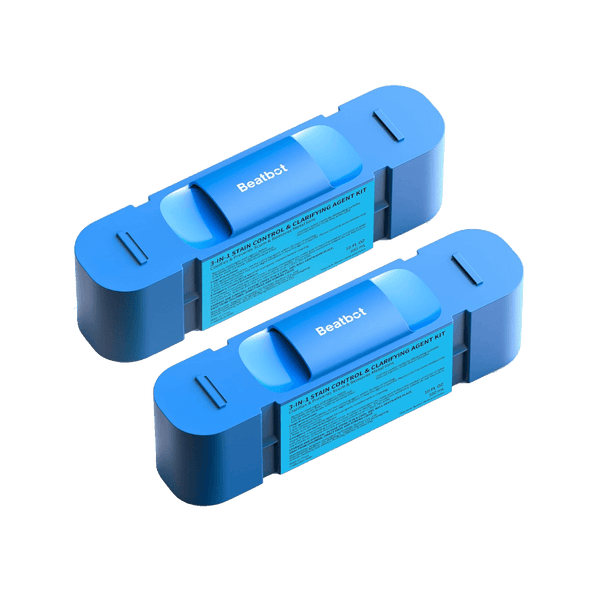
The iSkim Ultra addresses both. The ClearWater clarification system automatically dispenses a natural clarifier derived from recycled crab shells during cleaning cycles, capturing the dissolved residues physical skimming cannot.
A 24W solar panel paired with a 10,000mAh battery and SolarTrack light-chasing technology sustains runtime through overcast conditions and overnight cleaning, which matters in regions with variable weather or year-round pool seasons.
Is a Robotic Pool Skimmer Worth It for Your Pool?
The answer comes down to debris environment and pool season length. A robotic pool skimmer delivers clear value when:
-
Your pool is near trees, gardens, or areas with consistent wind-blown debris.
-
Your pool is open during spring pollen season and water clarity or chemical balance is a recurring issue.
-
You have heavy bather traffic and deal with recurring surface films from sunscreen or body oils.
-
Your pool is open year-round or for an extended season where manual skimming is a daily task.
Quantifying the time savings: if you skim manually twice a day for seven months of pool season, that is roughly 200 sessions per year. A robotic skimmer handles most of that with no manual intervention beyond periodic basket cleaning.
For pools open only two to three months per year, in debris-free environments, or covered when not in use, the math is less compelling. The device still cleans, but the time savings and water chemistry benefits are proportionally smaller.
For high-debris pools where a basic skimmer's navigation or capacity limitations are likely to frustrate, buying the more capable model from the start makes more sense than replacing a budget unit that spends half its time stuck on a ladder.
FAQs
Will a robotic skimmer work if my pool has a lot of steps or a tanning ledge?
It depends on the unit. Entry-level skimmers struggle with steps and ledges because their obstacle avoidance is limited to physical bumpers, so they often get stuck in the same spot repeatedly.
Higher-spec models like the Beatbot iSkim Ultra use multi-sensor navigation and anti-stranding designs that detect and route around these features. If your pool has multiple steps, a sun ledge, or a swim-up bar, prioritize a skimmer with sensor-based obstacle handling.
Can a robotic skimmer run at the same time as a corded pool cleaner?
Not safely. Corded floor cleaners present a serious entanglement risk. Most pool owners run them on separate schedules: the skimmer during the day and the floor cleaner during the pump cycle at night.
How often does the filter basket need to be emptied?
It depends on debris load and basket capacity. Entry-level units with 2 to 3 liter baskets may need emptying daily during heavy debris periods. The Beatbot iSkim Ultra's 9L basket holds 400 to 800 medium leaves before performance is affected, which extends the interval considerably under most conditions.
Does a robotic skimmer reduce pool chemical costs?
It can. By removing organic material such as leaves, pollen, and oils before it breaks down in the water, the skimmer reduces chlorine demand. The effect is more noticeable in pools with heavy organic debris loads, and it is not a substitute for regular water chemistry testing.


