Most Popular


 Sora Series


 AquaSense Series

 Skimmer & Bundle

 Retail Edition


 Accessories


To size a pool pump, divide your pool's total water volume in gallons by 8. That gives you the minimum flow rate in gallons per hour (GPH) your pump needs to circulate all the water once in an 8-hour cycle. A 20,000-gallon pool needs at least 2,500 GPH. A 15,000-gallon pool needs at least 1,875 GPH. From there, you match that flow rate to a pump that can deliver it against your system's actual pipe resistance.
Start With Your Pool Volume
Multiply your pool's length by its width by its average depth, then multiply by a shape factor: 7.5 for rectangular pools, 5.9 for round or oval pools, and approximately 7.0 for kidney or freeform shapes. The result is your pool volume in gallons. Average depth is your shallow-end depth plus your deep-end depth, divided by two.
|
Pool Shape |
Formula |
Example (gallons) |
|
Rectangle |
Length × Width × Avg Depth × 7.5 |
30 ft × 15 ft × 5 ft × 7.5 = 16,875 gal |
|
Oval |
Length × Width × Avg Depth × 5.9 |
30 ft × 15 ft × 5 ft × 5.9 = 13,275 gal |
|
Kidney / Freeform |
Length × Width × Avg Depth × 7.0 (approx.) |
28 ft × 14 ft × 5 ft × 7.0 = 13,720 gal |
|
Round |
Diameter × Diameter × Avg Depth × 5.9 |
16 ft × 16 ft × 4 ft × 5.9 = 6,042 gal |
Average depth is where most people underestimate. It is not the shallow end or the deep end on its own. Add those two depths together and divide by two. A pool that is 3.5 feet shallow and 7 feet deep has an average depth of 5.25 feet.
Understand Turnover Rate
Turnover rate is how long your pump takes to move all the pool water through the filter once. For outdoor residential pools in the U.S., the standard is one full turnover every 8 hours. Indoor pools target 6 hours because they have no sunlight to slow algae growth.
Running your pump for 8 hours per day is the practical baseline for outdoor residential pools in the U.S. Some pool owners run two shorter cycles rather than one continuous 8-hour session, which can work as long as the total circulation time adds up.
Calculate the Flow Rate You Need
Divide your pool volume by 8 to get the minimum GPH your pump must deliver. That is the flow rate needed to complete one full turnover in 8 hours.
A 20,000-gallon pool: 20,000 divided by 8 equals 2,500 GPH. A 30,000-gallon pool: 30,000 divided by 8 equals 3,750 GPH. Use the table below to find the number for your pool size.
|
Pool Volume (gallons) |
Turnover Time |
Min. Flow Rate Needed (GPH) |
|
10,000 |
8 hours |
1,250 GPH |
|
15,000 |
8 hours |
1,875 GPH |
|
20,000 |
8 hours |
2,500 GPH |
|
30,000 |
8 hours |
3,750 GPH |
|
40,000 |
8 hours |
5,000 GPH |
These are minimum numbers. Your actual pump should meet or slightly exceed this threshold. Do not size well above it. A pump that moves far more water than your filter can handle will force water through too quickly for proper filtration.

Account for Total Dynamic Head (TDH)
TDH is the total resistance your pump pushes water against, measured in feet. It is what determines how much flow rate a pump actually delivers in your specific system, not in a lab. A pump rated at 3,000 GPH may only deliver 2,000 GPH at your pool's actual TDH. Always check a pump's performance curve at your TDH, not just its headline rating.
TDH has two components. Static head is the vertical height water must travel from the pump to the return jets. Friction head is the resistance created by pipe length, bends, valves, and fittings. Add them together to get your total.
Most residential in ground pools fall between 40 and 60 feet of TDH. Above ground pools are typically lower, around 20 to 30 feet. If your pool has a long pipe run, multiple return jets, or a spa attached to the same system, TDH will be higher.
Pump performance charts, available from pump manufacturers, show output at different TDH levels. A pump that delivers 3,000 GPH at 20 feet of TDH may only deliver 2,000 GPH at 50 feet. Always check the pump's performance curve against your actual TDH, not just its headline flow rate.
Match the Pump to Your Filter
Your pump's flow rate at your actual TDH must fall within your filter's rated capacity. If the pump moves water faster than the filter can handle, water passes through without being properly cleaned. Check the filter manufacturer's maximum flow rate before finalizing your pump choice.
Filter manufacturers publish maximum flow rates for each filter size. Check that your pump's flow rate at your pool's actual TDH falls within the filter's rated range. In general, a larger filter is more forgiving because it gives you headroom if flow rates vary.
If you are replacing just the pump without changing the filter, the replacement pump should have a similar or slightly lower flow rate than the original. Upsizing the pump without upsizing the filter is one of the most common mistakes pool owners make.
Single-Speed vs. Variable-Speed Pumps
Variable-speed pumps let you run at lower speeds during normal filtration and higher speeds when needed. Single-speed pumps run at full power all the time. For most pools, full power is only necessary for backwashing or running water features. During routine filtration, a lower speed is enough and uses significantly less electricity.
Variable-speed pumps cost more upfront but tend to pay back the difference through lower electricity bills. Many U.S. states now require variable-speed pumps for new pool installations due to energy efficiency standards. Check local regulations before purchasing.
Common Sizing Mistakes to Avoid
The most common mistake is buying a pump that is too large. Oversizing does not clean your pool faster. It pushes water through the filter before it can be properly treated, uses more electricity, and puts unnecessary stress on your plumbing and fittings.
Do not size a pump based on horsepower alone. Two pumps with the same horsepower rating can have very different GPH outputs depending on their design. Always use the pump's flow rate at your specific TDH as the deciding number.
Do not ignore pipe diameter. Narrower pipes increase friction and raise TDH. If you are replacing an older pump and the existing plumbing uses narrower pipes, factor that into your TDH calculation before choosing a new pump.

What a Pool Pump Does Not Handle
Your pump circulates water through the filter. It keeps the water chemically balanced and removes dissolved and suspended particles. It does not scrub the floor, walls, or waterline, and it does not collect leaves and debris sitting on the pool surface or settled on the bottom.
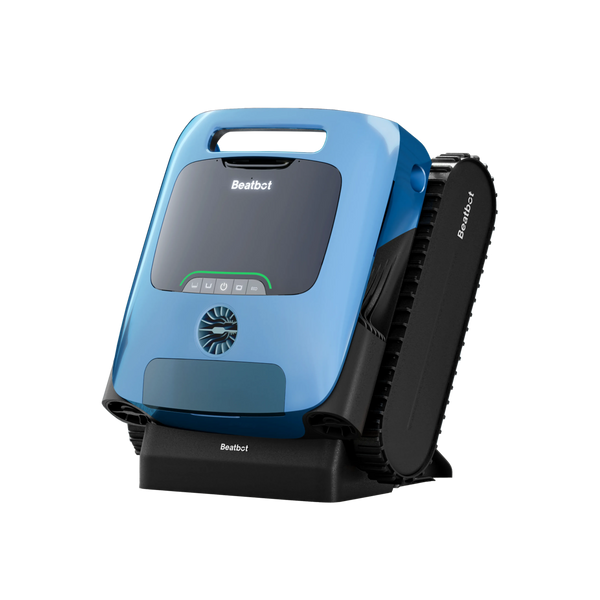
That physical cleaning is a separate job. Most pool owners use a robotic pool cleaner for it. A robotic cleaner works independently from the pump on battery power, with no plumbing connection needed. It runs while your pump handles filtration, and it removes the debris layer that your filter never sees.
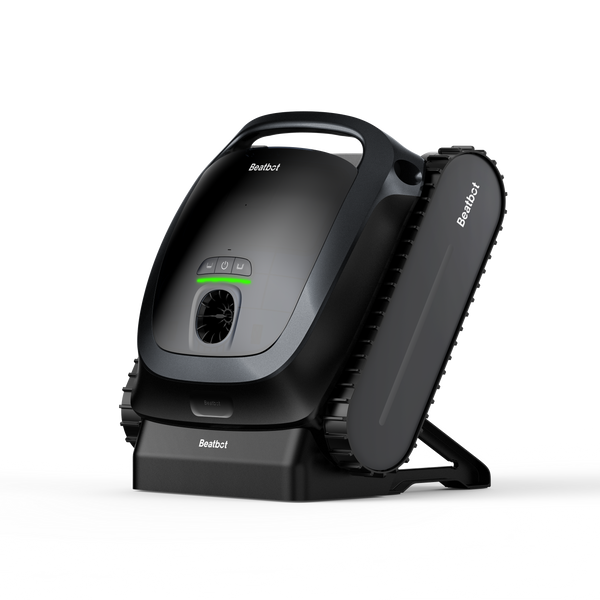
If you are setting up a complete pool maintenance system, a robotic cleaner is a natural complement to a well-sized pump. The Beatbot Sora 70, Beatbot Sora 30, and Beatbot Sora 10 are cordless robotic pool cleaners that all run on 6,800 GPH suction and cover pools up to 3,200 square feet.
The Beatbot Sora 70 also cleans the water surface, which helps on days when leaves and pollen collect faster than the skimmer can handle. The Sora 30 and Sora 10 focus on underwater zones. If your pool has tanning ledges or shallow steps, the Sora 30 reaches areas as shallow as 8 inches and the Sora 10 goes down to 12 inches.
FAQs
How do I calculate my pool volume?
Multiply your pool's length by its width by its average depth, then multiply by 7.5 for rectangular pools (or 5.9 for round and oval pools). Average depth is your shallow end depth plus your deep end depth, divided by two.
What is the standard turnover rate for a residential pool?
The pool industry standard for outdoor residential pools in the U.S. is one full water turnover every 8 hours. Indoor pools typically target 6 hours because they lack UV exposure to slow algae growth.
Is a bigger pool pump always better?
No. Oversizing a pump pushes water through the filter faster than it can be effectively cleaned. It also uses more electricity and can stress your plumbing. Match the pump to your pool volume, TDH, and filter rating rather than defaulting to a larger unit.
What is Total Dynamic Head and do I need to calculate it?
Total Dynamic Head (TDH) is the total resistance your pump works against, measured in feet. It accounts for vertical elevation changes and friction from pipes, valves, and fittings. You need it to accurately read a pump's performance curve. Most residential in ground pools fall between 40 and 60 feet of TDH.
Can a robotic pool cleaner replace my pool pump?
No. A robotic pool cleaner and a pool pump do different jobs. The pump circulates water through the filter for chemical treatment. The robotic cleaner physically removes debris from pool surfaces. Both are needed for a properly maintained pool. Robotic cleaners like the Beatbot Sora series operate independently from your pump system on battery power and require no plumbing connections.
How often should I run my pool pump?
Run your pump long enough to achieve at least one full turnover per day. For most residential pools, that means 8 hours of daily operation. You can split this into two 4-hour cycles if needed. Running the pump during off-peak electricity hours can reduce energy costs.