Most Popular


 Sora Series


 AquaSense Series

 Skimmer & Bundle

 Retail Edition


 Accessories


Fine silt and dust can be far more frustrating than leaves or larger pool debris. These tiny particles settle across the floor, collect in low spots, and can make the water cloudy again as soon as swimmers, brushes, or circulation disturb them.
This problem is especially common for pools near farmland, open fields, dry soil, dirt roads, or windy areas.
Beatbot Sora 70, Sora 30, and Sora 10 all offer optional ultra fine dual filter basket capable of capturing particles down to 3 μm. The right Sora depends less on which one can handle fine dust and more on what else your pool needs cleaned.
Which Beatbot Sora Is Right for Fine Silt and Dust?
All three Sora options can tackle fine particles when fitted with their compatible ultra fine dual filter basket. The main differences are surface cleaning, debris capacity, shallow water coverage, battery capacity, and how much cleaning capability you actually need.
| Beatbot Pool Robot | Best For | Key Cleaning Features |
|---|---|---|
| Sora 70 | Pools that need the most complete cleaning coverage | Cleans the water surface, floor, walls, waterline, and shallow areas down to 8 inches |
| Sora 30 | Pools that do not need surface cleaning | Cleans the floor, walls, waterline, and shallow areas down to 8 inches |
| Sora 10 | Pools with simpler everyday cleaning needs | Cleans the floor, walls, and waterline with a lighter, simpler design |
Beatbot Sora 70: Best for Fine Silt Plus Ongoing Surface Debris
Pools near farmland, open fields, or large yards often deal with more than fine silt alone. Wind can continuously bring pollen, leaves, insects, and lightweight debris onto the water surface, while finer dust and sediment may remain suspended in the water or eventually settle on the pool floor. Fine debris is especially troublesome because it can be stirred up again by circulation or swimming after it settles.
Sora 70 is useful in this type of environment because its surface cleaning can run for up to 10 hours, helping remove floating debris that keeps entering the pool throughout the day. For the finer particles that end up underwater, the optional ultra fine dual filter basket provides filtration down to 3 μm.
That makes Sora 70 a better fit for pools where the problem is not only a layer of fine sediment on the bottom, but also a constant supply of wind-blown debris at the surface.
Beatbot Sora 30: Best for Fine Silt Plus Higher Debris Loads
The Sora 30 is a good fit when surface cleaning is not a priority but the pool still collects a steady mix of fine silt and everyday debris.
It cleans the floor, walls, waterline, and shallow areas down to about 8 inches, with up to five hours of floor cleaning. That longer runtime is useful in dusty environments where sediment keeps returning rather than appearing only after an occasional storm.
In WIRED’s hands-on test, the Sora 30 averaged about 95% pool coverage, with cleaning runs reaching roughly 4.5 hours. The reviewer also found it capable of handling leaves, dirt, and mixed organic and synthetic debris, which is useful for pools where fine dust is only one part of the cleanup.
For fine silt specifically, the optional ultra fine dual filter basket combines a 400 μm outer filter with a 3 μm inner filter. The outer layer handles larger debris, while the finer inner layer targets the dust and sediment that may pass through a standard basket.
That combination makes the Sora 30 a strong fit for pools that do not need surface skimming but still deal with both recurring fine sediment and a heavier mix of everyday debris.
Beatbot Sora 10: Best for Fine Silt With Simpler Cleaning Needs
The Sora 10 is a good fit for pools where fine dust and settled debris are the main concerns, but surface cleaning is not necessary.
It cleans the floor, walls, waterline, and shallow areas, and provides up to five hours of floor cleaning. Its 7,800mAh battery charges in about 3.5 hours, which makes it easier to turn the robot around quickly when dusty conditions require more frequent cleaning.
At about 18.7 pounds, the Sora 10 is also lighter than the larger Sora options, making it easier to lift in and out of the pool for routine use.
For fine silt, the optional ultra fine dual filter basket provides filtration down to 3 μm, helping capture the smaller dust, algae, and sediment that may pass through the standard 150 μm basket.
The Sora 10 is therefore best suited to users who want fine-particle filtration and full underwater cleaning coverage in a lighter, simpler package, without the added surface-cleaning capability of the Sora 70.
Why Fine Silt and Dust Are Hard to Remove
Fine silt is more difficult to clean than larger pool debris such as leaves, insects, and visible dirt because these particles are much smaller and easier to disturb.
A standard filter basket is designed to capture larger debris, but fine dust, pollen, dead algae, and sediment particles can be small enough to pass through a coarser filter. Beatbot’s standard Sora filter baskets are rated at 150 μm, while the optional ultra fine dual filter baskett can capture particles down to 3 μm.
A robotic pool cleaner also needs enough suction to pull fine sediment into the robot instead of simply moving it around the pool floor. When fine silt is disturbed but not captured, it can become suspended in the water and settle again later.
Suction matters just as much as filtration. With up to 6,800 GPH of suction flow, Sora 30 and Sora 70 are designed to pull fine sediment off the pool floor rather than simply stir it back into the water. Sora 30 also delivers up to 40% more suction power than comparable products in its price range.
For fine-silt cleaning, these two parts need to work together: strong water flow helps draw sediment into the cleaner, while the 3 μm ultra fine filter basket helps keep those particles trapped once they are collected.
How the Ultra Fine Dual Filter Basket Helps Capture Fine Silt
For fine silt and dust, the challenge is not only picking up debris from the pool floor. The cleaner also needs to separate smaller particles from the water and keep them trapped inside the filter.
That is where the ultra fine dual filter basket makes a difference.
Compared with the standard 150 μm filter basket, the ultra fine dual filter basket is designed for much smaller particles. On Sora 30 and Sora 70, it uses a two-stage filtration system:
- A 400 μm outer layer captures larger debris and helps prevent the filter from becoming overloaded.
- A 3 μm inner non-woven layer targets finer particles such as dust, sediment, and small organic debris that may pass through a standard basket.
This layered design allows the robot to handle mixed debris more effectively. Larger particles are collected first, while smaller particles that are responsible for cloudy water and fine sediment buildup are captured by the finer inner layer.
The Sora 10 uses a different filter design, but its ultra fine dual filter basket also provides 3 μm filtration to help capture smaller particles that standard filtration may miss.
For pools affected by fine silt, the difference is easy to understand: a standard basket may remove what you can see, while an ultra fine basket is designed to capture the smaller particles that often remain after the pool looks clean.
How to Use Beatbot's Ultra Fine Filter Basket for Fine Silt and Dust
The ultra fine filter basket is designed for situations where the main cleaning challenge is small particles such as fine dust, silt, pollen, and dead algae. To get the best results, it should be used when fine debris is the primary target rather than when the pool is filled with large debris.
Use the Standard Basket for Heavy Debris, Then Switch to Ultra-Fine Filtration
If your pool contains a mix of leaves, grass, insects, and fine dust, remove larger debris first with the standard basket.
Large debris can quickly fill a fine filter and reduce water flow. Once most visible debris has been removed, switching to the Ultra-Fine Filter Basket allows the robot to focus on the smaller particles that are harder to capture.
For example:
- Heavy debris cleanup: Standard Filter Basket
- Fine dust and silt cleanup: Ultra-Fine Filter Basket
This approach helps the robot maintain strong water flow while allowing the finer filter layer to focus on the particles it is designed to capture.
Run the Cleaner After Fine Sediment Has Settled
Fine silt is easiest to remove when it has settled on the pool floor.
After brushing, swimming, or other activity that disturbs the water, allow time for suspended particles to settle before running the robot. This gives the cleaner a better chance to collect sediment instead of chasing particles that are still moving through the water.
Clean the Filter More Frequently in Dusty Environments
Fine filtration captures smaller particles, but those particles can accumulate inside the filter faster than larger debris.
For pools near farmland, dry soil, or windy areas, check the ultra fine dual filter basket more frequently during periods of heavy dust exposure. Rinse the filter after cleaning cycles when needed to maintain water flow and cleaning performance.
How to Choose Between Sora 70, Sora 30, and Sora 10
All three Sora models can use ultra-fine filtration down to 3 μm, and all three deliver up to 6,800 GPH of suction flow with up to 5 hours of floor cleaning. The main differences are cleaning coverage, shallow-water capability, basket capacity, charging time, and retrieval features.
| Feature | Sora 70 | Sora 30 | Sora 10 |
|---|---|---|---|
| Water surface cleaning | Yes | No | No |
| Floor cleaning | Yes | Yes | Yes |
| Wall cleaning | Yes | Yes | Yes |
| Waterline cleaning | Yes | Yes | Yes |
| Shallow-water / platform cleaning | Down to 8 in | Down to 8 in | Down to 13.8 in |
| Suction flow | Up to 6,800 GPH | Up to 6,800 GPH | Up to 6,800 GPH |
| Floor cleaning runtime | Up to 5 hours | Up to 5 hours | Up to 5 hours |
| Surface cleaning runtime | Up to 7 hours | — | — |
| Standard filtration | 150 μm | 150 μm | 150 μm |
| Optional ultra-fine filtration | Down to 3 μm | Down to 3 μm | Down to 3 μm |
| Debris basket capacity | 6L | 5L | 5L |
| Water-surface parking | Yes | Yes | — |
| Charging time | Approx. 4.5 hours | Approx. 4.5 hours | Approx. 3.5 hours |
| Weight | Heavier full-coverage option | Approx. 19.6 lb | Approx. 18.7 lb |
| Best suited to | Pools that need the most complete cleaning coverage | Pools that need broad underwater cleaning without surface skimming | Pools with simpler underwater cleaning needs and easier handling |
Sora 70 is the most complete option. It adds water-surface cleaning for up to seven hours, covers shallow areas down to 8 inches, and uses a larger 6L basket. It makes the most sense for pools that deal with both fine sediment underwater and regular floating debris.
Sora 30 keeps the same 6,800 GPH suction and five-hour floor runtime, while covering the floor, walls, waterline, and shallow areas down to 8 inches. It is the better fit when surface cleaning is not needed but broad underwater coverage still matters.
Sora 10 delivers the same suction flow and floor runtime in a lighter package, with a faster charging time of about 3.5 hours. Its shallow-water limit is higher at about 13.8 inches, so it is better suited to pools with simpler underwater cleaning needs rather than very shallow platforms.
Robotic Pool Cleaner vs Pool Vacuum for Fine Silt
Both robotic pool cleaners and traditional pool vacuums can remove fine sediment, but the day-to-day experience is very different.
A robotic pool cleaner is better suited to recurring fine dust and silt because it works independently, uses its own filter basket, and does not require hoses or cables running across the pool deck during cleaning.
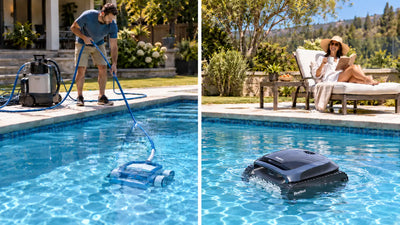
Traditional pool vacuums can still be useful for heavy or concentrated sediment, but they usually involve more setup. Hoses and cords can make the pool area look cluttered, create a tripping hazard around children or pets, and require more hands-on cleaning.
| Robotic Pool Cleaner | Pool Vacuum | |
|---|---|---|
| Best for | Recurring fine dust and silt | Heavy or concentrated sediment |
| Setup | Drop in and run | Usually requires hoses, cords, or connection to the pool system |
| Filtration | Uses its own filter basket | Usually relies on the pool filtration system |
| Poolside convenience | Less equipment around the pool | Hoses and cables can clutter the deck |
| Safety around kids and pets | Fewer external lines around the pool | Hoses and cords can create trip hazards |
| Routine maintenance | Better for frequent automatic cleaning | More hands-on |
| Long term upkeep | Mainly filter and robot maintenance | Hoses, connectors, and other parts may need periodic replacement |
Long term upkeep is another consideration. Pool vacuum hoses and connectors spend a lot of time exposed to sun and heat, which can eventually make them stiff, brittle, or prone to leaks. Replacement hose sections commonly cost around $20–$40 each, while replacing several sections can push the total toward $100–$300 or more, depending on the vacuum setup. In hotter climates, those replacement costs can become a recurring part of pool maintenance.
How Often Should You Run a Pool Robot in Dusty Conditions?
There is no single schedule that works for every dusty pool because the rate of contamination depends heavily on wind, surrounding soil, vegetation, and weather.
As a practical starting point:
-
Occasional light dust: two or three cleaning cycles per week may be enough.
-
Pools beside farmland or open dry ground: daily or every-other-day cleaning may make more sense during windy periods.
-
After a dust storm: allow suspended sediment to settle, then run the robot.
-
After unusually heavy debris: use the standard basket first, then follow with the ultra-fine filter if a layer of fine sediment remains.
The goal is not to run the robot constantly. It is to remove small particles before repeated buildup turns into a visible layer across the floor.
Conclusion
For pools affected by fine silt and dust, the right combination of strong suction and 3 μm ultra fine filtration can make routine cleaning much easier.
Choose Sora 70 for the most complete cleaning coverage, Sora 30 for broad underwater cleaning, or Sora 10 for a lighter and simpler option. All three can be paired with ultra-fine filtration to help capture the small particles a standard basket may leave behind.
FAQs
Can a robotic pool cleaner pick up very fine silt?
Yes, but filtration matters. Fine silt can pass through a standard basket or simply be stirred back into the water. A robot with strong suction and an ultra-fine filter is better suited to capturing and retaining these smaller particles.
Do I need an ultra-fine filter for pool silt and dust?
For very fine dust or sediment, it can make a noticeable difference. Beatbot’s standard Sora basket filters down to 150 μm, while the optional Ultra-Fine Filter Basket reaches 3 μm.
Why does fine dirt come back after the pool robot cleans?
The particles may be too small for the filter and return to the pool, or suspended sediment may settle again after cleaning. Using finer filtration and allowing disturbed silt to settle before another cleaning cycle can help.
Is a robotic pool cleaner or vacuum better for heavy silt?
A robotic cleaner is more convenient for recurring fine dust and routine maintenance. For a thick or concentrated layer of silt, a manual vacuum or vacuum-to-waste setup can be faster for the initial cleanup.
Can fine pool debris be pollen or dead algae instead of silt?
Yes. Fine sediment on the floor can sometimes be dust, pollen, dead algae, or a combination of them. If the material keeps returning despite cleaning, check water chemistry and the main pool filtration system as well as the cleaner.